

 ChatGPT
 Claude
 Perplexity
 Gemini
Key Takeaways:
- HVAC marketing ROI compares marketing-generated revenue against every dollar of marketing cost.
- Website traffic and leads matter only when they become paying customers.
- Accurate ROI requires counting agency fees, software, and internal staff time.
- Call tracking and CRM data connect each booked job to its source.
- Qualified leads at a higher cost often outperform cheap, high-volume leads.
- SEO returns build over months, so measure them across longer windows.
Are you sure your HVAC marketing budget is bringing in profit, or is it just making your phone ring?
Most HVAC companies run several marketing channels at once. They invest in SEO to rank for searches like “AC repair near me.” They run paid ads during heat waves. They update their Google Business Profile and send emails for seasonal tune-ups. Every channel promises more visibility, more calls, and more booked jobs. Because budgets are limited, those channels compete for a piece of the same pie.
Having a busy phone line and more website traffic feels good. But neither number tells you if those leads turn into profitable jobs. Many teams face this uncertainty. According to HubSpot’s 2026 State of Marketing Report1, 33% of marketing executives list measuring ROI as a top concern. That number jumps to 40.8% among U.S. marketing leaders.
Measuring HVAC marketing ROI closes that gap. It connects marketing costs to qualified leads, booked appointments, completed jobs, and revenue. In this guide, you will learn the ROI formula with a worked example, the metrics worth tracking, how to judge each channel, how to measure HVAC lead generation ROI, and ways to get better returns.
What Is HVAC Marketing ROI and Why Does It Matter?
HVAC marketing ROI, or return on investment, compares the revenue you earn from marketing against what you spend. Shown as a percentage, it answers one simple question: for every dollar you put into SEO, ads, or email, how many dollars come back as paid work?
This number only helps when you track real business results instead of surface activity. Website visits, likes, and ad impressions show that people see your brand. None of those numbers pays a technician’s wages. A campaign can double your website’s traffic and still lose money if visitors do not call, or only ask for low-value repairs.
That difference matters even more when budgets are tight. Gartner’s 2025 CMO Spend Survey2 found that marketing budgets sit flat at 7.7% of company revenue, and 59% of marketing leaders lack the budget to fully execute their strategy. For HVAC owners facing similar pressure, measuring ROI helps in many ways:
- Identifies Profitable Channels: ROI data shows which channels bring in completed jobs and healthy margins. A company might learn that local SEO books more full-system replacements than paid social ads, even if paid social gets more clicks.
- Improves Budget Allocation: Measuring every channel the same way takes guesswork out of the budget. Teams can stop relying on gut feelings and move money into campaigns that pay for themselves.
- Reveals Funnel Weaknesses and Supports Planning: High lead volume paired with low revenue points to slow follow-up or poor call handling. Knowing what each marketing dollar brings back also helps plan hiring, seasonal staffing, and business growth with confidence.
How Do You Measure HVAC Marketing ROI Step by Step?
Knowing why ROI matters only helps when you have a clear way to calculate it. The following five-step process can be used for a single campaign, one marketing channel, or your entire marketing budget.
Step 1: Define Your Marketing Goals
ROI cannot be judged without knowing what a campaign was meant to achieve. One campaign might aim to drive emergency calls during peak summer heat. Another might target high-ticket system installations. Group your goals into lead generation, customer acquisition, and revenue growth. Then tie each goal to a real business need, like keeping technicians busy in shoulder seasons or growing replacement work.
Step 2: Calculate Your Total Marketing Investment
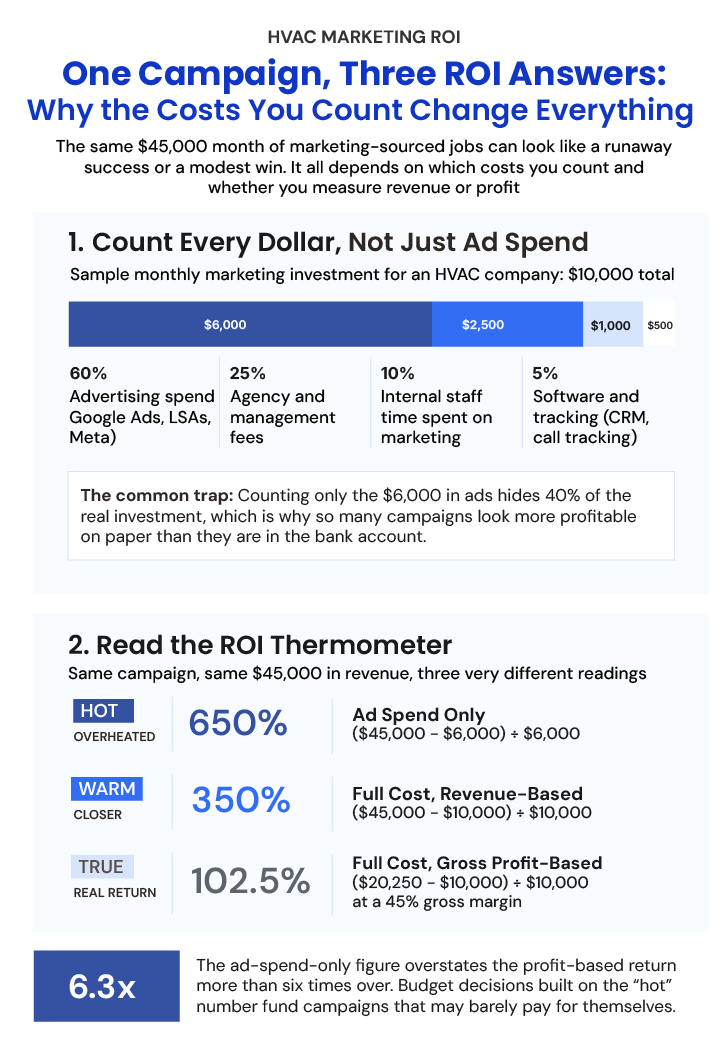
Once your goals are clear, capture the full cost of reaching them. Many companies only count ad spend, which makes returns look far better than they really are. A complete calculation includes:
- Advertising Spend: Count every dollar paid to Google Ads, Local Services Ads, Meta, and lead directories. These costs are easy to track, but they are only part of your total spending.
- SEO, Content, and Website Costs: Include keyword research, blog posts, service and location pages, link building, hosting, and site updates. Since SEO takes months to pay off, record these expenses carefully so they can be matched to returns over time.
- Agency Fees and Software: Add retainers, management fees, call tracking, CRM subscriptions, and analytics tools. Skipping these expenses is a key reason why HVAC companies overestimate their campaign profitability.
- Staff Time and Campaign Expenses: Count the hours spent managing campaigns, answering leads, or coordinating with agencies. Printing, photography, promotional offers, and discounts used in campaigns also belong here.
Step 3: Track Leads, Conversions, and Revenue
Next, track what your spending produced. Tag every lead with its source and follow it through each stage: inquiry, qualified lead, booked appointment, completed job, and paying customer. A qualified lead is someone in your service area who needs the service you offer. A paying customer is someone who has paid their invoice. Watching where people drop off shows where you lose money.
A CRM, call tracking, form tracking, and field service software make this easier. Together, they support revenue attribution, which links each completed job back to the source that produced it. Without that link, ROI becomes guesswork.
Step 4: Calculate Marketing ROI
Marketing ROI = [(Revenue From Marketing – Marketing Cost) ÷ Marketing Cost] × 100
Revenue from marketing is the total invoiced amount from jobs attributed to marketing during the measurement period. Marketing cost is your full investment from Step 2. Dividing your net return by that cost shows how much you earned per dollar spent.
Here is a simple example. An HVAC company spends $10,000 in one month, including $6,000 on ads, $2,500 in agency fees, $500 on software, and $1,000 in staff time. Those campaigns bring in $45,000 in revenue. The calculation is ($45,000 – $10,000) ÷ $10,000 × 100, which equals an ROI of 350%, or $4.50 in revenue for every dollar spent.
Revenue-based ROI leaves out equipment, labor, and fuel costs. If those jobs carry a 45% gross margin, they produce $20,250 in gross profit, and the profit-based ROI drops to 102.5%. Gross profit gives you a much clearer view of business growth.
Step 5: Evaluate Results and Adjust Your Strategy
An ROI number is a starting point, not the final answer. Compare your results against the goals you set in Step 1. Look at which channels brought in the best leads and highest-profit jobs. Before you shut down a weak campaign, find out why it struggled. Poor returns often come from the wrong keywords, bad lead quality, or slow follow-up. Use what you learn to adjust your budget for next month.
Which HVAC Marketing Metrics Should Every Business Track?
This five-step process only works when you track the right numbers. Activity metrics show how many people saw or clicked an ad. Business metrics show how many people became paying customers. Business metrics matter far more for ROI, and they fall into four groups.
I. Lead Generation Metrics
- Total and Qualified Leads: Total leads count every call, form, and booking request. Qualified leads include only real prospects in your service area who need a service you offer. Tracking both prevents inflated counts from making weak campaigns look successful.
- Cost per Lead and Lead Source: Cost per lead (CPL) divides your campaign cost by leads generated. Source attribution records which channel produced each lead. Together, they form the foundation of every channel-level ROI calculation.
- Website Conversion Rate: This number shows the percentage of site visitors who call, fill out a form, or book online. A low rate means your site is losing visitors you paid to attract, which hurts ROI across the board.
II. Sales and Customer Acquisition Metrics
- Lead-to-Customer Conversion Rate: This shows the percentage of leads that become paying customers. It measures both lead quality and how well your team closes sales.
- Cost per Acquisition and Customer Acquisition Cost: Cost per acquisition (CPA) measures what one campaign spends per conversion. Customer acquisition cost (CAC) divides total marketing and sales costs by new customers to show the true average cost of winning one.
- Booking and Call-to-Job Rates: These track how many qualified leads schedule a visit and how many inbound calls become jobs. Low numbers point to high prices, limited availability, or weak call handling rather than bad marketing.
III. Revenue and Profitability Metrics
- Revenue per Job and Average Job Value: Tracking job value by channel and service type shows whether marketing attracts replacement and installation work or mostly small repair calls. It also tells which channels deliver higher-value customers.
- Customer Lifetime Value: Customer lifetime value estimates the total money a customer spends with you over time, including repairs, maintenance plans, and future replacements. A channel that wins loyal homeowners is worth much more than the first invoice shows.
- ROAS, Gross Profit, and Marketing ROI: Return on ad spend (ROAS) measures how well your paid ads perform on their own. Gross profit and overall marketing ROI factor in all expenses. Looking at all three shows whether marketing makes your company more profitable or just keeps your phone busy.
IV. Website and Local SEO Metrics
- Organic Traffic and Local Visibility: Steady growth in organic visits to service and location pages, along with stronger map pack visibility across your service areas, signals rising lead potential from homeowners searching nearby.
- Google Business Profile Actions and Rankings: Profile calls, direction requests, and website clicks often mark the first touchpoint for urgent repairs, while rankings for searches like “furnace repair in [city]” show you are winning high-intent local searches.
- Organic Lead Conversion Rate: This measures the share of organic visitors who become leads. It ties your SEO effort to real sales and proves why organic search deserves steady funding.
No single metric tells the whole story on its own. A low cost per lead may hide poor conversion rates, and strong rankings mean little if the website fails to convert.
HVAC SEO Guide: How to Rank Your HVAC Business on Google
How Do You Measure ROI Across Different HVAC Marketing Channels?
Tracking metrics works best when you look at each channel separately, since each one reaches homeowners at a different stage, works on its own timeline, and produces different data.
1. SEO and Local SEO
Track organic traffic, local visibility, and the calls and forms coming from organic search and your Google Business Profile. Then follow those leads through to booked jobs and final revenue. Search rankings take months to build, and they keep bringing in leads long after the work is done. Because of that, judge SEO over rolling six- or twelve-month windows. An experienced HVAC SEO company can help link your search rankings to booked jobs.
2. PPC Advertising
Pay-per-click ads give you fast feedback. Track your ad spend, clicks, calls, form fills, and cost per qualified lead, then trace those leads to revenue. Remember that ROAS only compares revenue against ad spend. True ROI also includes agency fees and staff time, so a campaign with a strong ROAS can still break even. Judge your PPC campaigns by the profitable jobs they bring in, not just clicks.
3. Social Media and Email Marketing
Measure social media through engagement, website visits, and inquiries from tracked links or special offers. Measure email through link clicks, reminder responses, and repeat bookings. These channels keep past customers coming back, adding value to your bottom line. A Housecall Pro survey3 of over 1,000 U.S. homeowners found that 72% would pay up to 10% more for a contractor with a better customer service reputation. Steady updates by email and social media build trust and boost customer lifetime value.
4. Website and Landing Page Performance
Every marketing channel sends people to your website, so your site affects every single return. Track calls, quote requests, bookings, and form fills page by page, and pay close attention to mobile visitors. Many homeowners search for help on their phones during an emergency, and slow pages or long forms push them toward competitors. Raising a landing page’s conversion rate gives you more leads from every channel without spending extra money on ads.
How Do You Measure HVAC Lead Generation ROI?
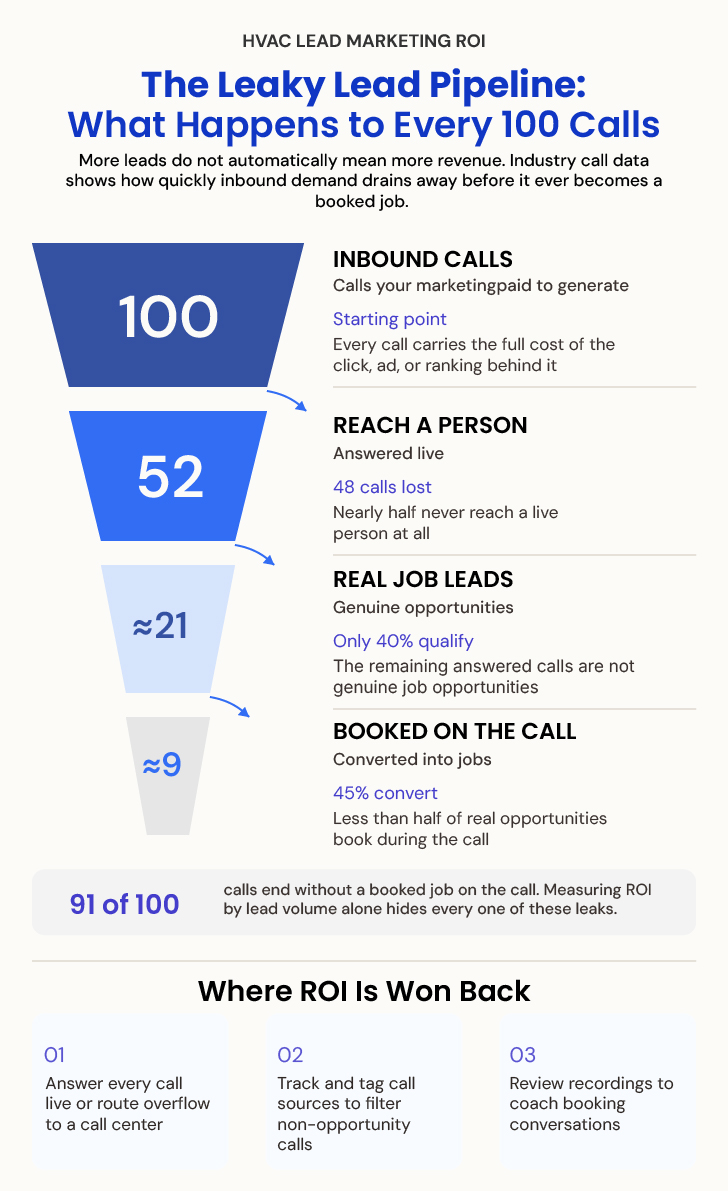
HVAC lead generation ROI looks at what your leads are worth, not just how many come in. A big pile of leads does not mean your marketing is working. Invoca’s 2026 Home Services Lead Conversion Benchmarks4 show that home service companies answer only 52% of incoming calls with a live person. Out of those calls, only about 40% are real job opportunities.
These four formulas show what raw lead counts often hide:
- Cost per Lead (CPL): Divide your total campaign cost by the number of leads generated. A $5,000 campaign that brings in 100 leads has a CPL of $50. This shows how cheaply you get leads, not whether they turn into paying jobs.
- Lead-to-Customer Conversion Rate: Divide new customers by total leads and multiply by 100. If 100 leads produce 20 customers, your conversion rate is 20%. This number shows both lead quality and how well your team closes sales.
- Customer Acquisition Cost: Divide total marketing and sales costs by new customers. A $5,000 campaign that wins 20 customers has a CAC of $250, which tells you much more than CPL alone.
- Lead Generation ROI: Subtract the cost of acquiring leads from the revenue or gross profit those leads generate. Divide that number by the cost, and then multiply by 100 to see if your lead generation is making a profit.
Consider two campaigns with the same $5,000 budget and a $650 average job value:
| Metric | Campaign A | Campaign B |
|---|---|---|
| Leads generated | 200 | 80 |
| Cost per lead | $25 | $62.50 |
| Lead-to-customer conversion rate | 5% | 25% |
| New customers | 10 | 20 |
| Customer acquisition cost | $500 | $250 |
| Revenue generated | $6,500 | $13,000 |
| Lead generation ROI (revenue-based) | 30% | 160% |
Campaign A looks great on a weekly lead report. Still, Campaign B wins twice as many customers at half the acquisition cost and brings back more than five times the return. Qualified leads and profitable jobs matter far more than lead volume. Cheap leads that rarely convert also waste time and tie up your schedule, which adds hidden costs that CPL never shows.
Why Your HVAC Website Gets Traffic but No Calls: 7 Funnel Leaks
What Makes HVAC Marketing ROI Hard to Measure, and How Can You Improve It?
Even with the right formulas, inaccurate data can lead you to the wrong conclusions. Spotting common tracking gaps is the first step toward fixing them. Once your numbers are clean, you can invest in improvement strategies that grow your profits.
I. Common Challenges That Distort ROI
- Disconnected Marketing and Sales Data: Leads live in ad platforms and analytics tools, while revenue sits in field service or accounting software. Without a link between them, you can see which campaigns create inquiries, but not which ones create revenue.
- Untracked Phone Calls: Many homeowners call rather than fill out forms, especially for urgent repairs. If you do not track calls by source, the channels driving them get no credit, and budgets may shift away from profitable campaigns.
- Long Conversion Journeys: A homeowner might find you through organic search, return through a paid ad, and book after reading reviews. Last-click reporting credits only the final touchpoint and undervalues the channels that started the relationship.
- Seasonal Swings and Incomplete Data: Weather-driven demand makes month-to-month comparisons misleading. Missing expenses, spam calls, and out-of-area leads also skew your numbers. Compare your numbers against the same season last year, and clean lead data regularly.
These obstacles make perfect attribution unrealistic. SparkToro co-founder Rand Fishkin made this point during a session at the DEMAND conference:
“Smart marketers inside smart organizations are going to move toward measurement over attribution.”
For HVAC companies, this means building steady tracking habits rather than chasing a perfect model. Use call tracking on every channel, log every lead’s source and outcome in your CRM, and check monthly reports against seasonal benchmarks. Once your numbers are reliable, these five moves can boost your returns.
II. Proven Ways to Improve HVAC Marketing ROI
- Focus on High-Intent Local Searches: Target service and location keywords such as “emergency AC repair in [city]” or “heat pump installation near me.” These searches come from homeowners who need help right away, so they convert at higher rates than broad informational terms.
- Improve Website Conversion Rates: Make phone numbers, booking options, and calls to action easy to find. Online scheduling, financing details, reviews, and certifications turn more visitors into leads without increasing ad spend.
- Strengthen Lead Follow-Up and Retention: Respond to calls, forms, and quote requests quickly, and give your team a clear process for following up with prospects who do not book on the first contact.
- Optimize Campaigns and Budget Allocation: Refine keywords, targeting, and landing pages, and feed booked-job data back into ad platforms. Move money into channels that consistently produce profitable jobs, adjusting season for cooling and heating demand.
- Work with the Right Marketing Partner: Experienced HVAC digital marketing services can improve tracking, run campaigns with revenue goals in mind, and deliver reports that connect spending to booked jobs rather than empty clicks and rankings.
Turn HVAC Marketing Spend Into Measurable Returns
Measuring HVAC marketing ROI means following every customer from the first search to the final invoice. Once you count every expense and tie revenue back to the right channel, your numbers can guide smarter budget decisions. Damco Digital helps HVAC businesses build that clarity through revenue-focused home services digital marketing. Ready to see what your marketing is earning? Talk to our experts and find out where your next profitable job will come from.
References
- [1]: HubSpot
- [2]: Gartner
- [3]: Housecall Pro
- [4]: Invoca