
 ChatGPT
 Claude
 Perplexity
 Gemini
Executive Summary:
- Traffic alone does not equal revenue: An HVAC website can attract consistent visitors yet generate too few calls because demand leaks at multiple stages of the funnel.
- The seven key leaks are: search intent, Map Pack visibility, page speed, trust, contact friction, missed calls, and attribution.
- Target the right traffic: Ranking for informational HVAC queries is less valuable than appearing for local, service-specific, and urgent searches that indicate purchase intent.
- Local visibility matters: Strong organic rankings do not guarantee Map Pack visibility; Google Business Profile management and review activity can influence high-intent local discovery.
- Website experience affects conversion: Slow mobile service pages can cause potential customers to leave before they see the company’s offer or contact options.
- Trust influences the decision: Recent reviews, credentials, proof of work, service-area information, and clear business details help customers decide whether to call.
- Reduce contact friction: Prominent click-to-call options and short forms make it easier for qualified visitors to become leads.
- Answer every valuable call: Missed calls can waste demand generated through SEO, paid campaigns, and local search, particularly during periods of high HVAC demand.
- Measure the full funnel: Track the journey from search → visit → lead → call → booked job → revenue, rather than relying on traffic and rankings alone.
- Fix the biggest leak first: Before increasing marketing spend, identify where the largest drop occurs and address that constraint.
Your HVAC website ranks. Your ads are running. Analytics shows a steady flow of visitors. Yet the phone is not ringing as often as the traffic suggests it should. The problem may not be a lack of traffic. It may be what happens between the search and the service call.
For HVAC businesses working with an HVAC SEO agency, understanding where visitors drop out of the funnel is essential to turning search visibility into qualified leads and booked jobs.
An HVAC customer can find your business and still leave because you rank for the wrong search, lose visibility in the Map Pack, wait too long to load, fail to establish trust, make contacting you difficult, or miss the call altogether. Each issue can reduce the number of visitors who become leads, and the number of leads who become booked jobs.
This article breaks down seven points where that demand can leak from your funnel. The objective is not to generate more traffic for its own sake. It is to identify where existing demand is being lost and determine which problem deserves attention first.
The 7 HVAC Funnel Leaks at a Glance
| Funnel stage | The leak | What to check |
|---|---|---|
| Visibility | Your website ranks for searches that do not signal a need for service | Local, transactional, and emergency search terms |
| Local search | Competitors capture the Map Pack even when you rank organically | Google Business Profile, reviews, categories, and local signals |
| Website experience | Visitors leave before the service page loads or becomes useful | Mobile speed and Core Web Vitals |
| Trust | Visitors are not convinced your company is the right choice | Reviews, credentials, proof of work, and recency |
| Contact | Interested visitors encounter unnecessary friction | Phone visibility, forms, CTAs, and number of fields |
| Call handling | Qualified leads call but nobody answers or responds quickly | Answer rate, missed calls, and response time |
| Attribution | You cannot identify where revenue is being lost | Source, lead, call, booking, and revenue data |
The order matters. A business that fixes its keyword targeting while continuing to miss half its inbound calls has not solved the revenue problem. Likewise, redesigning a contact form will not compensate for poor local visibility.
The right approach is to diagnose the funnel from search to booked job, find the largest break point, and fix that before increasing spend at the top of the funnel.
Not Sure Where Your HVAC Funnel is Losing Potential Customers?
Why Is Your HVAC Website Ranking for the Wrong Searches?
Ranking and being found by the right customer are not the same thing. Your website can attract substantial organic traffic while appearing less often for the local searches that signal an immediate need for HVAC service.
This is the visibility leak. It is easy to miss because conventional SEO reporting tends to emphasize rankings, impressions, and sessions rather than whether those visits represent potential customers.
Consider the difference between these searches:
- How does a heat pump work?
- Best HVAC system for a new house
- AC repair near me
- Emergency furnace repair in [city]
All four are relevant to HVAC. They do not carry the same commercial value.
If the business goal is service calls, the content and SEO strategy should give greater weight to searches connected to location, service type, urgency, and purchase intent. Informational content can support visibility and authority, but it should not become the main measure of local SEO for home services success.
“Good SEO is good GEO.”
Danny Sullivan, Director, Google Search
What Should an HVAC Company Measure Instead?
Separate traffic into informational, commercial, and local transactional intent. Then track which groups generate calls, form submissions, booked appointments, and revenue.
An increase in traffic is useful only when the additional visitors have a realistic path to becoming customers.
1. Are You Losing the Map Pack Even When You Rank Organically?
Organic rankings do not guarantee local visibility. For HVAC businesses, a strong website position can still produce fewer calls if competitors dominate the Google Map Pack for high-intent searches.
The Map Pack often appears above traditional organic listings when someone searches for a local service. That makes it an important part of the HVAC acquisition funnel, particularly for searches such as “AC repair near me,” “furnace repair [city],” or “HVAC contractor near me.”
This creates a common reporting blind spot. An HVAC company may see healthy organic rankings while another company receives more calls because its Google Business Profile has stronger local signals, more recent reviews, or a more complete service presence.
Your local search reporting should therefore go beyond website rankings. Track:
- Map Pack visibility for priority service terms
- Google Business Profile calls and website actions
- Review volume and recency
- Primary and secondary service categories
- Location-specific service pages
- Local relevance of business information
A Google Business Profile should not be treated as a setup-and-forget asset. Its information, services, photos, reviews, and other customer-facing elements need ongoing attention because local search is part of the conversion path, not merely a visibility channel.
“It’s not just about showing up. It’s about showing up when it matters.”
Mike Blumenthal, Co-Founder, Near Media
2. Is Your Website Losing Visitors Before They See Anything?
A slow mobile service page can eliminate potential leads before visitors see your offer, reviews, phone number, or call-to-action.
An HVAC customer searching for help is often dealing with a time-sensitive problem. Someone searching “AC not cooling” during a heat wave has little reason to wait for a page that takes several seconds to become usable.
Page speed therefore deserves to be assessed alongside rankings and traffic.
Look at the performance of the pages that receive the most valuable HVAC traffic. Service pages, location pages, emergency-service pages, and landing pages from paid campaigns should be checked individually, particularly on mobile devices.
Key measures include:
- Largest Contentful Paint (LCP): How quickly the main page content becomes visible
- Interaction to Next Paint (INP): How responsive the page is to user interaction
- Cumulative Layout Shift (CLS): Whether page elements unexpectedly move while loading
- Mobile conversion rate: Whether slower experiences correlate with lower lead generation
A useful diagnostic is to compare performance with conversion data. If a high-traffic service page has significantly weaker engagement or lead generation than comparable pages, page experience deserves investigation before more traffic is sent to it.
The goal is not simply to make a website “fast.” It is to make the path from search result to service inquiry fast enough that a customer does not abandon it first.
3. Does Your Website Earn Trust Fast Enough to Keep the Call?
HVAC customers need quick evidence that a company is credible, experienced, available, and worth contacting before they commit to a call.
Trust is particularly important for HVAC services because the customer is usually buying expertise rather than a standardized product. The visitor may be trying to decide whether the company can diagnose the problem correctly, arrive when promised, and complete the work professionally.
That decision can happen within seconds.
A service page should make important trust signals easy to find:
- Recent customer reviews
- Overall rating and review volume
- Licenses, certifications, or relevant credentials
- Years in business, where meaningful
- Service-area information
- Photos of completed work
- Manufacturer affiliations, where applicable
- Warranties or guarantees, if genuinely offered
- Clear contact information
Review recency also matters from a customer’s perspective. A company with an impressive historical rating but no recent customer feedback may create a different impression from one that consistently receives recent reviews.
The objective is not to make a page look impressive. It is to answer the customer’s immediate questions: Can I trust this company? Does it serve my area? Does it handle the problem I have? And can I reach someone now?
If those answers are difficult to find, the visitor has a reason to keep searching.
As per the latest reports, only 52% of home-services callers speak with a person. For calls lasting more than 15 seconds, the answer rate rises to 65%, suggesting that short calls and misdials account for part of the gap. Among answered calls, 38% are leads and 45% of those leads convert on the call. For HVAC specifically, 45% of answered calls are leads, and 43% of those leads convert.1
4. Are You Making It Harder Than Necessary to Contact You?
A visitor who has decided to contact your HVAC company should not have to search for the phone number, complete a lengthy form, or figure out what happens next.
Contact friction is often created unintentionally. Marketing teams want more information from prospects, so forms accumulate fields. Designers prioritize visual elements, pushing the phone number below the fold. Websites add chat tools that require several steps before a customer can reach a person.
Each additional obstacle creates another opportunity for abandonment.
For an HVAC service page, the contact path should be obvious and proportionate to the customer’s intent. At minimum, check whether visitors can:
- Call the business with one tap on mobile
- Find the phone number without scrolling extensively
- Identify the service being offered
- Understand whether emergency service is available
- Submit a short form without unnecessary qualification fields
- See what happens after submitting a request
A basic service inquiry rarely needs extensive information before a human conversation. Name, phone number, service required, and urgency may be enough to start the process; additional details can be collected during the call.
The important question is not “How much information can we collect before the lead reaches our team?” It is: “How little friction can we create between a qualified visitor and the next useful conversation?”
5. What Happens After Someone Actually Calls You?
An answered call is the point where marketing-generated demand becomes a real sales opportunity, so missed calls can undermine every improvement made earlier in the funnel.
The first five leaks happen before the customer reaches your team. This one happens after the customer has already taken the action you wanted. That makes call handling a critical part of marketing performance.
Track the following:
- Total inbound calls
- Answer rate
- Missed-call rate
- Calls outside business hours
- Average response time to missed calls
- Calls that qualify as genuine leads
- Lead-to-booking rate
- Revenue generated from marketing-sourced calls
The numbers should also be segmented by source where possible. A missed call generated by organic search, Google Ads, or the Google Business Profile represents a different marketing performance issue from an unqualified call.
Response speed matters particularly for HVAC because demand can change quickly. During a heat wave or cold snap, a customer who cannot reach one contractor can move to another search result within minutes.
That means marketing performance does not end when the phone rings. If the business pays to generate a lead but does not answer the resulting call, the marketing funnel has technically worked, and the revenue process has failed.
6. Do You Know Which Leak Is Actually Costing You Revenue?
Without connecting visibility, website behavior, calls, bookings, and revenue, an HVAC company can end up increasing marketing spend without fixing the stage where customers are actually being lost.
A traffic report might show growth. An SEO report might show improved rankings. An advertising dashboard might show more clicks. None of those metrics answers the most important question: Which marketing-generated visitors are becoming paying customers?
A more useful reporting chain looks like this:
Search visibility → Website visit → Lead → Call → Qualified opportunity → Booked job → Revenue
Each stage should have a measurable outcome.
| Funnel Stage | Useful KPI |
|---|---|
| Search | Local impressions and qualified organic traffic |
| Map Pack | Profile calls and website actions |
| Website | Engagement and conversion rate |
| Contact | Form completion and call clicks |
| Calls | Answer rate and qualified calls |
| Sales | Lead-to-booking rate |
| Revenue | Cost per booked job and marketing-generated revenue |
This changes how marketing decisions are made.
If traffic is growing but qualified calls are not, investigate intent and conversion. If calls are increasing but bookings are not, investigate call handling and sales processes. If bookings are healthy but acquisition costs are rising, examine channel efficiency and attribution.
The answer is not automatically “generate more traffic.”
Google has begun transitioning selected U.S. HVAC and other home-service advertisers from Local Services Ads to Performance Max campaigns using pay-per-lead goals. That makes conversion data increasingly important: advertisers need to know which calls and leads become customers, rather than optimizing around lead volume alone.2
7. How Can You Find the Biggest Leak in Your HVAC Funnel?
Start with the stage where performance drops most sharply, then fix that constraint before investing more heavily in the stages above it.
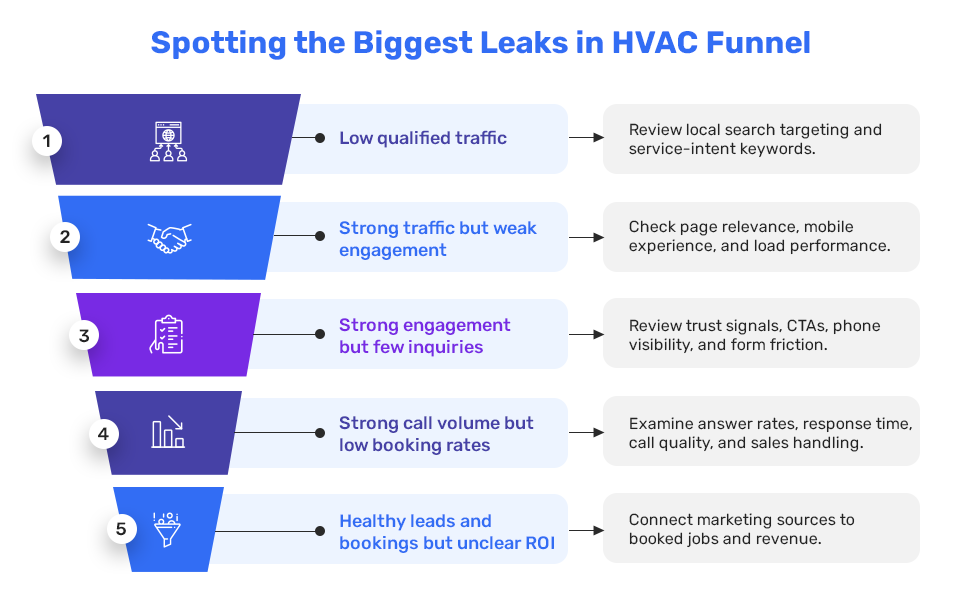
This prevents the common reaction of putting more budget into visibility when the actual problem sits further down the funnel.
The objective is not to make every stage perfect. It is to identify the largest preventable loss and address it first.
What Does Fixing Multiple HVAC Funnel Leaks Look Like in Practice?
A family-run local services company was receiving around 160 website visits a month, but very few visitors were turning into calls. The business relied heavily on referrals, leaving its online presence underused as a source of new customers.
The Challenge
The company had traffic, but the website was not converting enough of it into calls. It also lacked the local search visibility needed to capture ready-to-book customers consistently.
The Solution
The team rebuilt the website to improve speed and trust, strengthened its local SEO presence, and launched call-focused Google and Meta campaigns aimed at searchers who were ready to book.
Rather than treating traffic generation and conversion as separate activities, the approach addressed multiple points in the customer journey, from finding the business to taking the next step.
The Result
- 12x increase in website traffic, from 160 to 1,918 monthly sessions
- 4.44% conversion rate, exceeding the 4% target
- $123 lower cost per lead than forecast
- 7 additional leads generated on half the planned budget
The result illustrates an important point for HVAC businesses: increasing traffic is only part of the equation. Website performance, trust, local visibility, and conversion activity need to work together if that traffic is expected to produce leads.
Assess the Complete Funnel and Prioritize the Leaks That Matter Most
Turn HVAC Website Traffic Into More Booked Jobs
Traffic without calls is rarely solved by one more campaign, another batch of blog posts, or a higher advertising budget. The more useful question is where qualified demand is disappearing between the search result and the booked appointment.
The seven leaks provide a practical way to find that point: search intent, local visibility, page experience, trust, contact friction, call handling, and attribution.
Fixing the largest leak first can make existing marketing activity more productive without requiring the business to continually increase traffic acquisition.
For HVAC companies, Damco can assess the complete digital funnel, from local search visibility and website performance to lead generation, conversion, and attribution, to identify where potential customers are being lost and what should be addressed first.
For businesses looking to improve their home services marketing strategies, this funnel-focused approach helps connect search visibility with actual lead and revenue outcomes.