
 ChatGPT
 Claude
 Perplexity
 Gemini
Key Takeaways:
- HVAC SEO helps your business rank higher on Google by optimizing website content, local listings, keywords, and customer reviews. A strong SEO strategy increases online visibility, attracts qualified leads, and drives more service calls.
- Good practice is to rank for HVAC jobs and not traffic, as those bring in revenue. Generic how-to searches do.
- Google shows HVAC companies on four surfaces. This includes Local Services Ads, the Map Pack, organic results, and AI Overviews, where each one ranks businesses differently.
- Your Google Business Profile is equally important for AI search because Gemini relies on the same Maps data.
- City pages need real local detail, or Google may treat them as doorway pages.
- Commercial HVAC needs a separate approach that reflects how facility managers buy.
- Publish content a season before demand peaks, and measure success by booked jobs, not rankings.
Plenty of HVAC websites have one page that ranks beautifully and has never produced a single service call. Nine times out of ten, it’s a blog post explaining how a heat pump works. No words for the feeling, right?
There’s nothing wrong with that post. It’s accurate, it pulls in traffic, and it probably appears in the monthly report as a win. The trouble is who’s reading it. Someone researching refrigerant cycles is curious, not desperate. The homeowner whose AC stopped working at dinnertime is somewhere else entirely, probably scrolling through reviews on the map, tapping the ad at the top of the page, or reading whatever Google’s AI tells them.
Those jobs are still booked. But just not by you! They go to the competitor with fresher reviews, to an aggregator that sells the same lead to several of your rivals, or through Local Services Ads, where every lead has a price tag.
This guide starts at the other end. Instead of asking what you could rank for, it asks which jobs you want more of, then works back to the searches, profiles, and pages that bring those calls in. Think of it as an HVAC SEO guide for contractors who’d rather count booked jobs than keyword positions.
Effective HVAC SEO services should focus on attracting homeowners who need repairs, installations, and maintenance, then turning those searches into qualified leads and booked jobs.

Why Do Most HVAC SEO Efforts Produce Rankings but Not Booked Jobs?
Most HVAC SEO targets traffic rather than revenue. Agencies chase high-volume informational terms and thin city pages that rarely trigger calls. Without tying rankings to booked jobs in the CRM, contractors cannot see which pages earn revenue and which simply rank.
Most of the time, it comes down to what gets measured. Meaning, digital marketing agencies usually report rankings and visits because they’re easy to count. But this doesn’t benefit you, as you get paid for finished jobs. A page sitting at number one for “how does an air conditioner work” might bring in thousands of visitors a month, but hardly any of them need a technician this week.
The competition doesn’t end here! Keyword choice makes it even worse. Low-competition terms are easy wins, which is exactly why they pad out so many reports. But “AC filter sizes” and “emergency AC repair” are worlds apart. One is typed by someone planning a Saturday DIY job, while the other is done by a homeowner whose compressor just stopped working and wants it fixed today.
Not to forget the city pages. A lot of HVAC sites carry dozens of near-identical pages where only the town name changes. Like always, a few of them rank but rarely produce calls. That is because there’s nothing on the page a local homeowner would find useful.
Underneath all of this is an attribution gap. In Scorpion’s 2026 survey1, 67% said they cannot connect marketing spend directly to revenue, and 78% work with two or more marketing vendors. When nobody can connect a booked job to the search behind it, rankings quietly become the proof that marketing is working, and an HVAC SEO strategy built on the wrong goals gets renewed for another year.
How Does Google Decide Which HVAC Companies Show up?
Google ranks HVAC companies on four surfaces: Local Services Ads, the Map Pack, organic results, and AI Overviews. Map rankings rest on relevance, distance, and prominence. LSAs add bids and responsiveness. AI Overviews favor verifiable businesses.
Type “furnace repair near me” into Google and you could see four different kinds of results on the same page. Each one decides who shows up in its own way.
- Local Services Ads sit right at the top. Google2 orders them through an auction that looks at verification badges, bid, responsiveness, and profile quality, which covers your rating, review count, and response time. Missed calls can drag your responsiveness down, so where you appear depends partly on your bid and partly on whether someone picks up the phone.
-
The Map Pack usually comes next. Google says local results are based mainly on relevance, distance, and prominence. In plain terms, relevance is how well your profile matches the search, distance is how far you are from the person searching, and prominence is how well known you are.
Google has also confirmed that review count and rating feed into prominence. Since a service-area business can’t do much about distance, relevance and prominence are where your effort makes a difference.
- Organic results come down mostly to your website: how useful your service pages are, how local they feel, and who links to you.
- AI Overviews are the newest, and they are turning up more. A Whitespark study2 found AI Overviews on 68% of local business queries, compared with 39% for local packs. Informational and cost questions trigger them most. Plain “service + city” searches still tend to show the map.
Because each of these works differently, a single ranking report won’t tell you much about how visible you really are. You’ll want a separate goal for each.
Which HVAC Keywords Are Worth Ranking For?
The most valuable HVAC keywords map to high-ticket or recurring jobs: emergency repair, system replacement, maintenance agreements, and commercial service. Prioritize them by job value and buyer urgency, not search volume. Informational terms only support those buyers.
Search volume tells you how many people are looking. It doesn’t tell you what any of them are worth. The more useful question is what job a searcher is likely to book, and what that customer might be worth over the years. Looked at that way, HVAC keywords sort into four revenue tiers, plus two supporting categories you’ll see in the table below.
1. Emergency Repair
earches like “AC not cooling,” “no heat” and “24-hour HVAC repair” don’t have huge volume, but the people behind them need help now. Most will call the first company that looks credible. That makes these keywords quick money and, if the job goes well, the start of a long relationship.
2. Replacement and Installation
“AC replacement cost,” “heat pump installation,” and “furnace replacement” lead to the biggest tickets in residential HVAC. Homeowners tend to research these for days or weeks before they call, so your pages need to answer real questions about cost, sizing, and financing. A sales pitch on its own won’t do it.
3. Maintenance Agreements
Searches for “AC tune-up” or “furnace maintenance plan” bring in small tickets. The payoff comes later: recurring revenue, steadier work in the slow months, and being first in line when the system finally fails.
4. Commercial Service
Terms like “rooftop unit repair,” “chiller maintenance” and “commercial HVAC contractor” get less search volume, but the contracts are bigger, and the sales cycles are longer.
| Keyword cluster | Example queries | Job value | Competition | Priority |
|---|---|---|---|---|
| Emergency repair | AC not cooling, no heat, 24-hour HVAC repair | High: fast revenue plus a new customer | High (LSAs, aggregators) | 1 |
| Replacement / installation | AC replacement cost, heat pump installation | Highest per ticket | High | 1 |
| Maintenance agreements | AC tune-up, furnace maintenance plan | Medium per ticket, high lifetime | Medium | 2 |
| Commercial service | RTU repair, chiller maintenance, PM contract | Very high per contract | Low to medium | 2, if crewed for it |
| Buyer-research content | Heat pump lifespan, SEER2 explained | Indirect: feeds tiers above | Medium | 3, support only |
| DIY informational | Change AC filter, reset thermostat | Low | High | Skip |
A word of caution that applies to all of these. If you don’t have the crews, insurance, or after-hours coverage for commercial or emergency work, ranking for those terms won’t do you any good. Let your keyword list follow what your team can actually deliver.
Need an HVAC SEO Strategy That Drives Jobs, Market Profitability, and Revenue?
How to Set up Google Business Profile to Win the Map Pack?
HVAC contractors win the Map Pack with a precise primary category, named services, a service area matching where trucks go, review requests at job closeout, and seasonal posts. Completeness and fresh reviews drive Map Pack and AI visibility.
If you only fix one thing this year, make it your Business Profile. It feeds the Map Pack directly, and Gemini pulls the same Google Maps data when it answers questions.
I. Categories
Pick the primary category that matches the work you want most. For most companies, that’s “HVAC contractor.” Add secondary categories only for services you genuinely offer, such as “Furnace repair service” or “Air conditioning repair service.”
II. Services
List each service on its own, with a short, plain description: replacement, emergency repair, heat pump installation, maintenance plans, and so on. This is how Google works out which searches you’re relevant for.
III. Service Area
Google lets you add up to 20 service areas within roughly two hours’ drive of your base.4 That doesn’t mean you should use them all. Stick to the area your trucks can reach and still make money. A profile that claims the whole metro, backed by a single van, tends to attract reviews about technicians showing up late.
IV. Reviews
Nothing on the profile matters more. BrightLocal’s 2026 survey4 found that 97% of consumers read reviews for local businesses, and Scorpion1 found that 87% of homeowners will not hire a business rated below four stars, even though 67% of business leaders struggle to collect reviews consistently. Fixing this is mostly about the process. Have your field-service software send a review request the moment a technician closes the job, and ask customers to mention what you did and which town they’re in.
V. Posts
Match your business posts to the season and the weather. This could mean tuning up offers in spring, furnace safety checks in early fall, or opening appointments during a heat wave.
Having explored how to set up Google Business Profile to win the map pack, let’s now see what pages an HVAC business website needs to rank and convert.
What Pages Does Your HVAC Website Need to Rank and Convert?
An HVAC website needs a page for each core service, plus service-by-city pages for priority markets. Each city page needs genuine local content, HVAC business schema, click-to-call, financing details, and online booking.
Picture your site as a grid. Your services include AC repair, AC replacement, furnace repair, heat pump installation, maintenance plans, and indoor air quality. The markets you serve run across the top. Where an important service meets a priority market, you’ve got a page worth building.
Identical pages are at risk. Why? Because Google’s spam policies5 list doorway abuse, meaning pages built to rank for specific, similar queries, as a violation that can push a site down or out of results altogether. A city page where only the town name changes fits that description neatly.
So, give each city page something that is true only of that place:
- Climate: Humidity, heat waves or winter lows, and what they mean for choosing a system
- Housing Stock: Older homes without ductwork are often good candidates for ductless systems, while newer subdivisions may be full of builder-grade units close to replacement
- Local Proof: Reviews and project examples from that town, ideally naming the neighborhood
- Local Rules: Permits, utility rebates, and inspection requirements
This kind of detail helps with AI search as well. Businesses that name specific cities and neighborhoods consistently outscore those claiming broad regional coverage.
Structured data backs it up. Schema.org has an HVAC Business type within Local Business, so mark up your name, address, phone, service area, and hours, and keep them exactly in line with your Business Profile. Leave out review markup, though. Google doesn’t show star ratings for reviews a business publishes about itself.
Last, make the next step easy. Put a click-to-call button near the top of mobile pages, explain financing on replacement pages (a new system is a big, often unplanned expense), and let people book online. Scorpion1 found that 56% of homeowners want 24/7 scheduling or after-hours communication. Someone who lands on your site at 9 p.m. on a Friday and can’t book until Monday may well call someone else.
How Is SEO Different for Commercial HVAC Contractors?
Commercial HVAC SEO targets facility managers, not homeowners. They search by equipment and contract type, such as rooftop units, chillers, and preventive maintenance, and judge vendors on compliance, response guarantees, and proof.
When a homeowner’s AC breaks, they want someone there today. A facility manager with a failing rooftop unit wants that too, but they’re also asking a bigger question: can this company keep forty units running for the next three years?
That changes how they search. Commercial buyers use equipment terms like “RTU replacement,” “chiller maintenance contract,” or “VRF service.” They usually compare several vendors, often with procurement involved, and their first visit to your site is more likely to be homework than a phone call.
I. Profile
List your commercial services as separate entries on your Business Profile: rooftop units, chillers, boilers, preventive maintenance agreements, and building automation systems. If you have a dedicated commercial division, give it its own set of pages so Google can tell it apart from your residential work.
II. Pages
Build pages for each type of equipment you service and for the sectors you work in, such as offices, retail, healthcare, restaurants, and schools. A hospital facility director will pay far more attention to a page about infection control and critical uptime than to anything about home comfort.
III. Trust Content
With commercial buyers, this is often what gets you on the shortlist. Facility managers want to see that hiring you is a low-risk decision, so show them:
- Licenses, insurance, and safety records
- Written response-time commitments
- Technician certifications and manufacturer partnerships
- Case studies that specify building type, scope, and outcome
Outside listings count here too. Manufacturer dealer locators and trade associations such as ACCA confirm, independently, that you do the work you say you do.
It’s worth treating your commercial site less like a brochure and more like the paperwork a buyer would want before adding you to a vendor list.
How to Get the HVAC Business Cited in AI Overviews and AI Answers?
HVAC businesses earn AI citations by answering cost, sizing, and incentive questions at the top of the page, keeping business details identical everywhere, and building recent, detailed reviews. AI engines cite businesses they can verify.
AI tools are far choosier than the Map Pack about which businesses they mention. SOCi’s 2026 Local Visibility Index6 found that ChatGPT recommended 1.2% of locations, compared with 35.9% that appeared in Google’s local 3-Pack. The locations ChatGPT did recommend averaged 4.3 stars. In fact, 22% of homeowners now use AI tools to research or find home service providers, as per Scorpion1.
“AI has collapsed the local decision journey. Consumers aren’t scrolling through options anymore. They’re asking AI to decide for them, and the cost of invisibility has never been higher. If your brand isn’t optimized for AI search, you’re not just losing rank, you’re removed from consideration entirely at the moment of intent.”
Monica Ho, CMO, SOCi
There are four things that improve your chances of being cited, illustrated in the visual below:
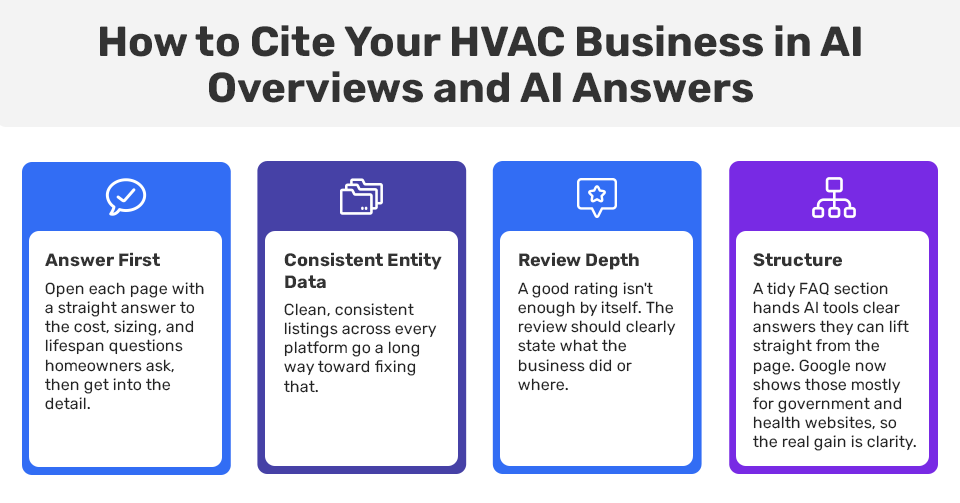
Along with these four things, what matters is the time. Simply put, when you publish the content plays a big role in getting you qualified leads during seasonal fluctuations.
When to Publish Content to Match HVAC Seasonal Demand?
Publish HVAC content ahead of demand, not during it. Release cooling content in early spring and heating and heat pump content in late summer, so pages are indexed before peak search. Use weather-triggered Business Profile posts for short-term spikes.
HVAC demand follows the calendar, and for the most part you know what’s coming. Rankings are slower. Google has to crawl, index and come to trust a new page, which is why a furnace page published in November usually misses the first cold snap.
As a rule of thumb, publish about three months before each season starts:
| Window | Publish or refresh on the website | Business Profile focus |
|---|---|---|
| Jan–Feb | AC replacement cost guides, heat pump vs. AC comparisons | Late-winter heating emergencies |
| Mar–Apr | AC repair, tune-up and maintenance plan pages | Spring tune-up offers |
| May–Jul | Emergency AC, indoor air quality, humidity control | Heat-wave availability |
| Aug–Sep | Furnace repair, heat pump installation, heating cost guides | Fall furnace safety checks |
| Oct–Dec | No-heat emergencies, plan renewals, next year’s cooling refresh | Cold-snap availability |
Weather adds shorter spikes on top of that. When a heat advisory or the first freeze shows up in the forecast, a same-day Business Profile post about open appointments and emergency hours puts you in front of people just as they start searching.
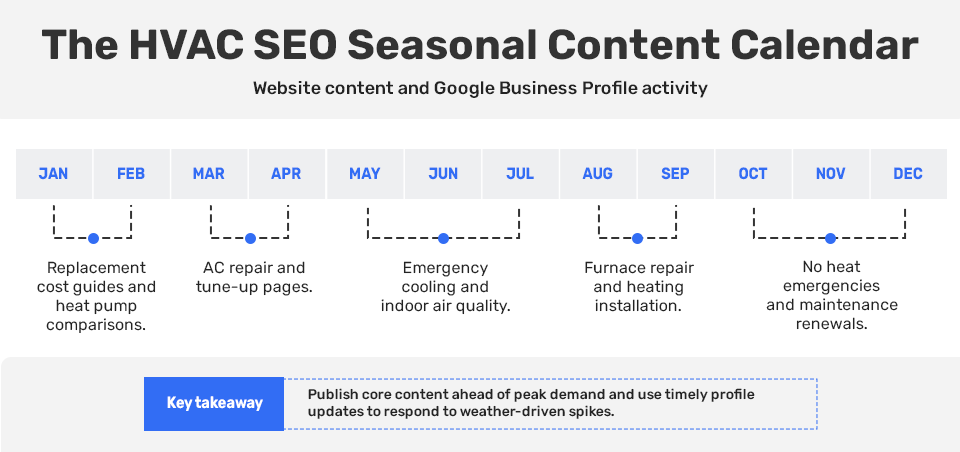
Use the quieter shoulder months to update pages, chase reviews, and write maintenance-plan content. Once every technician is booked solid, that work rarely gets done.
What HVAC SEO Strategy Should You Prioritize at Each Stage of Growth?
An HVAC SEO strategy should match company size. Under five technicians, perfect the Business Profile and reviews. At five to twenty, add service-by-city pages and attribution. Multi-location firms need a profile per location and formal reporting.
A three-truck shop and a regional operator with several branches shouldn’t be working from the same plan. What to focus on depends on your capacity, and each stage builds on the one before it.
| Stage | Do first | Skip for now | When to bring in an agency |
|---|---|---|---|
| Under 5 techs | Complete Business Profile; review requests at closeout; core service pages; click-to-call | Dozens of city pages; broad blog programs; commercial terms | When the owner can no longer manage reviews and posts every week |
| 5–20 techs | Service-by-city pages for priority markets; call tracking; CRM/FSM attribution; seasonal calendar | Markets outside profitable drive time | When pages rank but nobody can tie them to booked jobs |
| Multi-location / commercial | One verified profile per real location; commercial page clusters; trust content; AI visibility monitoring | Copy-paste location pages | Early, because coordination across locations needs dedicated ownership |
The most common mistake, and usually the costliest, is skipping the basics. A multi-location company with weak Business Profiles at each branch will struggle no matter how good its website looks.
Do you need an agency? It depends on where you are. A small company with a complete profile and a steady trickle of reviews may be fine on its own for now. A company that ranks well but can’t say which pages bring in revenue needs outside help sooner. When comparing HVAC SEO services, choose the partner that reports in booked jobs, not positions.
How to Measure HVAC SEO by Booked Jobs?
Measure HVAC SEO by calls, not clicks. Track calls from the website and Business Profile, pass lead sources into the CRM or field-service software, then watch booked jobs, revenue by channel, and cost per booked job.
“The most effective way to evaluate results is to look at the leads generated.”
Joy Hawkins, Founder, Local Search Forum and LocalU
Measurement is where SEO finally connects to revenue. It takes three pieces working together:
- Call Tracking: Give your website, Business Profile, and ads their own tracking numbers so you know where each call came from. On the Business Profile, set the tracking number as primary and list your main number as an additional one. On the website, use dynamic number insertion so search engines still see your main number.
- Business Profile Performance Data: Calls, direction requests, and website clicks show you how the profile itself is doing.
- CRM or FSM Attribution: Tag every booked job with its lead source, so you can trace revenue back to the search that started it.
Once that’s set up, there are only five numbers to watch:
- Booked jobs from organic and Map Pack
- Revenue by channel
- Cost per booked job
- Call-to-booking rate
- Average ticket by keyword cluster
Rankings and traffic are still worth keeping an eye on, since they tell you whether things are heading the right way. They’re just not the finish line.
Turn Your HVAC Search Visibility into Measurable Revenue with a Tailored SEO Strategy
Is Your SEO Built to Fill the Schedule?
The best HVAC SEO strategy for 2026 and ahead is revenue-led. Choose keywords by job value, complete the Business Profile, publish genuinely local pages, lead the season, and measure booked jobs. Rankings matter only when they fill the schedule.
As this HVAC SEO guide shows, the companies doing well in search in 2026 tend to be the ones that run a tight ship. Their profiles are accurate, they answer quickly, reviews come in steadily, and their pages deal with real local problems. Rankings usually follow. Whether those rankings turn into booked jobs depends on how well the rest of the process is set up.
Damco Digital is a home services SEO company built to be that kind of growth partner. The team starts with the jobs you want to win, builds the search presence to win them, and reports on booked jobs and revenue rather than rankings.
References
- [1]. Scorpion 2026 survey
- [2]. Whitespark Research
- [3]. Google Business Profile
- [4]. BrightLocal 2026 survey
- [5]. Google Spam Policies
- [6]. SOCi 2026 Local Visibility Index