

 ChatGPT
 Claude
 Perplexity
 Gemini
Key Takeaways:
- Use an HVAC SEO checklist to uncover website gaps and plan fixes.
- Build on a secure website that loads quickly and works well on phones.
- Create service and location pages that match homeowners’ searches.
- Complete your Google Business Profile to support local search visibility.
- Build customer confidence with recent reviews and timely replies.
- Use Google Analytics and Search Console to guide ongoing improvements.
An air conditioner fails on a hot July afternoon. When this happens, homeowners need a contractor right away, and being visible in that quick search window helps HVAC businesses win the job.
Online searches drive most of these decisions today. A 2026 survey for The Air Conditioning, Heating & Refrigeration News1 found that 54% of homeowners use Google Business Profile and 45% visit contractor websites. If your site ranks poorly or hides your phone number, you will likely lose the call.
Many HVAC websites struggle with common issues like weak local visibility, slow mobile pages, missing service details, thin content, and confusing menus. Spotting these weaknesses is the first step toward fixing them.

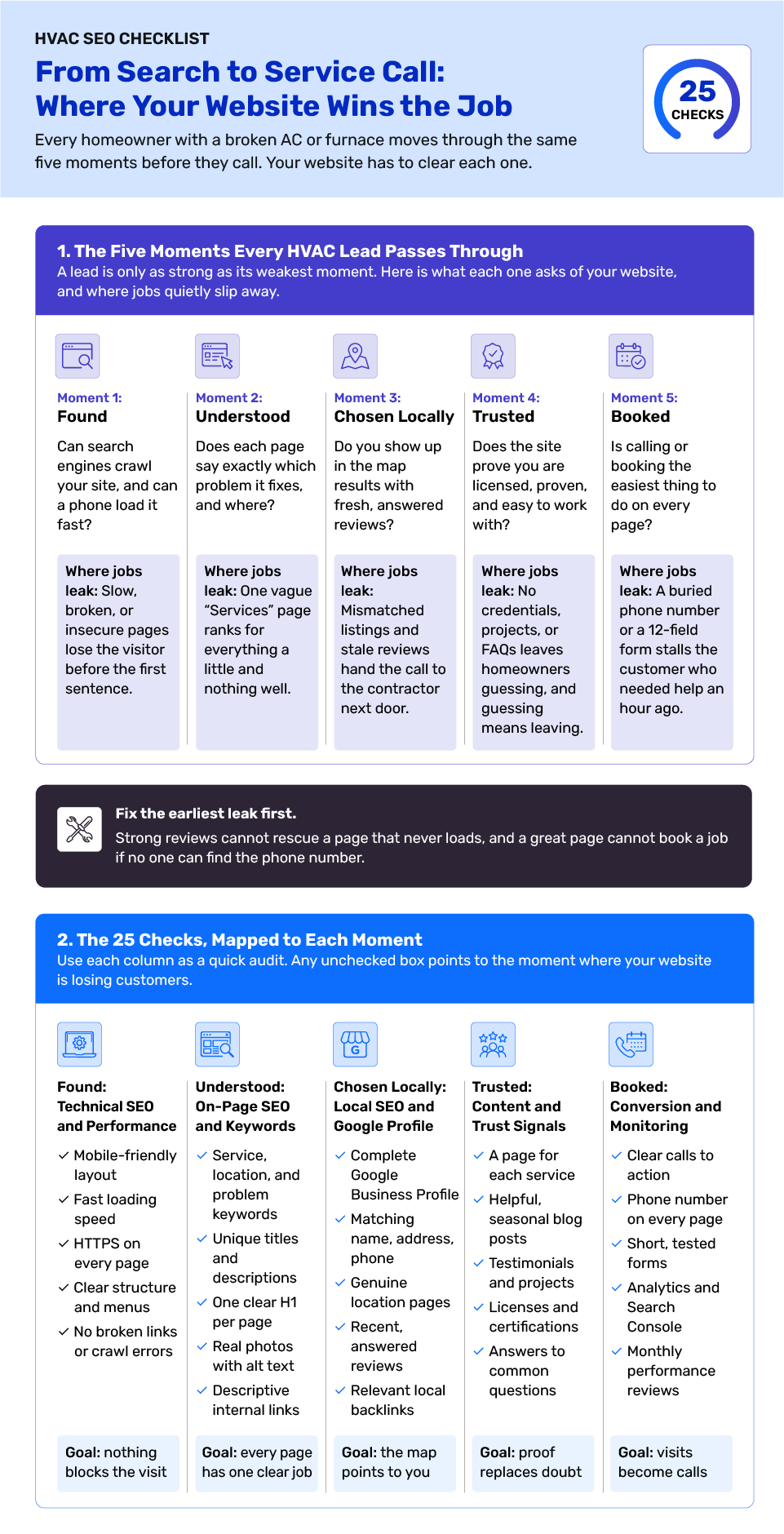
This HVAC SEO checklist breaks search engine optimization into 25 actionable checks. It covers technical performance, on-page optimization, local search, content, and lead generation. Use it to find what blocks your visibility and inquiries so you can prioritize your repairs.
For a deeper understanding of HVAC search optimization, explore our HVAC SEO Guide, which cover essential strategies to improve search visibility, attract local customers, and generate more qualified leads.
Why Do HVAC Contractors Need an SEO Checklist?
A noisy furnace, warm air from an air conditioner, or a needed tune-up can prompt homeowners to look for help. Housecall Pro’s State of Home Service Spending 2026 report2 found that 58% of homeowners call a professional after a sudden problem and 72% would pay more to resolve an emergency within 24 hours. These customers usually choose one of the first trustworthy companies they find.
Organic search connects you with people actively searching for repairs, replacements, or maintenance rather than a general advertising audience. Ranking well in your service areas helps turn that demand into phone calls.
Keywords alone do not earn visibility. Search engines also look at your page speed, mobile usability, clear service and location details, and trust signals from customers and other websites.
A checklist gives your website reviews a consistent structure and helps you prioritize tasks as your business grows. This guide covers five key areas:
- Technical SEO and website performance
- On-page SEO and keyword optimization
- Local SEO and Google Business Profile
- Website content and trust signals
- Conversion optimization and SEO monitoring
HVAC SEO Checklist: 25 Things Contractors Should Check on Their Website
Each check outlines what to assess, why it matters, and what to improve. This practical HVAC SEO guide is designed for most teams to follow without specialized tools.
1. Technical SEO and Website Performance
Technical SEO lays the groundwork for everything else. Search engines must be able to crawl your site, and visitors must be able to use it without long waits.
i. Check Whether Your Website Is Mobile-Friendly
Homeowners often search for HVAC help on their phones while standing next to broken equipment. Open your site on a smartphone to see if the text is easy to read without zooming, the navigation is simple, and your phone number is easy to find. Test every quote form and click-to-call button. A broken link or button can cost you an urgent customer. If your site is old, you may need a responsive rebuild from a web design and development team.
ii. Test Your Website Loading Speed
After checking the mobile layout, test your key pages using Google PageSpeed Insights. Compress large images, remove unnecessary plugins and scripts, and discuss caching with your developer. Fast mobile performance stops visitors from leaving out of frustration.
iii. Make Sure Your Website Uses HTTPS
Check security as well as speed. Hypertext Transfer Protocol Secure (HTTPS) encrypts data exchanged between your website and a visitor’s browser and requires a valid SSL certificate. Make sure your certificate is active, and your pages show no security warnings, especially on forms. Redirect old HTTP addresses to the secure HTTPS versions.
iv. Check Your Website Structure and Navigation
Make navigation as reliable as performance. Visitors should quickly find your services, locations, and contact details. Organize your menus around heating, cooling, and maintenance plans, with a logical page hierarchy. Important service pages should be no more than three clicks away from the homepage.
v. Find and Fix Broken Links and Crawl Errors
Page moves, name changes, and deletions can leave broken links. Scan internal and external links with a crawling tool, then check the Pages report in Google Search Console for indexing and crawling problems. Fix broken URLs, redirect old pages to active ones, and update any broken internal links.
2. On-Page SEO and Keyword Optimization
Once your technical foundation is sound, make each page’s subject clear through its copy, headings, and supporting elements.
i. Target the Right HVAC Keywords
Research the phrases customers type into search engines, such as “AC repair near me,” “furnace not turning on,” and “heat pump installation in Dallas.” Include terms centered on your services, locations, and specific problems. Think about the intent behind each search. For example, “AC making loud noise” means the customer needs a repair, while “best heat pump for cold climates” means they are still researching.
ii. Optimize Title Tags and Meta Descriptions
Give every important page a unique title tag that includes the service and location, such as “Furnace Repair in Columbus, OH | Company Name.” This becomes the clickable search headline, with your meta description below it. Use relevant keywords and a clear description of the offering to encourage clicks.
iii. Use Proper Heading Tags
Use headings to make your pages easy to scan. A single H1 tag should state the main topic, such as “AC Repair Services in Phoenix.” Organize your supporting details under descriptive H2 and H3 headings, adding keywords naturally without repeating them in every heading.
iv. Optimize Images with Descriptive Alt Text
Use real photos of your team, vehicles, and installations instead of generic stock images. Describe each photo accurately in the alt text, such as “technician installing a high-efficiency furnace,” to help visually impaired visitors and give search engines context. Compress your image files before uploading them, and use clear file names like “heat-pump-installation-denver.jpg” instead of generic names like “IMG_4521.jpg.”
v. Add Relevant Internal Links
Link each service page to related offerings, location pages, and helpful blog posts. Avoid vague labels like “click here.” Also, use descriptive text instead, such as “schedule a furnace tune-up,” so both visitors and search engines know where the link leads.
3. Local SEO and Google Business Profile
Local SEO helps HVAC contractors reach nearby customers within their service areas. Use these checks to establish your connection to the communities you serve.
i. Claim and Optimize Your Google Business Profile
Your Google Business Profile may be a homeowner’s first encounter with your business. The ACHR News survey named it the leading resource for HVAC contractor research. Claim and verify the profile, complete relevant fields, and choose an accurate primary category. Add secondary categories only for services you provide, maintain current hours and service areas, and upload fresh team, vehicle, and project photos.
ii. Maintain Consistent Business Information Across the Web
Keep your business details consistent across the web. Search engines compare your name, address, and phone number on your website against major directories. Check Yelp, Bing Places, Apple Business Connect, Angi, and the Better Business Bureau for outdated or conflicting entries, and then correct them immediately.
iii. Create Dedicated Location Pages
Location pages complement listings by explaining where you provide service. Build a dedicated page for each city or neighborhood you genuinely serve, with local details, such as climate considerations, permit requirements, and nearby projects. Simply swapping city names on duplicate pages adds little value and can hurt your search rankings.
iv. Collect and Respond to Customer Reviews
Reviews provide undeniable proof of your service quality. BrightLocal’s 2026 Local Consumer Review Survey3 found that 97% of consumers read local business reviews, and 74% seek feedback posted within three months. Keep reviews current rather than relying on an old collection. After each job, send satisfied customers a Google review link by text or email.
Make replying a part of your routine. In a session summarized by GatherUp, local search expert Joy Hawkins, founder of Sterling Sky, stressed the importance of responding:
“I think it’s really important to respond to all reviews, not just the good ones. It shows you’re paying attention.”
Thank positive reviewers personally and briefly. For negative reviews, stay calm, recognize the concern, and outline how you will address it.
v. Build Relevant Local Citations and Backlinks
Backlinks extend your credibility beyond review platforms. Pursue listings in trusted local directories, manufacturer dealer locators, and trade associations. Partnerships and community sponsorships can also earn valuable links. Choose relevance and quality over a high volume of unrelated links.
4. Website Content and Trust Signals
Being found online is only the first step. While technical optimization, keywords, and local signals attract visitors, useful content and proof of expertise help you earn their calls.
i. Create Separate Pages for Each HVAC Service
Create a dedicated page for each major service you offer, including AC repair, furnace installation, heat pump service, and maintenance plans. A single services page cannot cover everything in enough depth. Explain the scope of the work, the problems you solve, and what the customer can expect, ending with a clear call to action like a quote request.
ii. Publish Helpful HVAC Blog Content
Answer common pre-booking questions through blog posts about changing air filters, deciding whether to repair or replace an old furnace, and improving energy efficiency. Include seasonal topics. The DuraPlas 2026 Summer Cooling Report4 found that 50% of homeowners skipped HVAC maintenance to save money before summer, providing a timely reason to discuss the potential cost of delayed upkeep.
Connect each blog post to an appropriate service page. Organize your answers clearly so artificial intelligence tools can reference them. The ACHR News survey found that 37% of homeowners use AI tools such as ChatGPT when researching HVAC contractors, underscoring their growing role.
The Ultimate AIO Strategy: How to Optimize Content for AI Search Results
iii. Add Customer Testimonials and Project Examples
Back up your claims with real customer reviews and completed projects. Feature feedback on your homepage and service pages, ideally including the customer’s first name and city. Describe the problem, the solution, the equipment used, and the result for each project. Include before-and-after photos whenever possible.
iv. Display Clear Business Credentials and Expertise
Make your qualifications easy to verify before customers invite your team into their homes. Prominently display your license numbers, insurance, manufacturer certifications, and professional affiliations. Include credentials such as North American Technician Excellence certification and Environmental Protection Agency Section 608 certification. Use your “About Us” page to introduce your team and its service commitments.
v. Add FAQs That Address Customer Questions
Answer common customer concerns in an FAQ section. Address pricing, repair timelines, maintenance schedules, warranties, financing options, emergency availability, and your service areas. Keep your answers clear and link them to your service pages. This format helps search engines and AI tools match your content to conversational searches.
5. Conversion Optimization and SEO Monitoring
The last five checks focus on turning relevant traffic into booked work and measuring what happens along the way.
i. Add Clear Calls to Action Across Your Website
Make your next steps obvious with buttons that say “Schedule a Service,” or “Call Now.” Place these buttons high up on your pages, and keep a sticky call button visible on mobile screens. Match each action to what the visitor needs, whether they are calling for an emergency repair or asking for an installation estimate.
ii. Make Your Contact Information Easy to Find
Put your phone number in the header of every page. Enable tap-to-call links for mobile users. Provide a straightforward contact form, and clearly display your operating hours, emergency availability, and service areas in both your website footer and contact page.
iii. Simplify Your Website’s Lead Generation Forms
Create forms that are easy to complete. Only ask for the information you need to respond, such as the customer’s name, phone number, email address, location, and service type. Test your forms once a month to ensure inquiries land in the correct system.
iv. Set Up Google Analytics 4 and Google Search Console
Use Google Analytics 4 to understand your traffic sources, page views, and visitor actions. Track calls, form submissions, and appointment requests to see which pages bring the most leads. Google Search Console will give you complementary data on search queries, impressions, clicks, and indexing status. For help with accurate setup, consider Google Analytics consulting support.
v. Review Your SEO Performance Regularly
Check your search rankings, organic traffic, Google Business Profile activity, and website inquiries at least once a month. Use drops in traffic or slow lead generation to spot pages that need rework. Also, go through this HVAC SEO checklist every quarter to catch new issues early.
How to Prioritize Your HVAC SEO Checklist
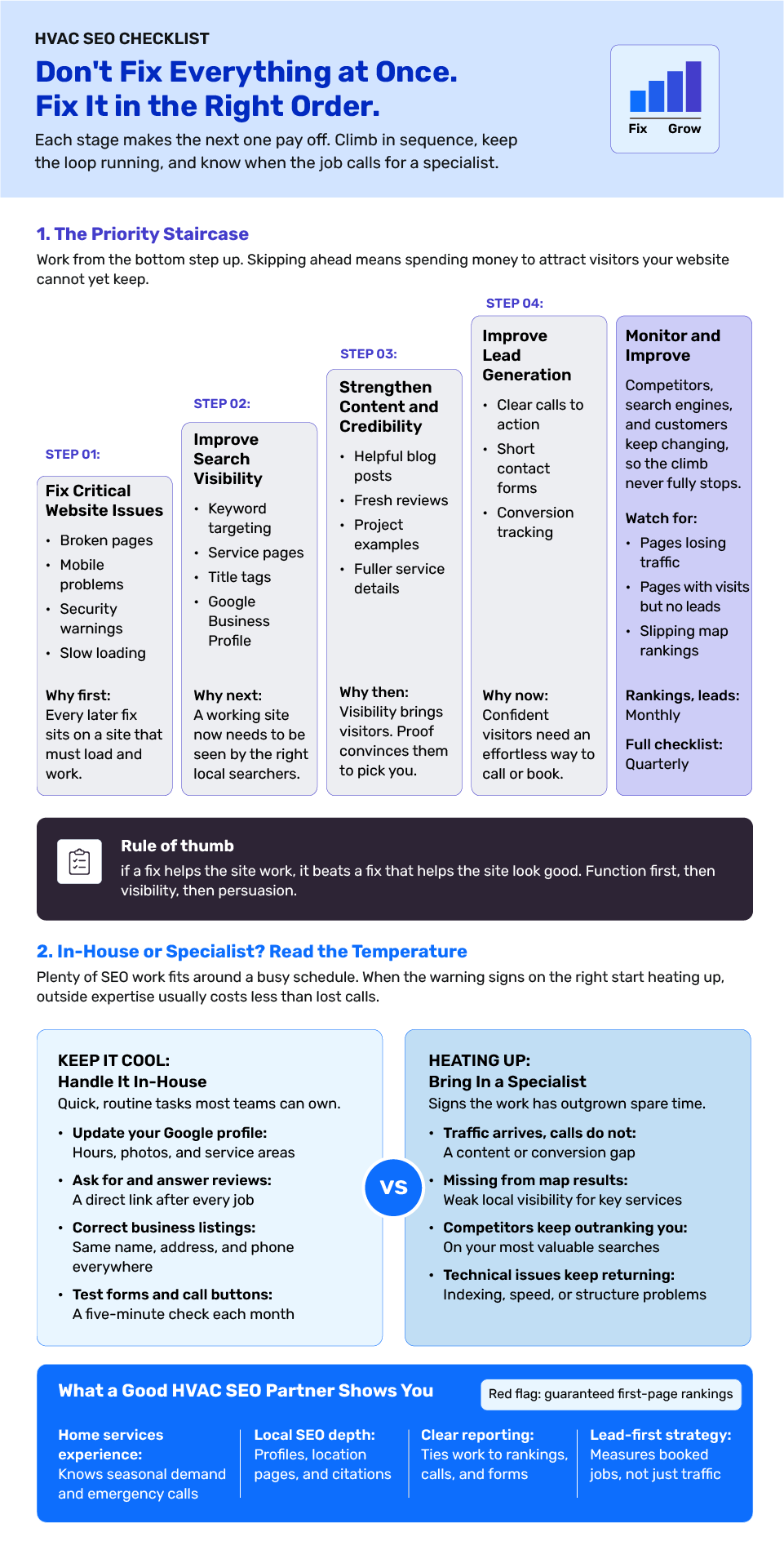
Tackle this checklist in stages rather than all at once. Let your website’s condition and business objectives guide your work, using this order as a starting point:
- First, fix critical website issues: Address broken pages, mobile problems, security warnings, and major loading delays that can hold back all other work.
- Second, improve search visibility: Strengthen keyword targeting, service pages, title tags, local SEO, and your Google Business Profile.
- Third, strengthen content and credibility: Add useful posts, gather reviews, showcase projects, and provide more detailed service information.
- Fourth, improve lead generation: Refine CTAs, contact forms, and conversion tracking to help visits become actual inquiries.
- Continuously monitor and improve: Reassess your results as your competitors, search engine algorithms, and customer habits change.
Working in this order helps you focus your energy on visibility and customer calls. When time or expertise is limited, professional HVAC SEO services can audit your site, identify your weaknesses, and carry out improvements in the right sequence.
When Should HVAC Contractors Consider Professional SEO Services?
Many basic tasks can be managed in-house. However, more demanding tasks require specialist knowledge and regular attention, especially during busy seasons. Outside help proves useful when:
- Visitors rarely become leads: Your site gets traffic, but few people call or submit forms, pointing to content or conversion issues.
- Your local visibility is limited: Your business seldom appears in map results for important HVAC services.
- Competitors outrank you: Other contractors consistently appear higher in search results for valuable service and location searches.
- Technical problems keep returning: Persistent indexing, speed, or structural issues require specialized attention.
- Your team lacks capacity: Managing content, local SEO, backlinks, and reporting takes time and focus away from your daily contracting work.
If these issues apply to your business, assess your potential partners carefully. An HVAC digital marketing company should offer:
- Relevant home services experience: Proven work with HVAC or similar businesses and familiarity with seasonal demand.
- Strong local SEO capabilities: A clear plan for Google Business Profile, location pages, citations, and service-area optimization.
- Clear reporting: Regular updates showing how the work relates to rankings, traffic, calls, and form submissions.
- A lead-oriented strategy: An approach that connects search visibility to qualified inquiries and booked jobs, rather than traffic alone.
Avoid agencies that promise first-page rankings or guarantee leads. No agency can control competition, your physical location, search engine algorithm updates, and other external ranking factors. Instead, look for realistic expectations, clear methods, and proof of steady progress.
Damco Digital follows this approach in its home services digital marketing work. As an HVAC digital marketing company, we bring together technical SEO services, local search optimization, content, and conversion tracking to help turn online searches into service calls. To assess your website’s current position, contact our marketing experts today.
Turn Local HVAC Searches Into Booked Service Calls
Turn Your HVAC Website Into a Dependable Source of Service Calls
To reach homeowners and businesses seeking urgent repairs, installations, or maintenance, your website needs more than visibility. Fast, secure, mobile-friendly pages, helpful content, local search presence, and an easy booking process work together to support service calls.
Use this HVAC SEO checklist for contractors to identify missing pieces. Begin with technical problems, improve visibility and content, then refine conversions and measurement. Return to the checklist as search behavior evolves.
Professional HVAC SEO services can handle audits, implementation, and monitoring when daily jobs take priority. Whether you work in-house or with a partner, regular website improvements help your business remain visible when customers search.