
 ChatGPT
 Claude
 Perplexity
 Gemini
Key Takeaways:
- A roofing digital marketing guide helps contractors attract qualified leads through SEO, PPC, and website optimization.
- Optimize your website and Google Business Profile to improve local visibility.
- Use targeted ads and service pages to reach homeowners actively seeking roofing services.
- Build trust with customer reviews, project photos, and helpful content.
- Respond promptly to leads and use a CRM to improve conversions.
- Track lead quality, acquisition costs, and revenue to measure your roofing digital marketing services.
A homeowner notices a water stain spreading across the living room ceiling after a night of heavy rain. They reach for their phone, search for a nearby roofing contractor, compare a few reviews, look at project photos, and call a company that seems trustworthy. If your roofing business doesn’t appear in those search results or makes it hard to request an estimate, a competitor can take that opportunity.
This is where a roofing digital marketing guide becomes useful. A well-planned digital strategy helps roofing contractors reach homeowners when they need repairs, build credibility before an estimate, and turn online interest into profitable projects.
The opportunity is significant. According to Roofing Contractors’ 2025 Homeowner Survey1, 62% of surveyed homeowners said they would search the internet for a roofing contractor, while 79% would consider word-of-mouth recommendations. Online reviews also influenced purchasing decisions for 95% of respondents, including those who considered reviews important, very important, or extremely important. These findings show why referrals and digital visibility should work together rather than compete.
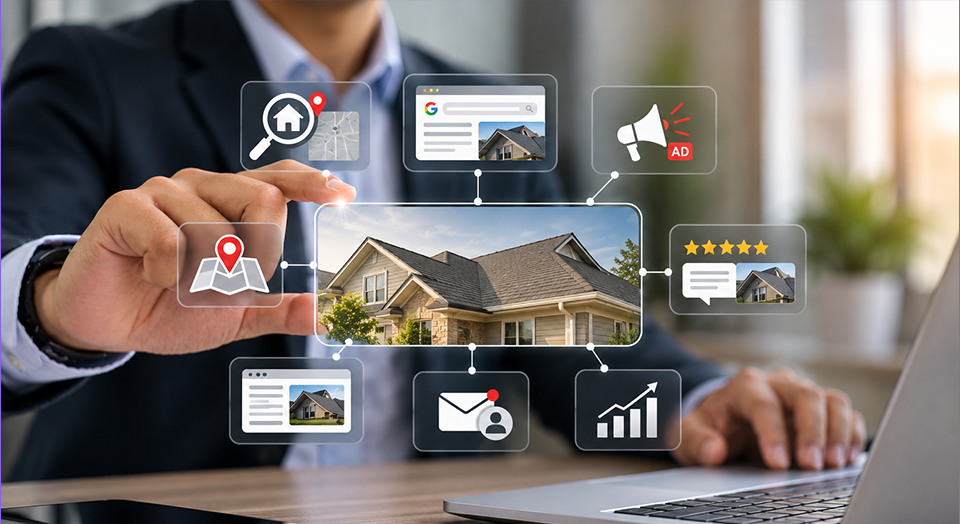
For roofing companies, the objective is not simply to attract more website visitors. It is to reach the right homeowners, earn their trust, generate qualified inquiries, and convert those inquiries into booked jobs.
What Does Digital Marketing for Roofing Companies Include?
Digital marketing for roofing companies combines search engine optimization (SEO), paid advertising, website optimization, online reputation management, content marketing, and lead follow-up. Together, these activities help contractors become discoverable, credible, and easy to contact.
Roofing is different from many other home services because customer needs can vary dramatically. A leaking roof may require immediate attention, while a complete replacement can involve weeks of research, multiple estimates, financing considerations, and comparisons between materials.
A contractor therefore needs marketing that addresses both urgent demand and longer buying journeys.
“The aim of marketing is to know and understand the customer so well the product or service fits him and sells itself.”
Peter Drucker, Management Consultant, Educator, and Author.
Which Roofing Customers Should Your Marketing Target?
Start by identifying your most valuable services and the customers most likely need them.
- Emergency repair customers: Homeowners dealing with leaks, missing shingles, or storm damage who need a prompt assessment.
- Roof replacement prospects: Homeowners research material options, installation costs, warranties, and contractors.
- Inspection and maintenance of customers: Property owners looking for preventive maintenance, seasonal inspections, or an assessment before buying a home.
- Storm-related prospects: Homeowners seeking damage documentation, repair estimates, or guidance on the next steps after severe weather.
Each group needs different messaging. An emergency repair landing page should prioritize phone access and service availability, while a replacement page should explain materials, project timelines, warranties, and financing options.
The best strategy connects each audience with the appropriate service page, advertising campaign, and next step.
How Can an AI Search Optimization Strategy Improve Online Visibility?
How Can Your Roofing Website Convert More Visitors Into Leads?
Your website should help homeowners understand what you offer, build confidence in your artistry, and request an estimate with minimal friction. A visually appealing website is useful, but its real value lies in how effectively it turns visitors into inquiries.
Imagine a homeowner comparing two roof replacement companies. One website contains a generic paragraph about roofing services and a contact page buried in the navigation. The other displays completed projects, explains its installation process, features customer reviews, and offers a prominent estimate request form. The second company gives homeowners more reasons to act.
What Should Every Roofing Website Include?
Create dedicated pages for roof repair, replacement, installation, inspections, and storm damage services where relevant. Each page should explain the service, common problems it addresses, what customers can expect, and how to request an estimate.
Include the following trust-building elements:
- Clear phone numbers and calls to action.
- Original photographs of completed roofing projects.
- Customer testimonials and links to verified review profiles.
- Relevant licenses, insurance details, certifications, and warranty information.
- Service-area information and a straightforward contact form.
- Financing information, where available, and clear explanations of project estimates.
Avoid unsupported claims about being the cheapest, fastest, or best roofing contractor in the area. Specific evidence is more persuasive than generic superlatives.
How Can Landing Pages Improve Roofing Lead Generation?
Build landing pages around individual services and advertising campaigns. Someone searching for emergency roof repair shouldn’t have to navigate a general homepage to find an emergency contact number.
Keep forms concise. Ask only for the information you need to qualify and respond to the inquiry, such as the homeowner’s name, contact details, service address or ZIP code, and the type of roofing problem.
Why Do Mobile Experience and Website Speed Matter?
Homeowners may discover your business while standing under a leaking ceiling or inspecting storm damage outside. Your website must work well on smaller screens, load reliably, and make it easy to call or submit a request.
Test the entire journey, from clicking an advertisement to submitting a form. Monitor mobile usability, page speed, broken links, and form errors. A campaign cannot generate its full potential if prospective customers struggle to contact you.
How Can Local SEO Help Roofers Reach Nearby Homeowners?
Local SEO helps roofing companies appear in relevant geographic searches and map results. By optimizing your business profile, service pages, reviews, and local website content, you can increase your chances of being found by homeowners searching for roofing services in the areas you serve.
A homeowner searching for “roof replacement in Denver” has a different intent from someone reading an article about roofing materials. Local SEO for home services helps your business connect with immediate, location-specific demand.
How Should You Optimize Your Google Business Profile?
Claim and maintain your Google Business Profile with accurate business information, appropriate categories, current hours, service descriptions, and the areas you genuinely serve.
Add original photographs of installations, repairs, materials, and completed projects. Keep your phone number and website consistent with your site and respond professionally to customer reviews.
Do not create multiple profiles for the same business or list virtual offices as real service locations. Accurate information helps prospective customers understand where and how you operate.
How Can Service-Area Pages Attract Local Leads?
Create useful pages for the cities and neighborhoods that matter to your business. A page targeting “roof repair in Aurora” should include relevant local project examples, service details, common roofing concerns, and a clear contact option.
Avoid producing dozens of near-identical pages that simply replace one city name with another. Each page should provide genuine value to homeowners in that area.
Which Roofing Keywords Should You Target?
Organize keywords according to what customers want to accomplish. Use service-specific terms on the corresponding pages instead of targeting every keyword on the homepage.
| Search Intent | Example Keywords | Recommended Destination |
|---|---|---|
| Emergency repair | emergency roof repair near me, leaking roof repair | Emergency repair page |
| Replacement | roof replacement cost, roof replacement contractor | Replacement service page |
| Local discovery | roofing contractor in [city], roofers near me | Local landing page |
| Storm damage | storm damage roof inspection, hail damage roof repair | Storm damage page |
| Research | metal vs. asphalt roofing, signs you need a new roof | Educational blog or guide |
How Do Reviews and Local Links Support Roofing SEO?
Earn relevant backlinks through local business partnerships, community sponsorships, supplier relationships, and useful industry resources. Maintain accurate listings in legitimate directories and encourage customers to share honest feedback after completing projects.
A specialist home services digital marketing company can help identify local keyword opportunities, improve technical SEO, and develop service-area content that supports measurable lead generation.
How Can Roofing PPC and Local Services Ads Generate Leads Faster?
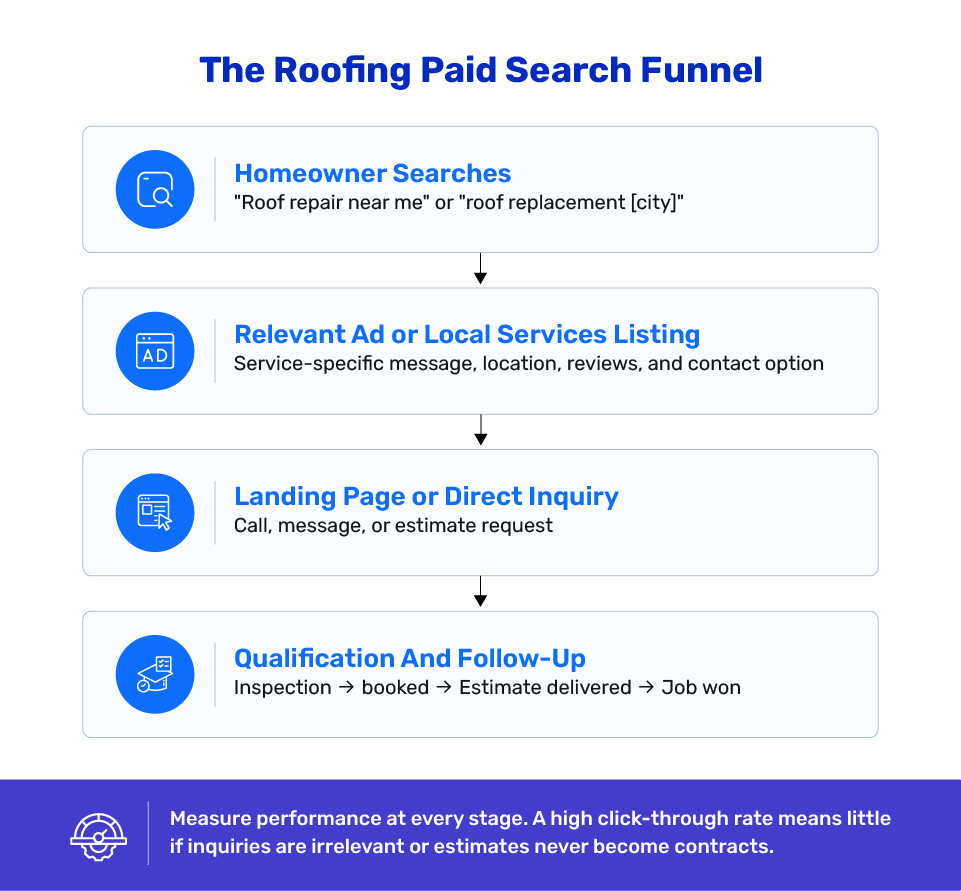
Paid search can put your roofing business in front of homeowners actively looking for a contractor. While SEO builds visibility over time, well-targeted, well-funded ads can generate inquiries more quickly.
Consider a contractor entering a competitive market where established companies already dominate organic results. Carefully managed advertising can create another route to visibility while the contractor develops its website authority and local reputation.
How Do Google Local Services Ads Work for Roofers?
Google Local Services Ads can display eligible service businesses prominently in search results and connect them with customers through calls, messages, and, where supported, booking requests. Roofing is among the listed eligible categories in supported markets, subject to Google’s current requirements.
Google’s documentation2 explains that advertisers pay for eligible leads rather than ordinary clicks in this format. Businesses should monitor lead quality, respond promptly, and review disputed or invalid leads through the available reporting process.
How Should You Structure Google Ads Campaigns?
Separate campaigns by service, customer intent, and geography. Emergency repairs, roof replacements, storm damage assessments, and commercial roofing may require different keywords, budgets, landing pages, and qualification processes.
Use negative keywords to reduce irrelevant clicks. For example, a contractor offering residential installations may want to exclude searches for roofing jobs, training courses, or unrelated products.
How Can You Improve Advertising Efficiency?
Measure the cost of qualified inquiries and booked estimates, not just clicks. Review search terms, geographic performance, conversion rates, and how many leads become paying customers.
How Can Roofing Content Attract Homeowners and Build Trust?
Roofing content helps potential customers understand their problems, compare solutions, and evaluate contractors before requesting an estimate. Useful educational pages can attract organic traffic while giving your sales team resources to answer common questions.
Instead of publishing generic articles simply to fill a blog, start with questions customers regularly ask during inspections and estimates.
Which Blog Topics Can Attract Qualified Roofing Leads?
Consider topics such as:
- How much does a roof replacement cost?
- When should you repair a roof instead of replacing it?
- What are the warning signs of hail damage?
- How long do asphalt shingles and metal roofs last?
- What should homeowners know before filing a storm damage insurance claim?
- How can regular roof maintenance prevent expensive repairs?
Provide accurate explanations and clarify where costs, material performance, insurance coverage, or installation requirements depend on the property and location.
How Can Project Stories Make Your Content More Persuasive?
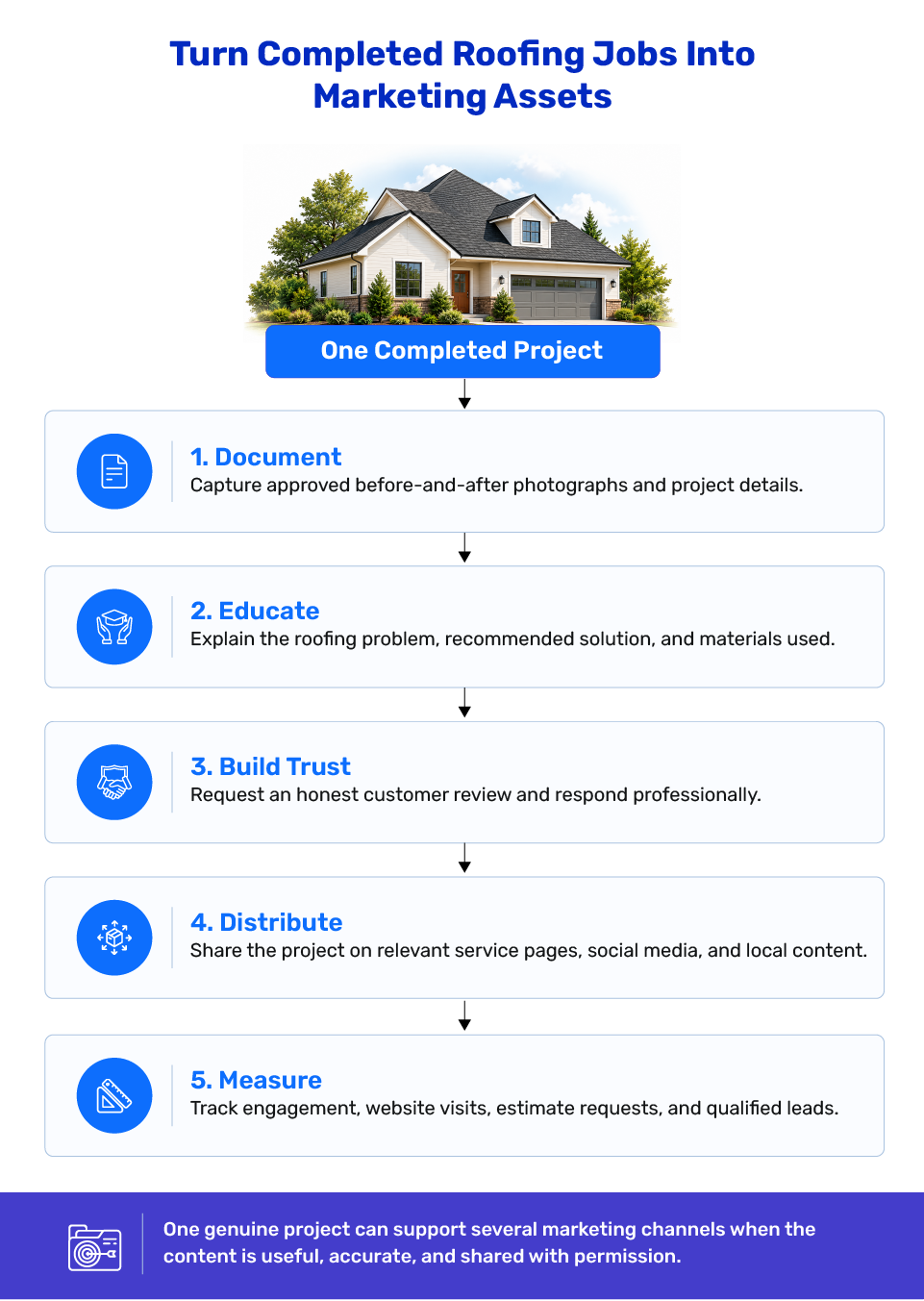
Turn completed projects into short case studies. Describe the original roofing problem, the inspection findings, the options discussed with the homeowner, the materials selected, and the work completed.
For example, a project story might explain how a contractor identified damaged flashing around a chimney, corrected the issue, and addressed the resulting water intrusion. Original photos and clear explanations make the work tangible without relying on exaggerated claims.
Always obtain appropriate permission before publishing identifiable customer information or property images.
How Should Roofing Companies Approach AI-Assisted Search?
Homeowners increasingly use AI-powered tools to explore options and ask detailed questions, making AI search optimization a necessity. Google’s 2026 guidance3 says established SEO best practices remain relevant to AI Overviews and AI Mode; businesses do not need a separate set of special technical optimizations to qualify.
Google4 also reported in June 2026 that AI Overviews had more than 2.5 billion monthly active users and AI Mode had surpassed one billion monthly users. These are broad search-platform figures, not estimates of roofing leads or AI referrals.
For roofing companies, the practical response is to publish accurate, original, and well-structured content. Use descriptive headings, answer questions directly, demonstrate real project experience, and keep business information consistent. Track referrals and conversions from AI sources where analytics allow, but do not promise that any specific content format guarantees AI visibility.
How Can Reviews and Social Media Strengthen Roofing Marketing?
Reviews and social media help homeowners assess a contractor’s credibility before contacting them. Reviews offer evidence of customer experience, while visual content can demonstrate quality, explain roofing problems, and make completed projects easier to understand.
BrightLocal’s 2026 Local Consumer Review Survey5 found that 97% of consumers read online reviews for local businesses. It also reported that 85% were more likely to use a business after reading positive reviews. The survey covers local businesses generally, but the findings reinforce why reputation matters in a high-consideration service such as roofing.
How Can Roofing Companies Generate More Reviews?
Make review requests a routine part of the post-project process. Send a polite request after the work is complete, provide a convenient link, and invite honest feedback without offering incentives or pressuring customers to leave positive reviews.
Respond to reviews professionally, including negative feedback. Where appropriate, acknowledge the concern, explain how the company will follow up, and take detailed customer-service discussions offline.
Which Social Media Content Works for Roofers?
Use social channels to show actual work and answer practical questions. Helpful formats include before-and-after project photos, short installation videos, material comparisons, employee introductions, customer testimonials, and seasonal inspection reminders.
How Can Roofing Companies Convert More Leads Into Booked Jobs?
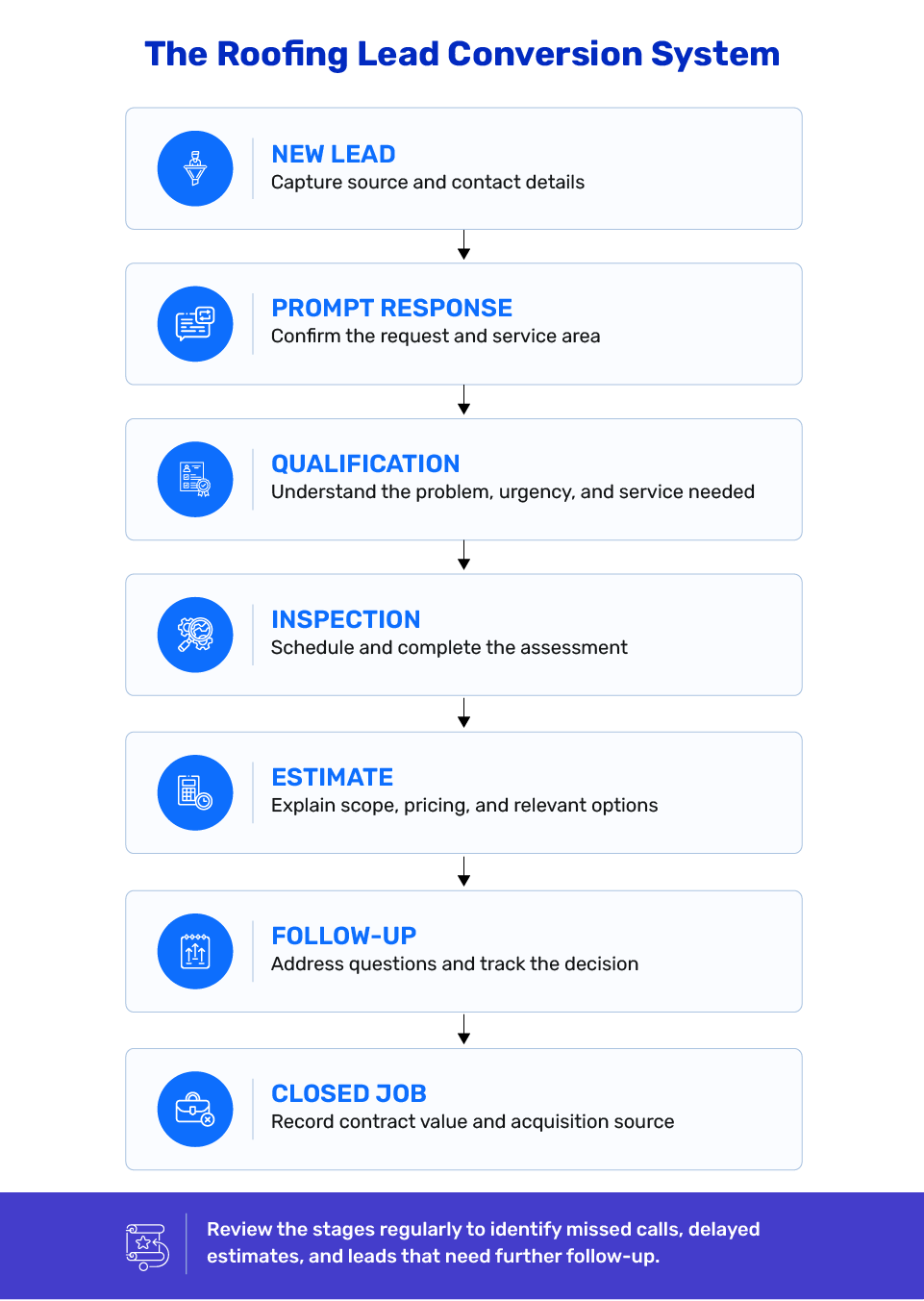
Generating inquiries is only one part of digital marketing for roofers. Effective home services marketing strategies must also include a reliable process for answering calls, responding to forms, scheduling inspections, sending estimates, and following up with prospective customers.
Picture two contractors receiving the same number of leads. The first responds when the office has time and occasionally forgets to follow up. The second routes inquiries to a responsible team member, confirms appointments, records customer requirements, and follows up on outstanding estimates. Even with similar advertising budgets, their sales outcomes may differ substantially.
“We can acquire leads and opportunities all day long, but if we’re not able to make a promise and ultimately keep that promise throughout the entire customer journey […] then everything you’re doing is garbage.”
Mark Tyner, Chief Customer Officer at Lifify
Why Does Lead Response Time Matter?
Jobber’s 2026 Home Service Trends Report6 found that more than 55% of surveyed customers expected a response within an hour or less. Its research also found that 60% of home service professionals responded to leads on the same day, while 20% responded within an hour.
These are broad home-services findings rather than roofing-only benchmarks. Still, they show why you should build prompt communication into a roofing lead-generation process.
Set up notifications for incoming calls and form submissions, assign responsibility for after-hours inquiries, and use an acknowledgment message when you can’t respond immediately.
How Can a CRM Improve Roofing Lead Management?
A customer relationship management (CRM) system helps track inquiries from their first interaction through inspection, estimate, and contract. Record lead sources, service requirements, appointment dates, estimated project value, and follow-up status.
This makes it easier to identify which channels generate profitable work and where potential customers drop out of the sales process.
How Should You Follow Up with Undecided Homeowners?
Provide the information customers need to make an informed decision. Follow up on outstanding estimates, answer questions about materials and warranties, and explain available financing where applicable.
Use permission-based email or text communications for longer-term prospects. Seasonal maintenance reminders and educational resources can keep your company visible without overwhelming homeowners with repeated sales messages.
Which Roofing Digital Marketing Metrics Should You Track?
Effective measurement connects marketing activity to qualified leads, booked estimates, signed contracts, and revenue. Tracking website traffic or ad clicks alone can’t show whether your marketing investment is producing profitable work.
Start by defining what counts as a qualified lead. For one contractor, that may be a homeowner within the service area requesting a roof replacement; for another, it may include commercial roofing opportunities above a minimum project value.
Which Metrics Reveal Marketing Performance?
| Metric | What It Tells You |
|---|---|
| Qualified leads | How many inquiries match your services and service area |
| Cost per qualified lead | How much marketing spend is required to generate a suitable prospect |
| Estimate booking rate | The share of qualified leads that schedule an inspection or estimate |
| Estimate-to-sale rate | The proportion of submitted estimates that become signed jobs |
| Customer acquisition cost | The marketing and sales cost of acquiring a customer, based on your defined cost scope |
| Revenue by channel | How much recorded revenue comes from SEO, paid search, referrals, or other sources |
| Marketing ROI | Whether the attributable return justifies the marketing investment |
How Can You Improve Underperforming Campaigns?
Connect website analytics, advertising reports, call tracking, and CRM data wherever possible. Review results by service, geography, device, and lead source to identify the points where performance weakens.
For instance, a campaign may generate many inexpensive inquiries, but few completed estimates are not successful. The problem could be irrelevant to search terms, a poorly matched landing page, limited-service coverage, or slow follow-up.
Use the findings to adjust budgets, improve landing pages, refine targeting, and strengthen sales processes. Evaluate performance over a meaningful period and account for seasonal demand, job values, and the time between initial contact and contract signing.
How Can HVAC Companies Rank Higher in Local Search?
How Should You Choose Roofing Digital Marketing Services?
The right roofing digital marketing partner should understand local search, paid acquisition, website conversion, and the operational realities of roofing businesses. Look beyond traffic growth and ask how the agency measures lead quality, booked estimates, and business outcomes.
A contractor expanding into new service areas may need a different strategy from an established company trying to improve its replacement-project pipeline. Your marketing plan should reflect your services, margins, capacity, and growth goals.
What Should You Look for in a Roofing Marketing Agency?
Evaluate prospective partners on their ability to:
- Develop a strategy around your services, locations, and ideal customers.
- Improve technical SEO, local visibility, and website conversion paths.
- Manage advertising budgets with clear reporting and conversion tracking.
- Support reputation management and credible project-based content.
- Connect marketing data with lead management and sales outcomes.
- Provide transparent reporting and preserve your ownership of accounts and data.
Ask how the agency distinguishes qualified leads from spam, tracks calls and forms, attributes revenue, and reports on work actually won.
When Should You Work with a Home Services SEO Company?
Specialist support for roofing digital marketing services can be valuable when your team lacks the time or expertise to consistently manage local SEO, technical website improvements, content development, and performance reporting.
Damco Digital helps home services businesses approach digital marketing as a connected growth system, aligning search visibility, targeted campaigns, website experience, and lead generation with measurable business objectives. The priority should be a marketing strategy that supports sustainable demand and helps turn more of the right inquiries into customers.
Conclusion
Generating more roofing leads online requires more than running advertisements or publishing occasional blog posts. This roofing digital marketing guide highlights the need for a coordinated approach that makes your business easy to find, builds homeowner trust, and provides a clear path from initial search to a booked estimate.
Start with the fundamentals: a conversion-focused website, a well-maintained business profile, useful local content, credible reviews, and campaigns aligned with customer intent. Then connect these efforts to consistent follow-up and meaningful revenue reporting.
With a clear strategy and regular performance reviews, your roofing company can build a stronger digital presence, use its marketing budget more effectively, and create a more dependable pipeline of qualified opportunities.
References
- [1]. Roofing Contractor
- [2]. Google
- [3]. Google
- [4]. Google
- [5]. Brightlocal
- [5]. Jobber