
 ChatGPT
 Claude
 Perplexity
 Gemini
Insurance agencies talk about lead generation constantly. But generating leads means nothing if they cannot be converted into signed contracts. The real question isn’t how many prospects you attract; it’s what you do with them once they show interest.
Today, B2B buyers research online, compare options digitally, and expect timely responses. The agencies that succeed use a disciplined digital strategy to gather leads and convert them. If an agency’s strategy hasn’t evolved with buyer behavior, they might leave business on the table.
This blog talks about the strategies used by top insurance agencies to turn interested prospects into loyal policyholders and improve conversions.

What Are the Challenges Healthcare Professionals Face in Building a Digital Presence?
Insurance marketing has changed dramatically in the last decade. Traditional insurance selling depended on cold calls, door-to-door visits, and printed brochures. These methods left customers feeling disengaged. The digital revolution has pushed the industry toward more interactive, customer-focused strategies.
I. The Shift in Marketing Strategies
Traditional insurance marketing used a ‘push’ model. Agents would sell policies to users without learning about their needs. This strategy led to poor conversions. It also created negative experiences for many potential customers.
Digital insurance marketing turned this model around. Instead of pushing products, insurers now pull customers in with useful content that addresses their concerns. Insurance companies publish online resources, such as guides for selecting the right coverage, clear policy explanations, or tools that estimate insurance needs.
This approach gives better results because users have already shown interest by interacting with the content. Customers who discover an insurer through meaningful content make better policyholders than those contacted through cold outreach.
II. Increased Focus on Personalization
Digital marketing in the insurance industry has transformed personalization for companies. Using traditional methods, it was hard to deliver tailored messaging to large audiences.
Digital tools now allow insurers to:
- Classify prospects using demographics and behaviors.
- Adjust content to suit specific life stages and insurance requirements.
- Create marketing strategies for various insurance products.
- Communicate targeted messages through different channels and platforms.
When personalization is done correctly, customers feel their needs are understood. They are more receptive to insurance solutions that fit their circumstances.
A Guide to Crafting a Winning Insurance Agency Marketing Strategy
What Makes Leading Insurance Marketing Agencies Stand Out?
Leading insurance agencies stand out from average ones through their use of specific strategies that get better results. They create systems that turn prospects into policyholders more effectively than standard marketing methods.
1. Deep Industry Expertise
Trusted marketing agencies know a lot more than just marketing basics. They understand every detail of different insurance domains.
This expertise shapes how these agencies communicate. They can explain complex insurance terms without using jargon. They make underwriting, risk assessments, and policy exclusions easy to understand. This skill helps customers understand their options and make better decisions.
These agencies keep up with the regulations in the insurance industry. They track changes in compliance laws for different regions and lines of business. They use this knowledge while creating marketing materials. All this helps them meet legal standards and protect client relationships.
2. Data-Driven Targeting
Insurance marketing experts find and reach potential customers through data analysis. This precise targeting improves conversion rates and reduces wasted spending.
These agencies use different data sources to create customer profiles. They study demographics, online behavior, buying history, and life events to find people most likely to buy their products.
Agencies use tools to study the entire customer journey. This helps them discover exactly where prospects drop out and fix those issues immediately. For example, if data shows people abandoning the quote form, they might fix it by making forms simpler or providing guidance at that step.
Agencies also predict future insurance needs. They monitor life events and reach consumers at the right moment with specific policies.
3. Customer-Centric Storytelling
Successful marketing agencies tell stories that put the customer first. They avoid complex policy details and explain how insurance helps people in real life. For example, they show a family how they can rebuild after a house fire, demonstrating the practical value of insurance.
Visual content strengthens these stories. Videos, infographics, and interactive tools simplify complex ideas and bring better engagement than text alone.
Leading agencies also depend on real customer experiences. These are far more effective at building trust than corporate messaging. Stories from different policyholders help prospects see themselves benefiting in similar ways.
Trusted insurers emphasize benefits rather than complex policy details. They talk about peace of mind, financial stability, and protection in their messages, addressing the core reasons behind people buying insurance.
| Key Strength | How it Benefits |
|---|---|
| Deep Industry Knowledge | Understands complex insurance products and regulations. Explains terms clearly and creates compliant marketing. |
| Data-Driven Targeting | Uses customer data to find the right people. Analyzes the customer journey to improve conversions and predicts future needs. |
| Customer-Centered Storytelling | Uses real stories and visuals to make insurance relatable. Focuses on emotional benefits, not just policy details. |
Strategies Top Insurance Marketing Experts Use to Convert Leads
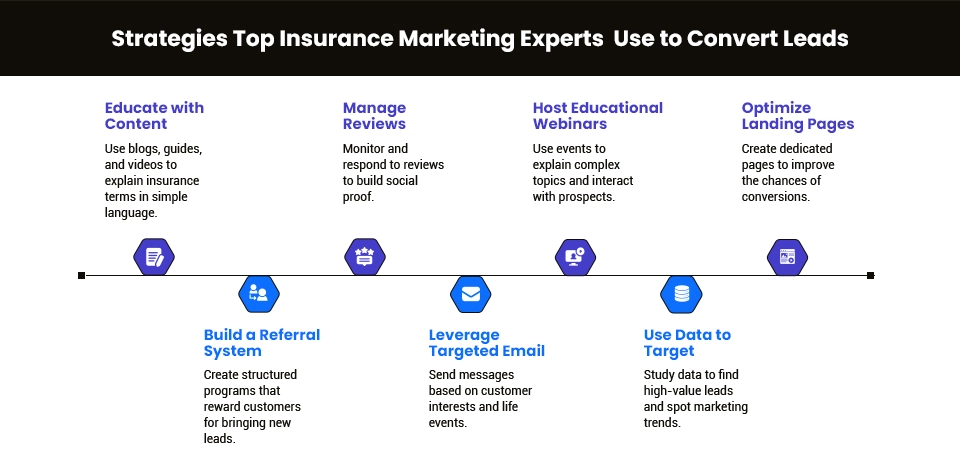
Leading insurance marketing agencies use unique approaches to convert prospects into policyholders. They don’t just generate leads. They create structured methods to guide potential customers during their buying journey.
I. Content Marketing to Boost Trust
Insurance marketing agencies use educational content to improve credibility. They create articles, guides, and resources that answer questions that their clients ask about insurance products.
Top agencies focus on making complex insurance concepts easy to understand. They create content that explains coverage options, policy limitations, and pricing in straightforward language. Clear explanations help users overcome their confusion about buying insurance products.
These experts use different content formats:
- Blog posts that describe coverage options
- Guides for life events like buying a home
- Infographics explaining insurance fundamentals
- Short videos that walk through the claims process
II. Referral Marketing to Improve Lead Quality
Referred leads convert at higher rates than other sources. Research tells us that referred customers have a 16% higher lifetime value compared to non-referred customers. For this reason, smart agencies do not depend on passive word-of-mouth. They build structured referral programs.
Successful referral programs reward both the referrer and the new prospect. Rewards might include premium discounts, gift cards, or charitable donations. These programs make sharing referrals simple. They provide digital tools that let satisfied customers refer others with little effort.
Premium agencies ask for referrals at key moments. They reach out after positive claim experiences or policy renewals when customers feel most satisfied. Such an approach significantly increases referral rates.
III. Monitoring of Online Reviews
Successful marketing agencies pay attention to what people are saying about them online. They track reviews, social media comments, and industry discussions. They respond promptly to both good and bad feedback when required.
These agencies also put positive feedback to good use. By adding customer reviews to ads, websites, and sales materials, they build trust with potential clients. After all, nothing sells better than genuine praise from satisfied customers.
These agencies also study trends in feedback and spot areas where they can do better. This helps them resolve issues before they hurt conversions.
IV. Email Campaigns to Strengthen Relationships
Expert marketers use email to build relationships, not just promote services. They group their email lists using key criteria such as policy interests, life stage, past engagement with content, and quote request status.
This grouping lets them send relevant messages that address specific needs. To give an example, after someone has requested a quote, they receive emails that talk about common customer concerns instead of generic promotions.
Effective email campaigns maintain contact with customers throughout the year, not just at renewal time. Regular communication keeps the agency in customers’ minds and positions them as a reliable resource.
V. Webinars and Live Events to Boost Selling
Agencies use webinars and virtual events to engage better with prospects and current customers. These formats help explain complex insurance products in ways static content cannot.
Many of these webinars address specific challenges or life events. For example, webinars around the essentials of life insurance or insurance considerations for new homeowners can attract an audience that is already seeking guidance.
These agencies also implement structured follow-ups after the event. They group attendees based on how they engaged (questions asked, time spent) and customize future communications. This approach converts many more prospects than generic follow-ups.
VI. Intelligent Use of Data and Analytics
Insurance marketing experts utilize AI-based data analytics in everything they do. They implement advanced analytics platforms that combine information from multiple sources. From this data, these specialists build dashboards that provide reports for underwriting, claims, marketing, and sales.
These marketers also use behavior-pattern recognition to understand customers on a deeper level. The process analyzes subtle digital behaviors rather than just basic data. To give an example, it can study how quickly a person fills out a form or what they look at on a website. The system also automatically detects major life events by noticing changes in a customer’s activity. All this knowledge helps predict what a customer might need next. Marketers can timely offer the right coverage and make their outreach more effective.
This smart use of data also helps insurance marketing experts find good quality leads more efficiently. They can also group their leads into micro-segments based on their actions, preferences, and interaction history, and tailor campaigns for each group to get better results. Companies that use AI-based tools for segmenting customers have achieved a 16% boost in policy sales.
VII. Optimized Landing Pages for Campaigns
Generic landing pages don’t deliver good results. Insurance marketing specialists understand this well. They create dedicated landing pages for different campaigns, products, and audience segments to achieve better performance.
Landing pages that bring results share many features:
- Conversion-focused layouts that guide visitors toward lead generation
- Clear value proposition that communicates benefits clearly
- Simple forms that make complex quote processes easier by breaking them into steps
These agencies use a breadcrumb approach for their lead forms. They split long questionnaires into smaller sections. Users start with simple information (e.g., zip code for home insurance) and provide more details as they move forward. This approach works because it reduces friction and increases completion rates.
Multi-Line Insurance Brokerage Experienced 53% Increase in Quote Requests After Website Redesign
The Future of Insurance Marketing
Technology is transforming how insurance companies market their services. It is changing how agencies interact with potential policyholders. Customers now expect customized experiences, and smart insurance marketing agencies will have to adjust their strategies to meet these needs.
1. Customized Solutions Using AI and Automation
88% customers demand more personalization from insurers. Artificial intelligence helps insurance marketing experts analyze large data sets and create highly customized experiences. AI systems do a lot more than simple demographic segmentation. They study behavioral patterns, life events, and risk profiles to deliver policy recommendations that closely match an individual’s needs, e.g., a user might need life insurance after marriage or home coverage after property purchase.
Automation also opens up new possibilities. Automated underwriting uses sophisticated risk assessment to deliver policy decisions quickly. The technology shortens the gap between application and approval, a stage where many potential customers lose interest.
2. NLP-Based Chatbots and Voice Search
“Call centers, websites, and mobile apps are no longer the only means of interaction with brands. Chatbots are fast becoming a business imperative for businesses that want to engage with their customers. Online chat through chatbots has grown faster than any prior channel.”
Customer service expectations are changing. People now want quick answers to their questions at any time of day. Technology is helping meet this demand through systems powered by natural language processing (NLP). NLP allows chatbots to analyze customers’ questions, understand their intent, and create nuanced responses.
To give an example, when a customer asks, “What life insurance do I need after getting married?”, the system knows this is a major life event. It then provides specific advice on coverage and not just a general answer. By 2032, the global insurance chatbot market is expected to reach $4.5 billion.
Automatic Speech Recognition (ASR) further boosts these interactions. It converts speech to text through complex algorithms and techniques. People can use their voice to get insurance quotes and compare policies. This makes information access more natural.
Voice search is also becoming important. Customers can ask questions in plain language, like “How much life insurance do I need at age 50?” instead of typing terms. This indeed is a massive opportunity. Agencies can tailor their content to answer these natural questions and easily connect with the right prospects.
3. Ethical Use of Data to Build Trust
As data collection capabilities expand, ethical handling of information becomes essential. Successful agencies stand out by being transparent about their data practice. They clearly communicate what information they collect and how they use it.
Ethical data usage means giving customers control over their information through clear consent mechanisms and simple opt-out options. Insurance marketing specialists understand that building long-term trust depends on responsible data management.
Future-centered agencies see data privacy as more than just a meeting compliance task. By demonstrating ethical data practices, they attract privacy-conscious consumers who value transparency in their financial dealings.
Conclusion
Insurance marketing has shifted from traditional cold calls and brochures to sophisticated digital strategies. Today, leading agencies use deep industry knowledge, analytical insights, and customer-centric storytelling to attract potential policyholders.
Insurance marketing agencies implement different strategies that engage customers in various ways. Content marketing explains complex products. Referral programs strengthen existing relationships. Emails and webinars guide them through the decision process. Analytics helps with tailored recommendations.
Looking ahead, the role of technology will become more important. AI-based personalization, conversational tools, and ethical data practices will continue to shape the industry. Agencies that pair technological capability with transparency and client focus will lead the market.