
 ChatGPT
 Claude
 Perplexity
 Gemini
How do you stand out in an industry where every competitor appears to offer the same low rates? The answer is not complicated, but it requires smart digital marketing that meets users where they spend a lot of their time.
Many insurance businesses still treat online marketing as an afterthought. This is a serious mistake that can lead to missed opportunities. If a homeowner searches for flood protection and your name does not appear, you lose that revenue to much more nimble competitors.
That said, digital marketing for the insurance industry faces unique challenges. You are selling something people hope they never have to use. Plus, prospects do not buy policies on a whim. They research extensively before making a decision. Consequently, the sales cycle stretches longer than most industries can tolerate. Businesses that want to overcome these issues and grow their client base can use the expertise of a reliable insurance digital marketing agency.
This blog explains digital marketing strategies that generate steady revenue for insurance businesses. SEO techniques, content strategies, and email automation can help them address the common challenges of their domain.

The Insurance Buyer Journey: What Has Changed
“Insurance business is about promises and trust. It is about delivering to the customer in times of need and if this cannot be imbibed in a professional neither him nor the industry will succeed.”
Tapan Singhel, MD & CEO at Bajaj General Insurance Limited
Customers buy policies differently now. This understandably creates a new challenge for insurance companies. They need to understand these shifts to connect with potential clients at the right moment.
I. How Insurance Customers Research and Decide
People do not follow a straight path when buying insurance. The modern insurance experience has several stages: awareness, consideration, purchase, onboarding, policy management, claims processing, and renewal. Each stage gives companies a chance to build relationships with customers.
Insurance shoppers do their homework before making decisions these days. About 47% of insurance buyers now purchase policies online. Even if people don’t buy policies online, they research on the web first. What’s more, they prefer to manage their policies through apps or portals with the same ease as ordering new products.
This research phase is, without a doubt, exhaustive. People take longer to choose. They compare features, benefits, and prices from many providers. They then request quotes, ask about specific products, and look at coverage options before making a final choice.
II. The Role of Trust Signals
People seldom buy insurance without trusting the provider first. Trust signals help them feel confident that a business is reliable and credible. These signals have become key parts of successful digital marketing for the insurance industry.
Reviews are powerful trust builders. Research tells us that most customers look at online reviews before they buy and trust them as much as personal recommendations.
These reviews build credibility in an industry where decisions depend on complex details and long-term security. They provide insights that help potential clients make critical choices, and insurers generate more leads and sales.
Other effective trust signals include:
- Industry awards and certifications
- Lists of prominent clients or recognizable publications
How Top Insurance Marketing Agencies Convert Prospects into Life-Long Customers?
III. Shorter Attention Spans and Slower Decisions
Insurers face an interesting challenge. People have shorter attention spans but take longer to make decisions. Companies need to provide valuable information consistently while people are weighing their options.
Often, complex insurance policies leave potential buyers confused. Many of them do not understand insurance terms well enough to estimate costs for different options. As a result, few users can find the right coverage that meets their needs.
People with chronic health conditions find it especially hard to compare plans. They need to study overall costs, access to providers, services, and prescriptions. These challenges make the decision process longer and might lead to higher bills or delayed care.
Companies can work with insurance digital marketing agencies to fix these concerns. They can grab user attention through various digital channels and offer the right guidance to keep people interested over time.
Digital Marketing for the Insurance Industry: Top Strategies That Drive Revenue
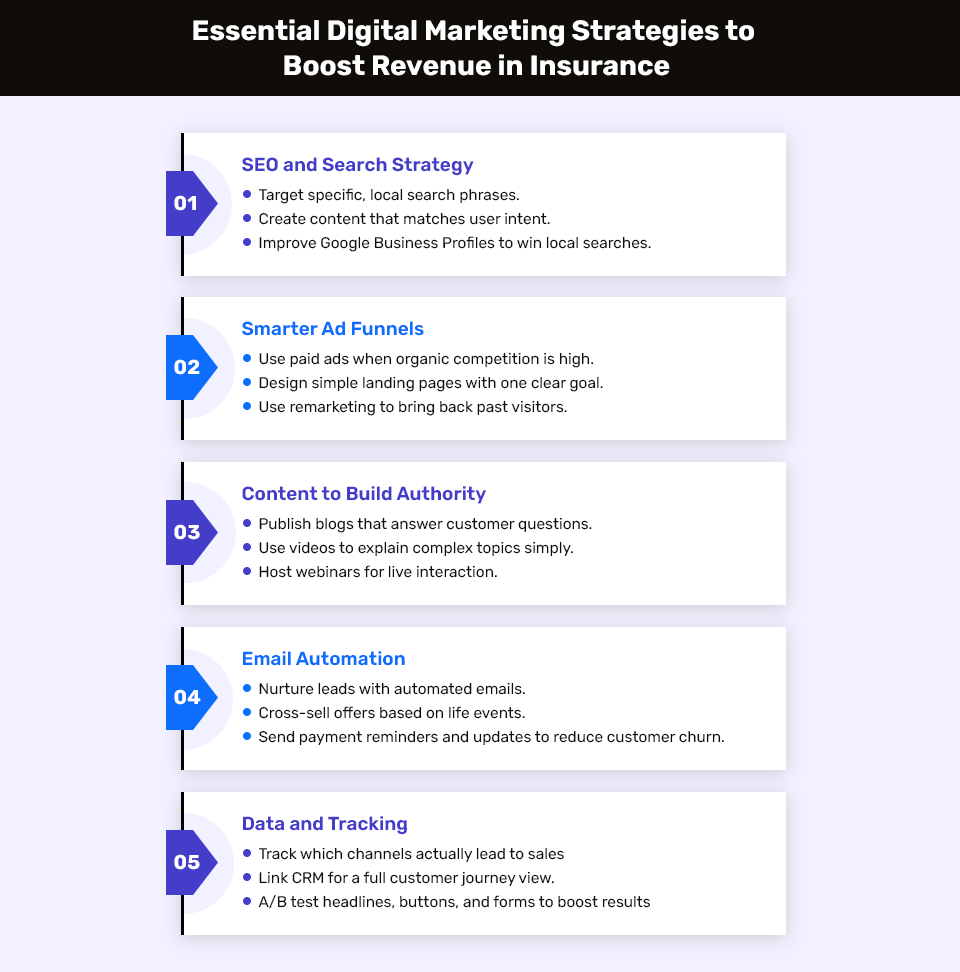
Organizations must combine the expertise of a trusted insurance marketing agency with technology to get measurable results from their digital efforts. These agencies help them spot the right prospects and provide them with relevant information.
1. SEO for Insurance Products
Success online depends on pertinent search engine optimization. Generic strategies rarely bring quality leads. Agencies build customized approaches to help insurance companies find users at key stages of their buying journey.
A. Beyond Generic Keyword Targeting
Generic terms like ‘insurance’ or ‘insurance agent’ bring high traffic but very few sales. Large companies with substantial marketing resources usually dominate these broad terms. Smaller insurers get better results when they focus on specific phrases that their competitors do not notice.
Research tells us that most searches are ‘long-tail’ queries. These are longer and more specific terms that reveal what users need. For example, a smart insurer may target phrases like ‘auto insurance companies in Bronx’ instead of just ‘insurance companies’ to reach people who are genuinely looking to buy solutions similar to theirs.
Smart keyword research also involves studying how potential clients talk about insurance needs. It examines:
- Questions that arise during client consultations
- Policy features that users ask about
- Local issues that impact coverage choices
B. Focus on Comparisons and Intent
Insurers convert more leads when their content matches users’ search habits. Prospects usually search for product or policy comparisons before making a decision. By providing these details, companies can show their expertise and attract search traffic.
Insurance-related searches usually fall into these groups:
- Informational: ‘Why do I need travel insurance?’
- Transactional: ‘Car insurance quote.’
- Commercial: ‘Best term insurance policy.’
Studies show that leads from intent-focused SEO convert much faster than regular ones. These prospects have done their homework and are prepared to buy. Capturing them becomes valuable in an industry where people take time to make purchasing decisions.
C. Local SEO for Agents and Branches
Local SEO allows smaller companies to compete with national brands. Most location-based searches lead to offline purchases. This makes local optimization a key growth opportunity.
A Google Business Profile forms the foundation of local SEO. A properly optimized profile needs:
- Consistent name, address, and phone number
- Correct business categories
- Regular updates about services
- Quick responses to customer questions and reviews
Businesses should work with insurance digital marketing agencies to create pages for specific areas. For example, a page for ‘life insurance company in Brooklyn’ that mentions local office details along with pertinent policies. These efforts improve visibility and help build a strong community presence.
2. Advertising with Smarter Funnel Design
Strategic funnel design moves people from initial interest to purchase in insurance. This approach targets users at different stages of their journey with the right messages and calls to action.
A. Paid Ads for Insurance Leads
Insurers can use paid searches to find new clients when the organic search space is too competitive. Companies with substantial marketing budgets secure quality leads at predictable costs using this method.
Costs for these ads vary by policy type. For example, home insurance leads usually cost much more than leads for two-wheeler insurance. Despite this, the potential revenue often justifies a higher price.
Social media platforms also offer good targeting options. Facebook, LinkedIn, and Instagram allow insurers to target specific groups based on their life events, such as buying a home or starting a business. Companies can reach people just when their insurance needs change.
B. Landing Pages Built for Clarity
The best landing pages focus on one goal. They do not overwhelm the visitor with choices. To keep pages effective, insurers need to follow these steps:
- Make the ‘Get a Quote’ button obvious.
- Explain what the customer gains.
- Keep the layout tidy and easy to scan.
- Ensure the page works smoothly on mobile.
Certifications, awards, and customer testimonials build trust with prospects who might otherwise hesitate to share their details. Short forms work better in most cases. Splitting questions across many pages reduces the effort needed from the user and prevents them from leaving the form incomplete.
C. Remarketing to Stay Top of Mind
A lot of people do not buy insurance on their first visit. Remarketing allows insurance companies to show ads to people who have already been on their site. This keeps them top of mind while users continue their research.
The method brings results, as brand familiarity is a powerful catalyst for sales. People prefer to buy from names they know well. Social platforms take remarketing beyond search engines, as companies can target users who have engaged with their social profiles.
Strategic remarketing also proves useful for current clients. Organizations can establish clear rules about when to remarket policies, e.g., when a policy is up for renewal or when clients’ risk profiles change.
3. Content Marketing That Builds Trust and Authority
Trust is the foundation of every insurance deal. Content marketing allows companies to prove their reliability and build their authority. They can create meaningful content to build genuine connections with potential clients long before they even ask for a quote.
A. Blog Posts That Answer Questions
Insurance organizations can establish credibility through blogging. Companies that publish quality content show they understand their markets well. Businesses that blog on a regular basis get around 55% more website visitors than those that do not. Each blog post becomes an entry point that guides readers toward insurance products.
The best blogs solve specific problems rather than offering generic information. Topics like ‘filing an auto insurance claim online’ work better than broad subjects. This approach helps insurers become partners who answer their clients’ questions at every step, and don’t just sell policies.
B. Video Explainers and Client Stories
Insurance terms can be dense and confusing. Explainer videos make complex insurance concepts easier to understand. The result? Clients feel more informed about their coverage options. They also remember information better. For example, visual content can easily explain complicated claims processes and policy activation rules.
Client testimonials help build emotional connections with users. These stories provide solid evidence that insurance delivers on its promises during a crisis.
C. Webinars and Live Q&A Sessions
Webinars allow organizations to speak to their audience in real time. These sessions let them answer questions immediately, which boosts credibility. The open format helps address objections or misconceptions that might stop sales.
Successful webinars use polls and case studies to make complex topics more relatable. They follow up with users by sending notes with a summary of the key points and a clear next step. By tracking who attends and asks questions, they measure how well their message is hitting the mark.
4. Email and Automation for Policy Growth
Email automation helps insurers boost client relationships. This approach helps them find new businesses while supporting current clients. By using automated tools, they can send the right message at the right time without much effort.
A. Lead Nurturing Before the Sale
Not every prospect is ready to buy immediately. Lead nurturing campaigns guide potential clients through their research phase. These campaigns use automation to spot prospects with high conversion potential and trigger a helpful response automatically.
Automation tools allow insurers to:
- Address leads by name and mention the specific policy they viewed.
- Keep emails short and focused on clear benefits.
- Provide useful guides, e.g., a checklist for first-time homebuyers.
B. Cross-Sell and Upsell Opportunities
A client’s needs change as their life changes. Policy anniversaries and life events create chances to sell more coverage. Automation helps spot these moments by linking email systems to client records.
This works best with context and timing. Automated systems can track life changes, such as a client buying a new home. It then alerts agents to offer property insurance. Or, if a client gets married, the system suggests life insurance upgrades. Recommendations can be given based on what the client is lacking, so that they appear helpful and not salesy.
C. Reducing Churn Through Communication
Keeping current customers is the fastest way to grow. Research tells us that just a 5% increase in retention can boost profits by 25-95%. But many insurers lose a large proportion of their clients, often due to poor communication.
Customer communication tools help solve this challenge by providing:
- Instant confirmation emails as soon as a claim is filed.
- Helpful reminders for due payments.
- Status updates that keep clients informed during a claim.
For example, a text message can be sent two weeks before a policy’s renewal date. These small steps keep the clients involved throughout the policy lifecycle and prevent them from moving to competitors.
Multi-Line Insurance Brokerage Boosts Quote Requests By 43% with Strategic Website Redesign
5. Tracking Performance and Refining Strategy
Insurance companies that want to prosper in competitive marketplaces need to base their decisions on solid data. They can achieve constant growth by using tracking systems that allow them to see what works and where they are wasting money.
A. Attribution Modeling for Insurance Leads
People engage with an insurance company in several ways before buying their product. They might see a Facebook ad, visit their website many times, read blog posts, and make a call after getting an email. So, which interaction influenced their purchase the most?
Attribution modeling helps here by ascribing credit to the right marketing steps. It shows which actions resulted in a sale. This technique allows businesses to measure ROI accurately.
Different models provide different views:
- First-Touch: Crediting the first interaction that brought the prospect.
- Last-Touch: Giving credit to the final interaction.
- Multi-Touch: Spreading the credit across every step of the journey.
B. CRM Integration for Full Visibility
Connecting marketing tools with CRM systems provides a complete picture of every client. This integration helps with seamless lead nurturing. For example, a user browsing home insurance pages might get an email with a guide on storm preparation. This keeps them interested without much manual effort.
CRM integration also allows insurance professionals to track leads across many channels. No lead slips through the cracks. Small teams can run high-volume campaigns because of this efficiency.
C. A/B Testing to Improve Results
A/B testing compares two versions of a content piece to test which performs better. Users see these versions randomly, and marketers study the results to find the winner. Even small changes in pages or email copies can bring remarkable improvements in revenue.
Insurance companies should test key elements, including:
- Headlines and subject lines
- Call-to-action buttons and their placement
- Form length and design
| Strategy | Key Steps | Advantage |
|---|---|---|
| High-Intent SEO | Target long-tail phrases and local search terms. | Reaches buyers ready to make a purchase. |
| Smart Ad Funnels | Use life-event targeting and clear landing pages. | Reduces cost per lead. |
| Authority Content | Create explainer videos and problem-solving blogs. | Builds trust before a sale happens. |
| Email Automation | Send personalized reminders and offers. | Increases retention and cross-selling. |
| Data and Tracking | Use CRM integration and A/B testing. | Shows where to spend money. |
Conclusion
Insurance marketing has fundamentally changed. Cold calls and newspaper ads do not work anymore. Today, prospects research online, compare options across multiple devices, and expect personalized experiences in their journey.
Insurers thriving in this age follow a different set of rules. They focus on more specific keywords that attract people who are ready to buy. They build trust through meaningful content. They use automation to stay connected during long decision cycles.
Companies that work closely with insurance marketing agencies and embrace these strategies position themselves for immediate sales, along with long-term growth. Businesses that adapt quickly will gain the biggest market share as consumer behavior keeps changing.