
Think about the last time your schedule was fully booked? Your patients likely didn’t find you just by calling the first clinic they saw. They probably searched for their symptoms online, compared you with other local specialists, and scrolled through every review they could find.
This is the new normal in healthcare. Patients do not just show up anymore. Before making a decision, many of them carry out thorough research to weigh their options. A positive online reputation influences which physician they might end up choosing. Traditional marketing methods fall short in such a scenario.
Digital marketing agencies in healthcare help bridge this critical gap. They offer specialized services that connect your healthcare organization with patients browsing the online space. They ensure a patient discovers you easily when looking for “pediatricians near me” or “treatment for knee pain,” and what they find builds trust. Their expertise turns a quiet office into a growing practice where patients find the care they need, and you get the growth you deserve.

How Patient Behavior Has Changed in the Digital Age
The modern healthcare consumer looks nothing like patients from the past. Technology and easy access to information have changed patients who now make active choices about their healthcare experience.
I. Patients Research Providers First
A decade ago, the doctor’s word was final. That blind trust is now gone. Today, patients research providers’ details online before booking an appointment. They check medical licenses, verify board certifications, and make sure their insurance is accepted.
Review platforms like Healthgrades and RateMD play a big role in this process. Patients usually turn to these sites to learn what others have experienced. Yet, reviews are not the only deciding factor. Patients also look at the provider’s qualifications, expertise, and educational background.
II. Digital Expectations Shaped by Other Industries
Experiences in other industry verticals have changed expectations. Patients now demand convenience. Users who can move thousands of dollars or book a flight with a thumb-tap expect their healthcare to be just as frictionless.
The change to digital has set new standards for ease and availability. Many patients prefer to use digital channels for their primary interactions. They use phones to check provider details and find their location.
Mobile health apps have also become ubiquitous. These apps help users track their health, handle ongoing conditions, and get healthcare services. Users can also share this data with providers and get more control over their medical information.
III. Why Traditional Marketing Methods Fail
The old ways of healthcare marketing have become painfully ineffective with today’s healthcare consumers. Many outdated approaches don’t recognize that patients have become informed consumers.
Healthcare organizations may drive patients away when they use medical jargon or criticize their behaviors. Brands that show empathy, offer real help, and use everyday language to gain trust are usually more successful in attracting patients.
Digital tools have changed how patients evaluate their healthcare providers. Online feedback often creates the first impression for potential patients before they even book an appointment. Ignoring these reviews can hurt a provider’s reputation.
Success in this new digital world requires healthcare organizations to create marketing campaigns that fit well with patient behavior. They need to understand both healthcare regulations and what patients expect. And this is where healthcare digital marketing firms show their value.
How Healthcare Providers Earn Patient Trust and Grow Their Practice with Reliable Digital Marketing Experts
Core Services Offered by a Healthcare Digital Marketing Firm
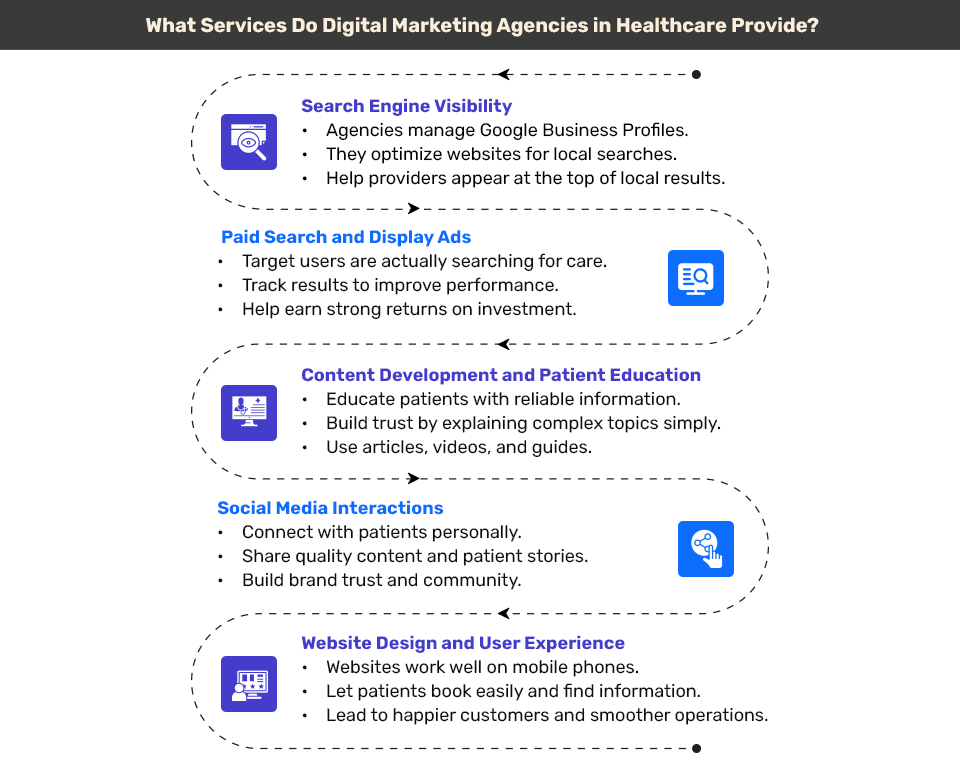
Healthcare digital marketing agencies help medical practitioners connect with users who need care. Healthcare digital marketing agencies help medical practitioners connect with users who need care. They provide customized solutions that follow the regulations of the healthcare industry and help doctors remain visible in an immensely crowded market.
1. Search Engine Visibility and Local SEO
Digital marketing services for healthcare make practitioners more visible through local search. Nearly 46% of individuals today use Google to find new doctors. This makes search optimization a vital part of the marketing strategy.
Agencies manage Google Business Profiles. They help keep providers’ information accurate and respond to patient reviews to build trust. These experts also refine their website’s content and add location-specific phrases. They also create separate pages for different office branches. All this allows providers to appear at the top of search results for medical services in specific areas.
Agencies also use schema markup that helps search engines understand the services a clinic provides.
2. Paid Search and Display Advertising
Paid search advertising brings traffic to healthcare websites through sponsored ads. Billions of health-related searches happen daily. Healthcare advertising agencies create and manage pay-per-click campaigns to put providers in front of users who need care. They bid on key phrases to assist them in ranking higher in search engines.
These campaigns are cost-effective because they target users searching for specific healthcare services. Businesses earn a strong return on their investment. Agencies also track the results and watch for clicks and conversions to improve performance.
3. Content Development and Patient Education
People search for answers related to health issues every day. This shows how much they crave reliable medical information. Content marketing helps healthcare organizations educate and reach patients. Providers use well-crafted content to become trusted resources while addressing patient concerns.
Healthcare content marketing builds trust and relationships through valuable communication. Agencies write articles about various diseases and their treatments. They create videos showing procedures and produce guides that help patients understand their health conditions. By explaining complex medical terms in simple language, providers build good relationships with their patients.
4. Social Media Engagement and Brand Trust
Social media gives healthcare organizations a way to connect with patients on a personal level. Research tells us that 52% of Americans try health trends they find on social media. Healthcare brands can use these channels to educate their audience and grow their reach through regular posts.
Healthcare digital marketing firms handle these social platforms. They help providers build trust by posting quality content and engaging with users. They leverage patient stories and polls to create meaningful connections and spread the brand’s message.
5. Website Design and User Experience
“Your healthcare facility’s brand is its reputation. That starts with a modern, clean logo, and website that reflect the quality of service your team provides.”
David Sanchez, CEO of Digitalis Medical
A website often gives patients their first impression of a doctor. Marketing agencies create websites that are easy to use on phones and work smoothly. This matters because most mobile searches result in bookings within an hour.
Agencies work on improving a website’s user experience. Patients can find information without trouble. They can check their medical records and understand treatments easily. They can also book appointments with little effort. All this leads to happier customers and a smoother healthcare business.
How Agencies Use Data and Analytics to Improve Patient Acquisition
Data helps healthcare providers find and keep patients. They can employ advanced analytics to spot potential patients, use resources properly, and measure their marketing success with precision.
I. Building Detailed Patient Profiles
Information collected directly from patients becomes a critical resource for healthcare marketing. Providers gather this data through medical records, appointment history, and feedback surveys. Agencies help them use this information to create detailed patient profiles and understand their needs and behaviors.
Healthcare brands can send better-targeted messages with this approach. They can create content for specific age groups and health interests instead of sending the same health tips to everyone. For example, they can send lifestyle advice to a diabetic patient. Or they can send reminders to a young family about children’s vaccines.
II. Predicting Future Patient Needs
Predictive analytics uses past patterns to forecast future results. This gives healthcare marketers a powerful tool to anticipate patient needs. They can study patients’ age, past visits, and circumstances to identify which candidates are likely to need specific services.
Advanced analysis further helps healthcare organizations:
- Decide where to put resources for growth
- Prepare for seasonal rushes, like flu season
- Find patients who might skip appointments
This allows providers to grow without wasting money on broad campaigns that deliver unsatisfactory returns.
III. Measuring Marketing Success Across Channels
Healthcare providers need to track numbers across all platforms to achieve steady growth. Digital marketing services for healthcare keep a watch on these key metrics to help them do so:
- Acquisition Cost: How much do they spend to get one new patient to their clinic?
- Patient Lifetime Value: What is the total revenue a patient brings in over the years?
- Conversion Rates: How many people who see their website actually book an appointment?
Agencies regularly track and study many such metrics to prevent money from being wasted on methods that don’t work. They can use marketing budgets wisely and help providers earn measurable returns.
Life and Health Insurance Provider Increased User Engagement and Conversions with Strategic Website Redesign
How Agencies Employ Technology to Propel Patient Growth
Strong technology powers successful healthcare digital marketing strategies. The right tools create a system that helps acquire and retain patients while following strict compliance standards.
1. Role of CRM Systems
Healthcare Customer Relationship Management systems organize patient interactions. These platforms combine multiple data sources to build a complete picture of every patient. This helps providers acquire and retain patients throughout their healthcare experience.
Healthcare CRMs provide many benefits. They create a central hub for consumer and patient data that integrates with healthcare technologies. They build comprehensive patient profiles by combining information from electronic medical records and contact centers. They also track the money earned through various marketing channels.
2. Marketing Automation for Lead Nurturing
Marketing automation tools have changed how healthcare organizations stay connected with potential and existing patients. These systems send helpful information at the right moment and ensure timely engagement without adding work for the front-desk staff.
Automated systems handle each stage of the patient’s experience. They send customized appointment reminders and share tailored wellness tips. These platforms also manage pre-treatment instructions, which help patients prepare for procedures weeks in advance.
After the patient visits, these systems focus on patient education and share guides to help patients recover better. This constant communication builds trust and loyalty that drives business growth.
3. Tools for Secure Communication
Healthcare’s strict regulations demand communication tools with high security standards. Tools that comply with HIPAA protect patient information through data encryption, access controls, and digital trails for messages sent.
Secure patient communication platforms:
- Show the clinic’s numbers instead of doctors’ personal contact details
- Keep patient details private while allowing providers to email health tips and newsletters
- Allow patients to text quick questions and receive fast answers
These specialized tools remove the trepidation associated with digital healthcare. When patients know their data is safe, they are much more likely to engage with healthcare services.
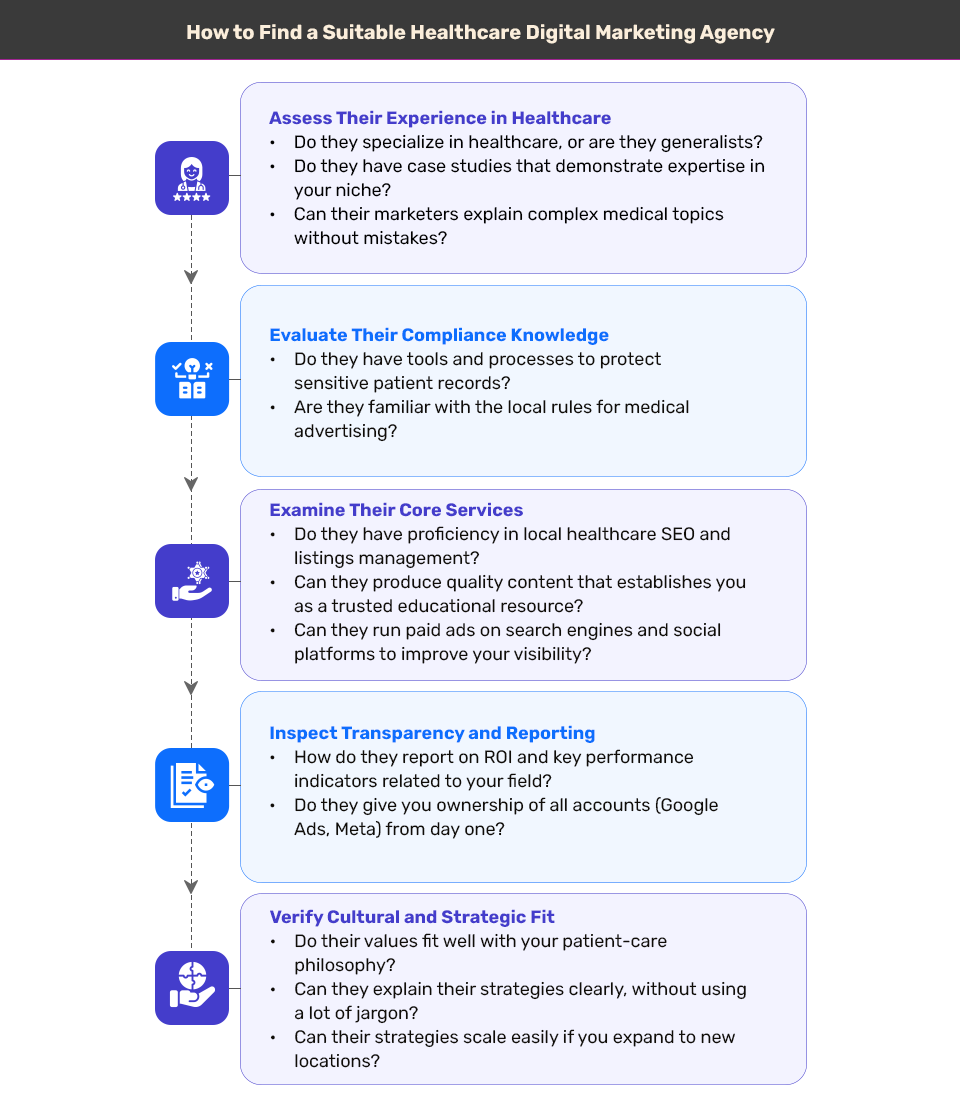
How Marketing Firms in Healthcare Focus on Long-Term Growth
Healthcare digital marketing agencies aim to create growth models that work beyond short-term metrics. Their strategies keep marketing plans aligned with broader healthcare goals to create lasting success.
I. Aligning Marketing and Care Delivery Goals
Trusted healthcare advertising agencies ensure that marketing goals match the core objectives of the provider. They use frameworks to make decisions that allow providers to find new patients while following the regulations of the healthcare industry. Their marketing plans boost patient satisfaction and deepen trust through authentic messages that reflect the actual experience inside the clinic. When marketing becomes an inseparable part of care delivery, success follows.
II. Balancing New and Current Patients
Finding a new patient is expensive, and smart healthcare organizations understand this well. Getting a new patient costs around five times more than keeping an existing one. Current patients are also much more likely to return for future care. By contrast, patients choose a new provider far less often.
Because of this, agencies create a balanced budget. They don’t just try to attract new patients. They also invest in keeping the patients they have. All this keeps a provider afloat during slow months.
III. Using Live Data to Improve Campaigns
Optimization in real time is integral to success in healthcare marketing. Historically, campaigns used delayed performance reports. That approach led to wasted spending and outdated changes. Modern healthcare advertising agencies use impression-level optimization that works within milliseconds. Each impression gets a score based on its predicted effect on healthcare outcomes. This creates a feedback loop, where campaigns are adjusted instantly. More money is spent on promising leads. This makes every dollar in the marketing budget count.
Conclusion
Modern healthcare cannot succeed without digital marketing. Today’s patients expect the same online experience from healthcare providers as they get from other services. Medical organizations need experts who understand both healthcare rules and online promotion strategies.
Successful healthcare providers grow through balance. They combine search rankings, ads, and meaningful content with genuine social media engagement. With the assistance of healthcare digital marketing agencies, they constantly track important metrics to guide their future actions. This approach brings steady growth that attracts new patients and promotes strong relationships with current ones. Organizations that follow this path are better equipped to flourish in the digital world.