
 ChatGPT
 Claude
 Perplexity
 Gemini
Key Takeaways:
- Solar marketing strategies should focus on profitable customer acquisition, not simply generating more leads.
- SEO, paid media, content, and local search should work together across the customer journey.
- Solar companies can build trust by providing clear information on pricing, financing, warranties, equipment, and installation timelines.
- Measure marketing performance through qualified leads, conversion rates, CAC, revenue, gross margin, and customer lifetime value.
- AI can help identify high-intent prospects, improve personalization, and uncover conversion opportunities rather than simply producing more content.
- Post-installation engagement can create additional revenue through batteries, EV charging, referrals, and repeat services.

A solar company’s marketing dashboard can look healthy even as its economics weaken. Website traffic is rising, paid campaigns are generating leads, and the sales pipeline is growing. Yet the CFO may still be asking a more important question: How much does it cost to turn that demand into a profitable customer?
That question matters more as the solar market matures. Global solar deployment remains strong, while individual markets grow more competitive, and policy conditions shift. In the US, for example, residential solar installations fell 2% in 2025 to 4,647 MWdc, while commercial solar grew 6% to 2,345 MWdc.1
For solar companies, this makes marketing less about generating the most leads and more about acquiring the right customers at an acceptable cost.
That shift should shape every part of solar marketing guides, from SEO and paid media to content, customer experience, and post-installation engagement.
Why Is Solar Marketing Becoming More Difficult?
Solar is no longer an unfamiliar category that needs extensive market education. Many customers already understand the basic proposition. They know solar can reduce electricity costs and may already be comparing installers, financing options, equipment, and battery systems.
The challenge is now differentiation and trust.
A 2025 Smart Energy Consumer Collaborative survey found that half of US homeowners had already taken an action to explore solar, such as researching online or requesting an installer quote. Among homeowners considering rooftop solar, 59% cited saving money on electricity as a key motivation, while reliability, environmental benefits, and home value also influenced decisions.2
That means solar marketing strategies increasingly have to do more than explain why solar matters. They must help homeowners decide which provider to trust, which offer to choose, and whether the promised economics hold up. Trust matters most in a market where financing, installation quality, warranties, and long-term savings can vary significantly between providers.
Lead volume is no longer enough.
Consider two installers. One generates 1,500 leads in a quarter and closes 3% of them. Another generates 700 leads but closes 9%. If the second company also wins larger projects and spends less sales time on unqualified prospects, its smaller pipeline may produce substantially better economics.
That is why leadership should track the entire acquisition journey:
| Metric | What It Tells the C-Suite |
|---|---|
| Qualified Leads | Whether marketing is reaching the right prospects |
| Opportunity Rate | Whether prospects have genuine commercial potential |
| Close Rate | How efficiently demand becomes customers |
| CAC | What it costs to acquire a customer |
| Gross Margin | Whether growth is profitable |
| Customer LTV | How much value the relationship can generate |
Marketing should ultimately be measured by revenue and margin, not traffic or lead volume alone.
What Do Solar Buyers Need Before They Commit?
A solar purchase combines a technology decision, a financial decision, and a long-term service relationship. Customers want to know what the system will cost, how much it may save, what financing is available, which equipment will be installed, and what happens if something goes wrong.
That makes transparency a marketing asset.
Solar companies can respond by bringing more of this information into marketing experience. Rather than asking prospects to wait for a salesperson to explain everything, websites can provide pricing guidance, financing explanations, savings assumptions, installation timelines, warranty information, and system visualizations.
Trust Needs Evidence
Trust matters because customers are choosing an installer for a significant investment that may remain on their property for decades.
Customer reviews help, but they are only one part of the evidence. Detailed project case studies, installation photographs, warranty information, technical credentials, and clear service commitments can help customers evaluate the company before they request a proposal.
This is also where storytelling becomes useful. A homeowner is more likely to understand a solar system’s relevance when they can see how a similar customer approached the decision, what system was installed, and what happened afterward.
The strongest solar content therefore combines evidence with context. Facts establish credibility; customer stories make those facts easier to understand.
How Home Service Businesses Can Win with Local SEO in 2026
Which Digital Channels Should Solar Companies Prioritize?
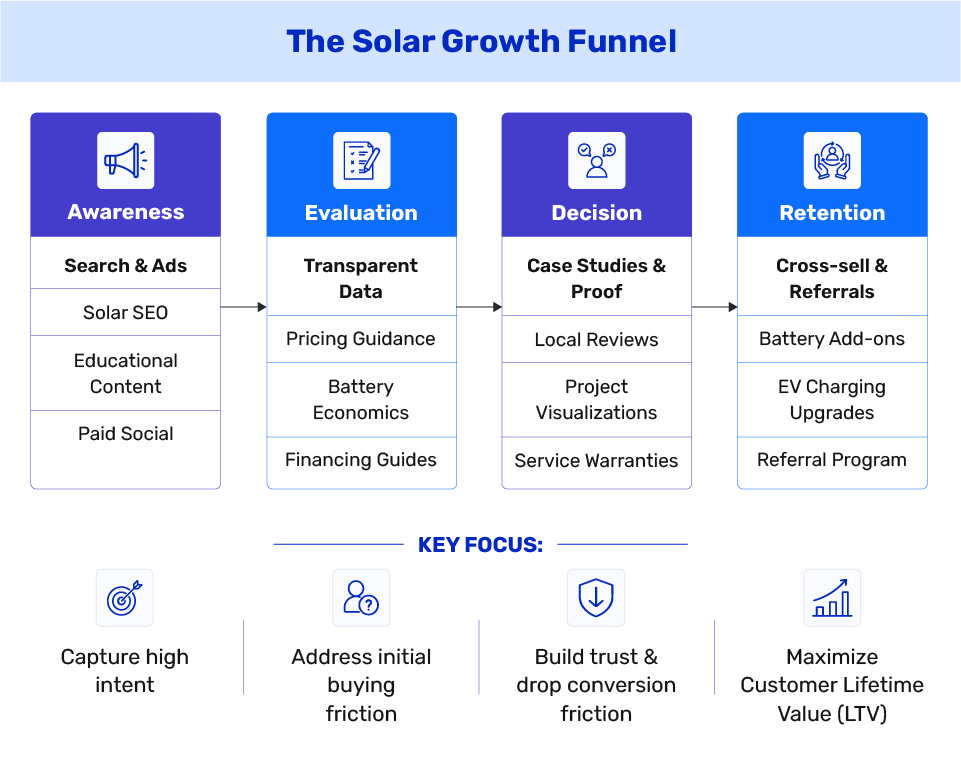
A modern solar digital marketing program should not treat SEO, paid media, content, and the website as separate activities. They work at different points in the same buying journey.
Effective solar marketing strategies should not be evaluated by channel metrics alone. Each channel has a different role in the customer journey, so leadership should connect marketing activity to qualified demand, acquisition cost, revenue, and customer value.
| Solar Marketing Channel | Primary Role | What to Measure | Business Outcome |
|---|---|---|---|
| Solar SEO | Capture high-intent organic demand | Organic leads, qualified lead rate, conversions | Lower long-term acquisition costs |
| Local SEO | Reach customers searching for nearby installers | Local visibility, calls, quote requests | More qualified local opportunities |
| Content Marketing | Answer questions and build trust | Engagement, assisted conversions, lead quality | Faster purchase decisions |
| Paid Search | Capture immediate buying intent | CAC, conversion rate, opportunity rate | Faster pipeline generation |
| Paid Social | Build awareness and nurture demand | Lead quality, engagement, assisted conversions | Broader customer reach |
| Email and Remarketing | Re-engage prospects who are not ready to buy | Conversion rate, revenue per lead | Higher conversion efficiency |
| Referral Marketing | Turn satisfied customers into advocates | Referral rate, referral revenue | Lower-cost customer acquisition |
Solar SEO Should Capture Buying Intent
Search remains valuable because customers often begin with specific questions. They may search for solar installation, then move to cost, financing, battery storage, and local installers.
This creates several solar SEO opportunities.
Local pages can capture customers looking for installers in specific markets. Commercial-intent pages can address installation costs, financing, batteries, and warranties. Educational content can answer questions that customers have before they are ready to request a quote.
For SEO for solar companies, the goal should therefore be commercial visibility rather than traffic for its own sake.
The same principle applies to home services SEO. Solar increasingly intersects with roofing, EV charging, electrical upgrades, batteries, and other home-energy services. Companies that can address these connected needs can capture a broader part of the customer journey.
Content Should Answer Sales Questions
The sales team is often the best source for a solar content strategy.
If prospects repeatedly ask whether batteries are worthwhile, create content explaining battery economics. If financing confuses, build a detailed financing guide. If customers question installation timelines, explain the process.
This approach makes content useful to both search engines and sales teams because it addresses genuine customer concerns rather than producing articles simply to fill an editorial calendar.
Paid Media Needs Downstream Measurement
Paid search can capture customers with strong existing intent. Paid social can introduce solar to potential customers earlier in the decision process. Neither should be judged solely on cost per lead.
A channel that generates fewer but better-qualified opportunities can be more valuable than one producing large numbers of inexpensive leads.
Agencies offering solar SEO services should be assessed on qualified opportunities, customer acquisition cost, and revenue, not simply lead volume.
How Is AI Changing Solar Digital Marketing?
AI is changing both sides of the marketing equation.
Customers can increasingly use AI tools to research solar financing, compare technologies, understand battery storage, and evaluate installers. That means companies need to make their expertise easy to discover and verify across a wider range of digital experiences.
At the same time, AI can improve the marketing and sales process itself.
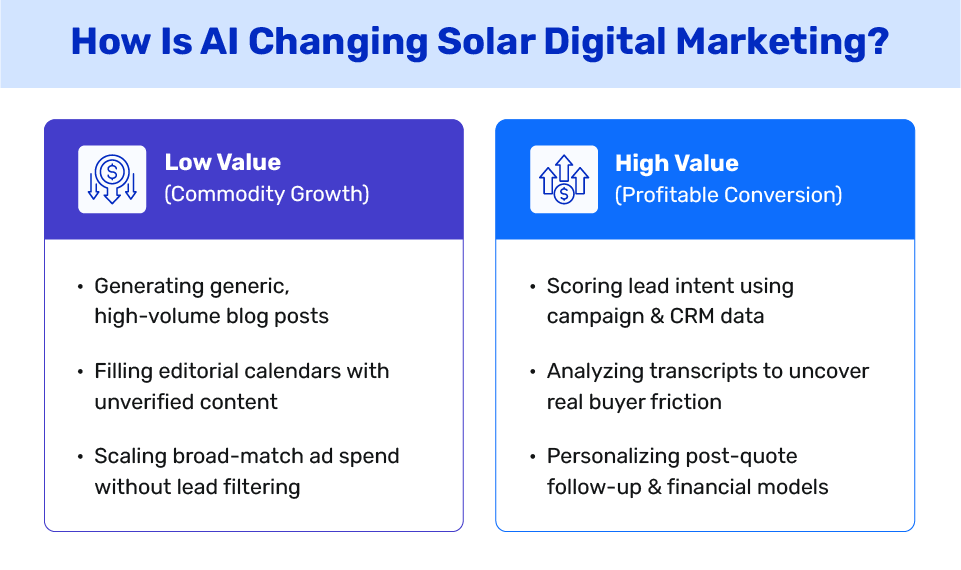
Companies can use it to identify high-intent leads, analyze customer questions, summarise sales conversations, personalize follow-ups, and identify patterns across campaign and CRM data.
The important distinction is between using AI to produce more marketing activity and using it to improve commercial performance. As Microsoft CEO Satya Nadella noted:
“AI is the defining technology of our times. It’s augmenting human ingenuity and helping us solve some of society’s most pressing challenges.”
Satya Nadella, CEO, Microsoft
Generating another hundred generic solar articles may add little value. Identifying which questions prevent customers from converting can measurably affect revenue.
For executives, the more useful question is therefore: Where can AI reduce acquisition costs, improve conversion, or increase customer value?
Why Should Solar Companies Look Beyond the Initial Installation?
The customer relationship does not have to end when the panels are installed.
An existing customer may later need battery storage, EV charging, energy management, or other electrification services. They can also generate referrals and reviews.
Battery storage is becoming particularly important. The IEA’s 2025 analysis identified battery storage as the fastest-growing power technology, with global additions reaching 108 GW in 2025.3
For solar companies, this creates a broader opportunity. Instead of marketing a single product, they can develop an ongoing relationship around the customer’s energy needs.
“Don’t sell the thing. Show the future. One that your customers want to live in.”
John Hegarty, Co-founder & Creative Director at The Business of Creativity
The installed base can reduce acquisition pressure.
A satisfied customer can become a source of future demand through referrals. They may also be more receptive to additional products because the company already understands their property and energy requirements.
This makes customer experience part of the acquisition strategy.
A company that delivers a strong installation, communicates clearly, and provides responsive support is more likely to generate positive reviews and recommendations.
The commercial implication is significant: marketing does not necessarily end at conversion.
What Should the C-Suite Measure in 2026?
The executive dashboard should connect marketing investment to customer economics.
Marketing investment → Qualified demand → Sales opportunities → Contracts → Installed revenue → Gross margin → Customer lifetime value → Referrals + additional services
The most important metrics are therefore not simply impressions, clicks, or leads. Leadership should know which channels produce qualified opportunities, what those customers cost to acquire, how much revenue they generate, and whether they create additional value after installation.
This also makes it easier to decide where to increase or reduce investment.
A channel with a high cost per lead may be highly profitable if those leads close at a strong rate. Conversely, a low-cost lead source can destroy efficiency if sales spend significant time pursuing prospects who never become customers.
The objective is to allocate marketing capital based on customer economics.
How Healthcare Marketing Can Drive Sustainable Patient Growth
The Next Advantage in Solar Marketing Is Profitable Customer Acquisition
Solar demand remains substantial. With average residential systems running $2.75 to $3.34 per watt installed (per NREL and SEIA data), most projects quickly exceed $20,000. Because of that investment, homeowners spend weeks researching, comparing three or four quotes, and vetting financing options before signing.4
The challenge for individual companies is capturing enough of that demand at an acceptable cost.
That requires a more integrated approach to solar marketing. SEO needs to capture high-intent demand. Content needs to answer the questions that delay purchase decisions. Paid media needs to be evaluated against downstream revenue. Websites need to make complex financial and technical information easier to understand. AI needs to improve decision-making, not simply increase content volume.
Most importantly, marketing needs to remain connected to what happens after the sale.
The companies best positioned for the next phase of solar growth will be those that can acquire the right customers, earn their trust, deliver on their promises, and build enough value into the relationship to generate referrals and additional business.
That is the real purpose of a modern solar marketing guide and effective home services marketing strategies: not simply to generate more leads, but to build a repeatable path from market demand to profitable, long-term customer relationships.