
 ChatGPT
 Claude
 Perplexity
 Gemini
The volume of online health searches is staggering. Billions of health-related queries are run on Google every day. This behavior is now fundamental to patient decision-making. Most people look for new providers online, and many even dismiss a practitioner without a proper website. This makes a strong digital marketing strategy essential for healthcare providers. It allows them to find patients where they spend the most time: online. Without a robust digital presence, providers risk becoming invisible to the patients they aim to serve.
This blog explains the challenges and opportunities that healthcare professionals face as they build their presence in today’s digital world. Let’s get started.

What Are the Challenges Healthcare Professionals Face in Building a Digital Presence?
Healthcare professionals face many challenges as they try to build an effective online presence. Despite rising digital marketing budgets, many providers still find it hard to make their mark online.
1. Limited Awareness of Digital Channels
Healthcare organizations often lag in adopting new digital channels. This gap exists because of challenges specific to healthcare.
The primary obstacle is time. Patient care leaves little room for professionals to explore new technologies. This is compounded by a flood of digital content. Many providers feel overwhelmed by the sheer volume of information available online. This noise makes it difficult to identify which tools could help their practice.
Most providers view digital participation as extra work, rather than a way to streamline operations. The benefits are often lost in the daily grind.
2. Fragmented Digital Strategies
Digital initiatives are often rolled out in a scattered manner across healthcare systems. This creates an inconsistent experience for patients and weakens the provider’s online presence.
Technical barriers prevent the development of unified digital strategies. Patients frequently find conflicting information about the same provider across different websites, directories, and other online platforms. This inconsistency confuses patients and damages trust. It also reduces the impact of providers’ digital presence.
3. High Competition
Healthcare providers face intense competition in local markets. Many have websites that do not appear in the top search results, resulting in less visibility and fewer patient acquisitions. This situation has become worse as global telehealth platforms with substantial marketing resources enter these markets.
At the same time, marketing budgets for many healthcare organizations have decreased while the average cost per lead has increased. These financial constraints make it difficult for smaller and independent healthcare providers to build and maintain an effective digital presence.
5 Digital Marketing Strategies Every Healthcare Provider Should Adopt
How Can Digital Marketing Improve Patient Acquisition and Retention?
Digital marketing in the healthcare industry attracts new patients and builds lasting relationships with existing ones. Research tells us that 77% of patients perform online research before booking appointments. This makes a strong digital presence essential for providers aiming to grow their practice.
I. Search Engine Visibility
Hospital websites receive three times more visitors from search engines compared to other sources. For this reason, healthcare providers must make SEO integral to their digital strategy. Without it, they risk being invisible to patients searching for care.
Local search optimization delivers exceptional value to providers with physical locations. A well-optimized Google Business Profile forms the foundation of this effort. Healthcare professionals should ensure their profiles contain correct practice details, facility photos, and properly managed patient reviews.
Local keyword optimization is also important. Healthcare providers should include location-based terms in their website’s content. This allows them to be found by patients searching in specific locations.
II. Patient Engagement and Education
Educational content establishes healthcare providers as authority figures while boosting search rankings. McKinsey notes that 75% of people read health-related content at least once weekly. Quality content meets this need and builds trust.
Video marketing has shown strong results in healthcare engagement. Landing pages that feature video can boost conversions significantly. Healthcare benefits from video content through:
- Patient testimonials that create a sense of trust and connection
- Procedure explanations that simplify complex topics
- Webinars that showcase clinical expertise
- Educational series that talks about common health concerns
Social media presence can impact treatment decisions. Many consumers consider a provider’s social media activity when selecting care. Valuable posts on these platforms support patient relationships and improve online visibility.
III. Personalized Patient Communication
Personalized communication strengthens patient relationships. Patients respond better to messages that reflect their individual needs and history. The approach boosts patient engagement significantly, leading to improved health outcomes and stronger retention.
Healthcare marketers should group their audiences based on demographics, behaviors, and health conditions. With this classification, they can deliver messages that suit specific patient groups. This relevance drives better engagement and conversion rates.
A CRM system supports this process by organizing patient data. Marketers create detailed patient profiles using this data. They deliver communication that matches each patient’s specific situation.
Automation tools help manage personalized outreach. Providers can send timely messages without burdening their staff. The result? Clearer patient communication. Improved appointment adherence. Stronger loyalty.
| Strategy | Action | Benefit |
|---|---|---|
| Search Engine Visibility | Optimize for local search and maintain a complete Google Business Profile. | Be found by patients who are searching for care in an area. |
| Patient Engagement | Create educational content and use videos to explain procedures and build trust. | Build authority and connect with patients, influencing their decisions. |
| Personalized Communication | Use patient data to send relevant messages and reminders. | Boost relationships, improve appointment attendance, and increase loyalty. |
Which Digital Marketing Strategies Drive the Most Impact in Healthcare?
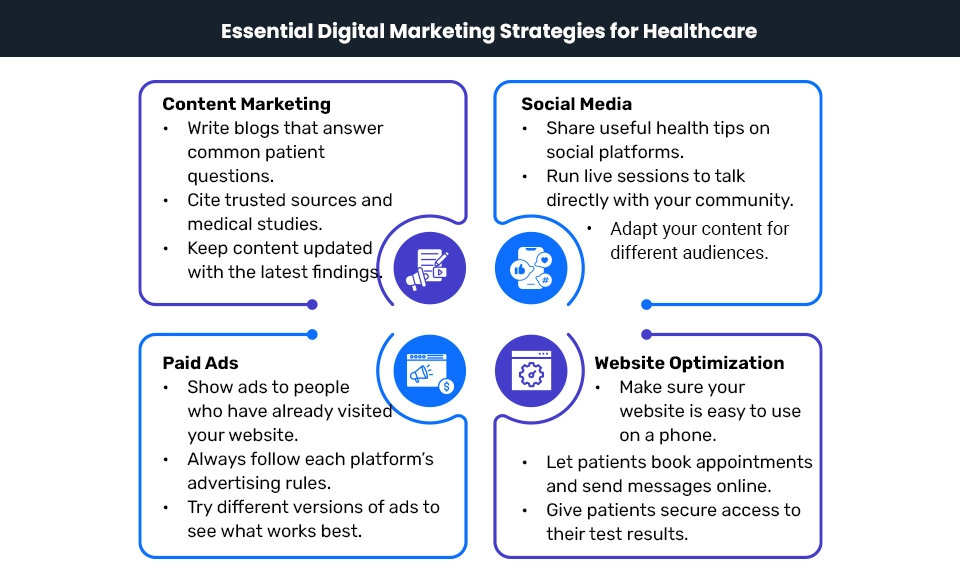
In digital marketing for healthcare, some methods deliver better results than others. These four strategies stand out and produce exceptional results when teams implement them properly.
1. Content Marketing as a Clinical Authority Tool
Content marketing enables healthcare providers to establish themselves as trusted authorities in their respective fields. Quality healthcare content should reference reputable studies and research to strengthen its credibility. Healthcare websites with expert-written articles that answer common patient questions show commitment to education and patient empowerment.
Most people search for health information online today. They trust content from qualified experts and are wary of non-expert sources. To maintain this trust, healthcare providers should keep their content updated based on the latest findings and guidelines.
2. Social Media Engagement for Patient-Centric Care
Social platforms have changed how healthcare providers connect with patients. These channels allow direct communication with specific communities. They also work as powerful tools to raise awareness about public health topics through different content formats.
A sizeable portion of consumers say social media influences their healthcare decisions. Each platform attracts different age groups. Most of the Instagram users are under 35. A majority of people aged 50-64 use Facebook. This variation requires tailored content strategies.
Live Q&A sessions on social platforms help build patient trust. Patients appreciate real-time interaction with healthcare providers, though these sessions require proper planning and preparation.
3. Paid Media for Funnel Acceleration
Paid advertising gives healthcare providers better targeting options than organic methods. Since only a small fraction of first-time visitors to healthcare websites convert, retargeting helps re-engage potential patients who showed initial interest.
Providers can run retargeting campaigns through LinkedIn and Meta Audience Network. They must follow platform-specific healthcare advertising rules when doing so. Needless to say, paid media requires continuous optimization. Successful campaigns regularly test different ad copies, landing pages, and audience segments. This helps find out what works best with specific patient groups.
4. Website Optimization
A healthcare provider’s website is the first point of contact for many patients. And a big part of this traffic comes from mobile devices today. This makes a powerful website that works smoothly on mobile devices essential.
Integrating the patient portal also boosts the user experience. When patients can book appointments, view test results, and message their providers from a single platform, their satisfaction increases. This consolidation of services also makes the process more efficient for staff.
What Are the Compliance and Trust Considerations in Healthcare Digital Marketing?
Strict patient privacy laws make digital marketing difficult for healthcare. Providers must manage their online presence with a level of caution uncommon in other sectors to avoid legal risks.
I. Regulatory Compliance
Healthcare marketing needs to follow strict privacy regulations. Organizations must get written patient authorization before using protected health information for marketing. This rule applies to every digital channel, from emails to social media.
Organizations that work internationally must follow GDPR rules. These rules demand consent for collecting personal data for marketing. Patients have the right to get their data deleted whenever they ask, and organizations must be clear about how they collect and use data.
II. Ethical Marketing Standards
Legal compliance is just the starting point. Ethical marketing needs truthful promotional messages that do not create unrealistic expectations. Healthcare marketers should base their claims on evidence and avoid overselling outcomes. The focus should be on giving balanced information that reflects clinical reality instead of just highlighting positive results.
Medical success rates can mislead users when they are not given enough context about patient selection criteria. Without transparency, marketers can create false hopes for patients who may not be suitable candidates for a treatment.
III. Data Privacy as a Brand Differentiator
Data privacy plays a big role in how patients choose their healthcare providers. Research shows that patients share health information more freely when they trust their doctor’s commitment to confidentiality. Healthcare organizations can build stronger relationships with patients by applying data protection through clear policies and reliable safeguards.
Trust creates the foundation of successful marketing in healthcare today. Without it, even the best digital strategies will fall short.
Global Life and Health Insurance Provider Witnessed Improved Conversion Rates Through Website Revamp
How Can Healthcare Professionals Adapt Their Digital Marketing for What’s Next?
Technology changes quickly. Healthcare professionals need forward-looking digital marketing strategies to keep pace. These strategies focus on new technologies that align with how patients want to receive care.
1. AI-Based Engagement
AI chatbots now handle a big portion of routine patient inquiries. These assistants schedule appointments, answer common questions, and assess initial symptoms. This helps the clinical staff team focus on complex cases while reducing wait times.
Healthcare organizations analyze data from these interactions to spot patterns that boost patient acquisition. These tools also learn from past patient interactions and improve their responses over time.
2. Telehealth Integration
Telemedicine has become popular in healthcare. It helps providers reach more patients, including those who live far away. Busy patients contact providers depending on their convenience, and this reduces missed appointments. For sensitive health issues, it provides anonymity that allows patients to get care privately. With telehealth, providers can build a broader patient base and deliver timely care.
3. Voice Search
Voice search is now a significant channel for patient discovery. With millions of people using voice assistants to search for healthcare information and widespread smart speaker adoption, how people find care is changing. Many of these searches have local intent. Patients use voice commands to find doctors nearby.
Voice optimization requires content that answers common questions using conversational language that matches how people speak. To give an example, a patient will ask, “Where is the nearest heart doctor?” rather than typing a concise keyword.
Healthcare providers who align their content with these spoken search patterns will better connect with patients seeking care.
Conclusion
Healthcare providers need a strong digital presence to reach patients who are searching for care. Agreed, the path has many challenges, but the benefits make it worth the effort. A successful digital marketing strategy for healthcare combines technical skills with a genuine patient focus. Digital channels help build meaningful connections that benefit everyone. The journey of a patient now begins online. The question is no longer whether you should participate, but how quickly you can get started.