
 ChatGPT
 Claude
 Perplexity
 Gemini
Key Takeaways:
- Local SEO for HVAC companies is a business-growth strategy that connects local visibility with qualified leads, booked jobs, and revenue.
- A complete HVAC SEO strategy combines Google Business Profile, service and location pages, reviews, local authority, useful content, technical SEO, and AI search visibility.
- Local SEO should reflect the markets they genuinely serve, rather than relying on artificial locations or thin city pages.
- Understand HVAC-specific customer journeys, seasonal demand, service areas, and lead economics, rather than applying generic SEO tactics.
- AI Overviews and AI Mode do not replace local SEO. They expand the ways a credible, well-structured local business can be discovered.
When a homeowner searches for an HVAC contractor, location and intent are inseparable. Someone searching for “AC repair near me” or “furnace replacement in [city]” is not casually browsing. They are looking for a provider that can serve a specific need, in a specific market, often within a narrow timeframe.
That makes local visibility a business-growth issue for HVAC companies. And the search landscape is expanding. Google Business Profile (GBP), Maps, organic results, reviews, local content, and increasingly AI-powered search experiences all influence how customers discover and evaluate service providers.

The implication for leadership teams is straightforward: local SEO for HVAC companies should not be treated as a collection of isolated optimizations. Manage it as an integrated acquisition channel that connects visibility with qualified demand, leads, and revenue.
What Is Local SEO for HVAC Companies?
Local SEO for HVAC companies is the process of improving an HVAC business’s visibility when prospective customers search for heating, cooling, or related services in the company’s geographic service area.
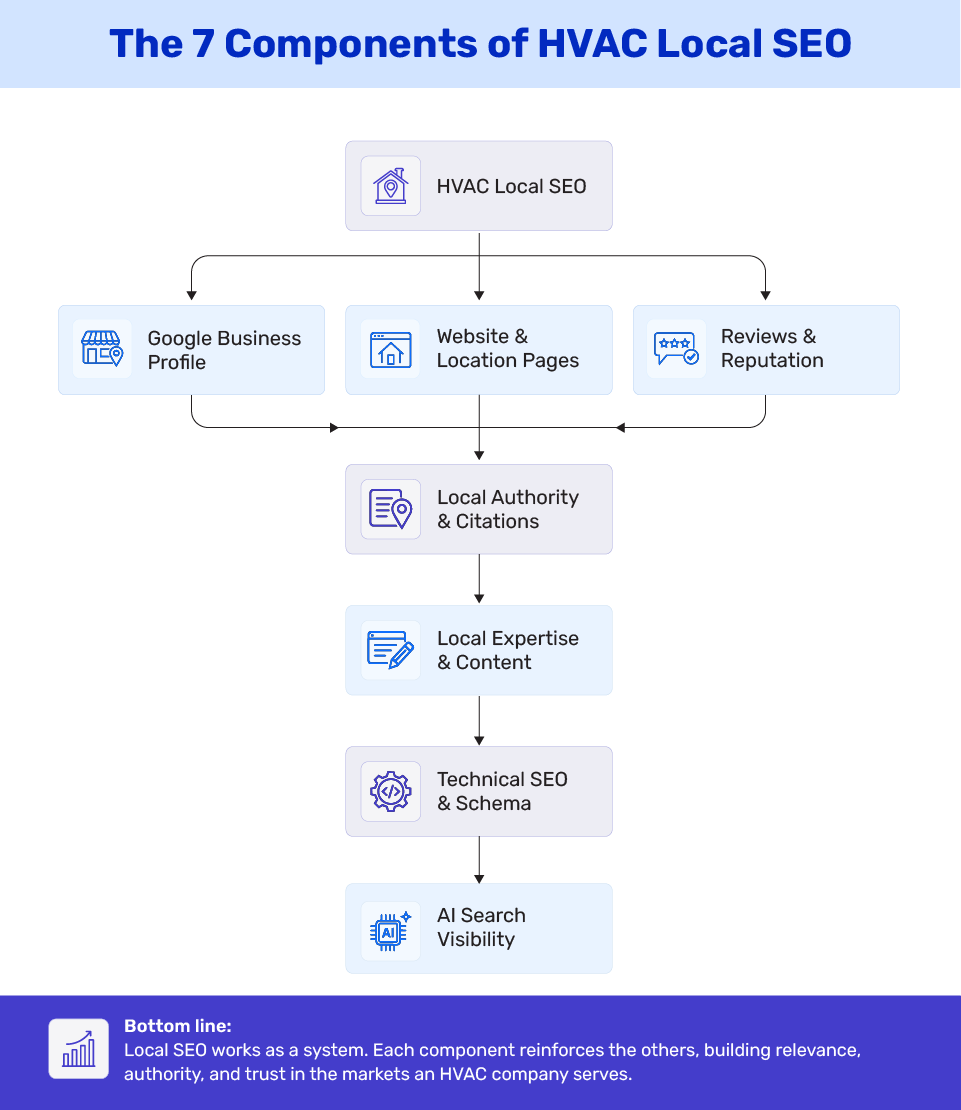
It encompasses several connected components:
- Google Business Profile optimization for local and Maps visibility
- Service and location pages that establish relevance for specific searches
- Reviews and reputation management that strengthen trust and local prominence
- Citations, mentions, and backlinks that corroborate the business’s presence and authority
- Locally relevant content that demonstrates HVAC expertise
- Technical SEO and structured data that help search engines interpret the business and its website
- AI search visibility, including representation in experiences such as Google’s AI Overviews and AI Mode
Google says local results are primarily influenced by relevance, distance, and prominence. Complete business information helps Google determine relevance, while reviews and links can contribute to prominence.
For an HVAC company, the objective isn’t simply to rank a website. It is to establish the business as a relevant, credible, and clearly identifiable local provider for the services and markets that matter commercially.
How Can HVAC Companies Build a Strong Google Business Profile?
For many HVAC companies, Google Business Profile is the first place prospective customers encounter the business. It can communicate the company’s services, operating information, reviews, location or service area, and reputation before a customer ever reaches the website.
That makes GBP foundational, but not something to manipulate.
1. Get the Core Business Information Right
Start with the fundamentals: the correct business name, appropriate categories, phone number, website, hours, and accurate business information.
Google recommends keeping Business Profile information complete and up to date, noting that businesses with complete and accurate information are more likely to appear in relevant local searches.
For an HVAC business, accuracy matters because the profile needs to answer several questions immediately:
- What kind of HVAC company is this?
- Which services does it provide?
- Where does it operate?
- How can a customer contact it?
- Is it available when the customer needs it?
2. Build the Right Service-Area Strategy
An HVAC company can serve multiple cities without having a physical location in each one. That does not justify creating a GBP for every city.
Define service areas based on the company’s actual operational footprint. Avoid virtual offices, artificial locations, or other practices that can undermine credibility and compliance.
3. Use GBP’s Service and Visual Elements Strategically
Services, photos, business information, and other profile elements should make the listing useful to both Google and prospective customers.
For an HVAC business, that might mean clearly communicating core offerings such as AC repair, heating, installation, maintenance, or emergency service, while using authentic imagery that demonstrates the company’s work.
The goal isn’t to stuff the target keyword everywhere. It is to make the business unambiguous.
4. Treat Reviews as an Ongoing Asset
Reviews belong at the intersection of reputation, customer experience, and local search.
BrightLocal’s 2025 Local Consumer Review Survey1 found that 96% of consumers were open to writing a review, while 74% said they use at least two websites when reading reviews before deciding on a local business.
That argues for a systematic process rather than sporadic review campaigns.
Build a consistent process for requesting feedback, making reviews easy to leave, and responding appropriately to customers.
Dominate Your Market with Local SEO for Home Services
How Can an HVAC Website Strengthen Local Relevance?
GBP establishes businesses in the local ecosystem. The website needs to substantiate that presence.
A strong HVAC website should make it easy for both customers and search engines to understand which services the company provides, where it provides them, and why customers should choose it.
I. Create Dedicated Pages for High-Value HVAC Services
A single “HVAC Services” page rarely provides enough depth to address every commercial search.
Depending on the business model, high-value service pages could include:
- AC repair
- AC installation and replacement
- Furnace and heating services
- Heat pump services
- HVAC maintenance
- Emergency HVAC services
Each page should address the specific customer’s intent behind the service, explain the company’s capabilities, provide relevant trust signals, and offer a clear path to contact or booking.
This also creates a stronger foundation for local targeting. A customer searching for furnace repair has a different need from someone researching a full HVAC replacement.
II. Build Location Pages Around Genuine Markets
Location pages can help establish relevance in markets the business actually serves, but only when those pages provide meaningful value.
The temptation is to create dozens or hundreds of near-identical pages by swapping city names into the same template. That approach is increasingly difficult to justify.
A stronger location page should provide useful local context, clearly communicate service availability, and connect customers with the appropriate services.
The question for leadership teams is not “How many city pages can we publish?” but “Which markets are commercially important enough to deserve a genuinely useful local presence?”
III. Connect Services and Locations Through Site Architecture
Internal linking should establish clear relationships between:
Service → Location → Supporting content
For example, a local HVAC market page can connect to AC repair, installation, maintenance, and emergency-service pages, while supporting content answers questions customers in that market are likely to ask.
This gives customers clearer navigation and helps search engines understand the relationship between the company’s services and markets.
IV. Make Every Local Landing Page Conversion-Ready
Visibility is only valuable when it can translate into action.
Local landing pages should make it easy to:
- Call the company
- Request a quote
- Book a service
- Contact an emergency HVAC team
- Understand service availability
- Validate the company through trust signals and reviews
This is where SEO becomes a business discipline, not just a traffic-generation exercise.
How Can HVAC Companies Build Local Prominence Through Reviews, Citations, and Authority?
Local prominence depends on more than what an HVAC company says about itself. Reviews, relevant third-party mentions, links, directories, and consistent business information can reinforce the company’s credibility and presence within its market.
1. Make Review Acquisition an Operating Process
Integrate review generation into the customer lifecycle.
After a successful service visit or installation, the company should use a consistent mechanism to request feedback. The goal isn’t to manufacture reviews, but to make it easy for satisfied customers to share genuine experiences.
The 2025 BrightLocal research also found that consumers increasingly want facts and objectivity, including detailed accounts of both positive and negative experiences.
For an HVAC company, that makes detailed reviews particularly useful. A customer explaining how quickly a technician responded to an emergency, what problem was diagnosed, or how clearly an installation was explained provides information that a five-star rating alone cannot.
2. Turn Customer Experience Into a Reputation Advantage
Reviews can reveal the attributes customers consistently associate with the company.
If customers repeatedly praise technician professionalism, fast emergency response, transparent pricing, or clean installation work, those themes can inform broader marketing and content strategy.
Reputation management should therefore sit closer to customer experience management than to a simple SEO checklist.
3. Establish Authority Beyond GBP
Relevant local authority can come from:
- Industry and trade organizations
- Local business directories
- Community organizations
- Local media
- Sponsorships and community involvement
- Relevant local websites and backlinks
Focus on relevance and legitimacy, not accumulating links for their own sake.
4. Keep Business Information Consistent
Keep the company’s name, contact information, website, service areas, and other important business details accurate across relevant third-party properties.
As search becomes more fragmented, consistency becomes increasingly valuable. Customers may discover a company through Google, a directory, social media, an AI platform, or another website before reaching the company’s own site.
How Can HVAC Companies Create Content That Demonstrates Local Expertise?
The HVAC market is saturated with generic content: “How often should you change your filter?” “Signs your AC needs repair.” “How to save energy.”
These topics can be useful, but publishing more commodity content doesn’t automatically build authority.
I. Stop Publishing Generic HVAC Content
Instead, focus on questions that precede real service decisions.
A strong content strategy should help customers understand problems, evaluate options, and determine when professional intervention is appropriate.
II. Build Content Around Local Demand
Useful themes can include:
- Seasonal HVAC problems
- Climate-specific considerations
- Common equipment failures
- Local homeowner concerns
- Maintenance questions
- Repair-versus-replacement decisions
The goal is to connect what customers search for with what the company actually knows and sells.
III. Use First-Hand Service Knowledge
This is increasingly important as generative AI makes commodity content easier to produce.
Technician experience can provide differentiated information about:
- Problems encountered repeatedly in the field
- Installation considerations
- Equipment-specific issues
- Common customer questions
- Troubleshooting patterns
- Practical maintenance recommendations
Google’s current guidance for generative AI search emphasizes unique, valuable, non-commodity content and first-hand experience, not simply reproducing information already available elsewhere.
“Good SEO is good GEO.”
Danny Sullivan, Director, Google Search.
IV. Connect Informational and Commercial Intent
Content should support a customer journey:
Question → Education → Service consideration → Contact/booking
The objective is not to maximize pageviews. It is to create useful touchpoints that move relevant prospects closer to a service decision.
How Should HVAC Companies Optimize for AI Overviews and AI Mode?
This is where the local SEO conversation is changing fastest.
AI Overviews and AI Mode give users new ways to research questions, compare options, and discover information. Google itself says these experiences are grounded in its existing Search systems.
That distinction matters.
Understand What Has Changed in Search
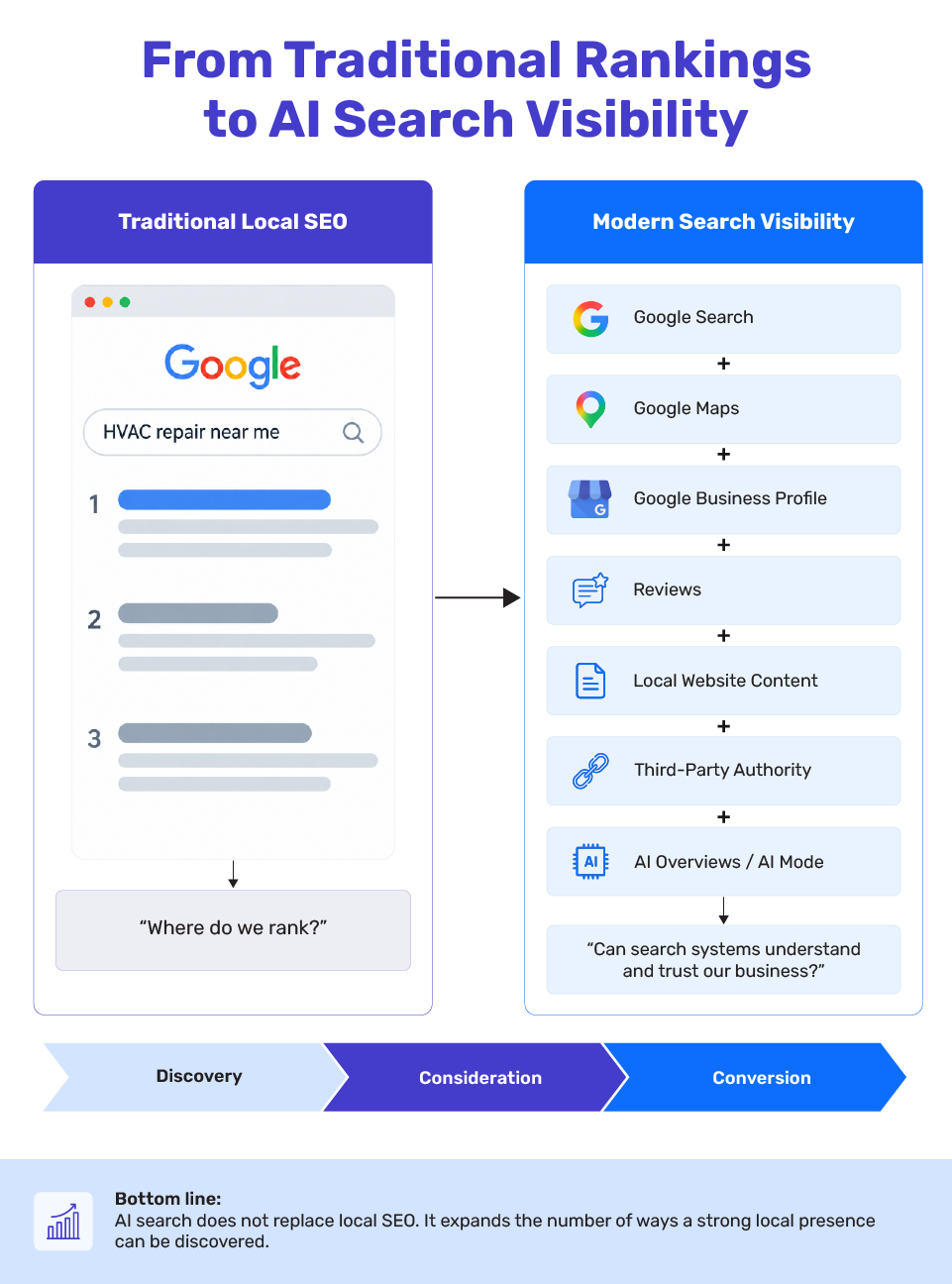
The traditional question was:
“Where does my company rank?”
The emerging question is:
“Is my business information clear, credible, and authoritative enough to be surfaced across Google’s evolving search experiences?”
Google2 reported in May 2025 that AI Overviews were driving more than a 10% increase in Google usage for the types of queries that trigger AI Overviews.
That does not mean every HVAC query will produce an AI Overview, or that traditional rankings no longer matter. It does mean the search interface, and potentially the path from discovery to consideration, is expanding.
2. Understand What Has Not Changed
You don’t need to create a separate “AI SEO” silo.
Google’s own guidance is explicit: existing SEO fundamentals remain relevant to AI Overviews and AI Mode, and there are no additional technical requirements or special schema types required for inclusion.
“Focus on your visitors and provide them with unique, satisfying content.”
John Mueller, Senior Search Analyst, Google.
For HVAC companies, that means continuing to prioritize:
- Crawlable, indexable pages
- Accurate business information
- Strong local relevance
- Helpful, people-first content
- Reputation
- Authoritative third-party references
- Appropriate structured data
3. Create Information AI Systems Can Confidently Interpret
An HVAC company’s digital footprint should tell a consistent story.
It should be clear:
- Who the company is
- What services it provides
- Where it operates
- What it specializes in
- What customers say about it
Consistency matters because generative search can draw on multiple sources rather than relying on a single webpage.
4. Create Content Worth Surfacing
Google’s current guidance reinforces the value of content that offers a unique point of view and value beyond information a generative AI system could easily reproduce.
For HVAC companies, that means using genuine expertise, local context, direct answers, original observations, and credible supporting information.
5. Think Beyond Traditional Rankings
Search visibility increasingly has multiple surfaces.
A prospective customer might encounter an HVAC company through:
Organic results → Maps → GBP → Reviews → Local content → AI-generated search results
The strategic goal, then, is not to optimize for one isolated ranking position. It is to build a strong local entity and digital presence that remains discoverable as search interfaces evolve.
How Should HVAC Companies Measure Local SEO by Business Outcomes?
Local SEO performance should ultimately be evaluated by its contribution to qualified demand and revenue, not rankings alone. Leadership teams should connect visibility and local search actions with leads, booked jobs, customer acquisition costs, and revenue by market or service.
Track Visibility by Service and Market
Performance should be segmented by:
- Location
- HVAC service
- Search intent
- Branded versus non-branded searches
This makes it possible to identify markets where demand exists, but visibility is weak.
Track Actions, Not Just Rankings
Relevant indicators include:
- Calls
- Website visits
- Quote requests
- Form submissions
- Bookings
- Qualified leads
Connect SEO to Revenue
Where attribution allows, connect search-generated leads with:
- Booked jobs
- Customer acquisition cost
- Revenue by service
- Revenue by market
- Customer value
This changes the executive conversation from “Did our rankings improve?” to “Where is SEO creating profitable demand?”
Google’s 2025 guidance on AI search also cautioned against evaluating search solely through clicks, noting that visits originating from AI search can be more engaged and that businesses should consider broader conversion indicators.
Google has since introduced dedicated Search Console reporting for visibility in generative AI features, including AI Overviews and AI Mode, making it increasingly possible to analyze this layer separately from traditional search performance.
Use Performance Data to Prioritize Investment
Leadership teams should be able to answer:
- Which services have strong demand but weak visibility?
- Which markets offer the greatest growth opportunity?
- Where does strong visibility fail to convert?
- Which services or locations justify additional investment?
That is how HVAC local SEO becomes a resource-allocation decision rather than a marketing vanity metric.
Unify SEO, Content, Paid Media, and Conversion Strategy to Strengthen Local Acquisition
How Should HVAC Companies Choose the Right SEO Services Partner?
The right partner should understand more than SEO mechanics. It should understand HVAC economics and operating realities.
Look for expertise in:
- HVAC customer journeys
- Service-area businesses
- Local search
- Seasonal demand
- Lead-generation economics
The strategy should connect:
GBP + website + reputation + content + authority + AI search + measurement
rather than treating each as a separate deliverable.
Ask how the agency will connect SEO performance to qualified leads and revenue. Be cautious of guaranteed rankings, fake locations, keyword stuffing, thin location pages, manipulative review tactics, or claims that a proprietary “AI SEO” trick can bypass foundational search practices.
For an HVAC company evaluating HVAC SEO services, the right question is not simply whether an agency can improve rankings. It is whether the agency can build a local search presence that compounds into greater market visibility, stronger customer trust, and more qualified service demand.
What Does Local SEO Mean for the Future Growth of HVAC Companies?
GBP remains foundational, but it is only one component of modern local visibility.
The strongest HVAC companies will align their Business Profile, website, reviews, local authority, content, and AI-search readiness into one connected system. They will measure that system not only through rankings, but through qualified leads, booked jobs, and revenue.
For leadership teams, that is the real shift: local SEO for HVAC companies is no longer simply about being found. It is about building a digital presence that makes the company the obvious local choice, wherever the customer begins the search.
References
- [1]. BrightLocal
- [2]. Google