
Key Takeaways:
- AI search combines multiple sources to deliver contractor recommendations to homeowners.
- Homeowners who trust AI recommendations often skip comparing service providers.
- A complete Google Business Profile boosts AI-generated local recommendation visibility.
- Structured schema markup helps AI systems parse business information accurately.
- Fresh, original local content earns more citations than generic, AI-written pages.
- Consistent business details across every directory build trust with AI platforms.
How do homeowners find you if they never visit your website?
That question is reshaping marketing for home service companies. Homeowners now use ChatGPT, Perplexity, and Google’s AI Overviews to research local contractors. They ask detailed questions about costs and credentials before clicking on any website link.
Traditional search returns a list of websites, whereas AI search blends information from multiple sources and delivers direct recommendations. This change makes AI search optimization critical for home service companies.
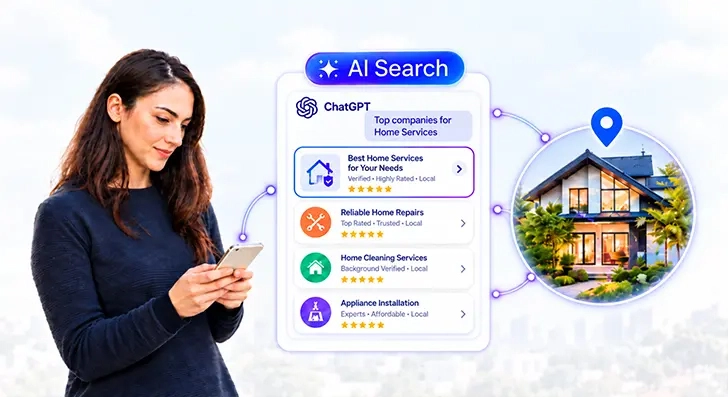
Businesses now need content that answers real customer questions and trust signals that AI systems recognize when homeowners ask for referrals. This guide explains how home service companies can adapt and win in the age of AI-powered search.
What Is AI Search Optimization for Home Service Companies?
AI search optimization for home service companies refers to practices that make your business visible inside AI-powered platforms like ChatGPT, Google’s AI Overviews, Perplexity, Claude, and Gemini. These systems use natural language processing, machine learning, and large language models to understand the intent behind customer queries rather than just matching keywords.
An AI platform analyzes context and identifies relevant businesses as entities when someone asks for plumber recommendations or HVAC comparisons. It then pulls information from many sources and delivers a direct response.
How AI Search Is Different from Traditional Search
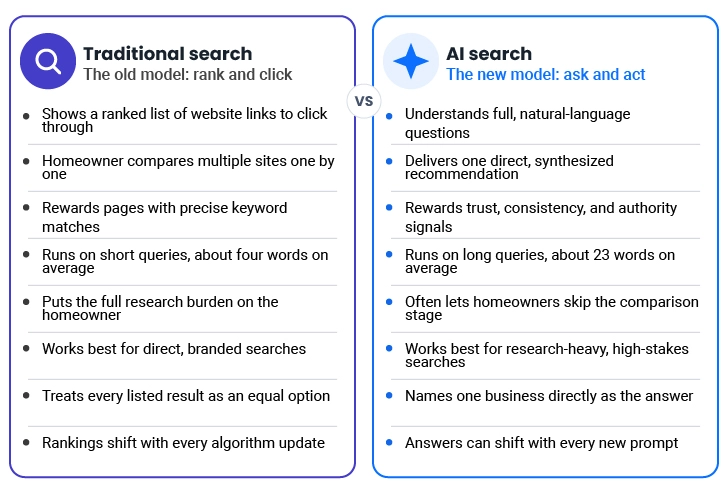
Traditional search gives users a ranked list of website links. People must click through and combine information on their own. AI search, by contrast, interprets full questions, understands semantic relationships, and generates direct answers with supporting citations.
The questions themselves have changed. AI search queries average 23 words1 compared to a traditional search’s 3.4-word average. This change shows how customers now speak naturally when asking about repair costs, service options, or provider credentials.
AI also evaluates companies differently. It understands what a business offers by scanning directories and review sites. They check its authority through consistent information across sources and match capabilities to specific customer needs.
Why Does AI SEO for Home Services Matter?
45%2 consumers now use ChatGPT or other generative AI tools to find local businesses. And usage is among the highest in the home improvement sector, where customers research extensively before making a call. Yet, most local businesses have no strategy for appearing in AI search results. This gap creates a clear opportunity for home service companies.
Google still captures most transactional local queries. But AI tools increasingly influence which contractors seem established and worth calling. In fact, homeowners who get a recommendation from an AI tool often skip the comparison stage completely. The business that gets named first gets the call. That makes AI SEO for home services vital for staying competitive.
Home Services Marketing Strategies That Help You Generate More Leads
How Does AI Search Help Different Home Service Businesses?
AI search affects each home service sector differently. The way customers ask questions and make decisions varies by industry. Understanding these differences helps companies tailor their approach.
1. HVAC (Heating, Ventilation, and Air Conditioning) Digital Marketing
HVAC customers deal with emergencies. They search for phrases like “furnace repair near me” or “AC not working” when their system fails on a given day. HVAC Seo for AI search requires content that tackles specific problems homeowners describe systems blowing warm air, unusual noises, rising energy bills, and overdue maintenance schedules. Companies that talk about these concerns in simple language become the cited source on AI platforms.
2. Roofing Marketing
Roofing decisions happen quickly. In fact, 54%3 of homeowners choose a provider within four hours of starting their search. AI search meets this tight timeline by answering pressing questions that homeowners ask about storm damage assessment, repair versus replacement decisions, material comparisons, and warranty coverage. Roofing marketing works best when companies publish content that mirrors the way customers phrase these questions.
3. Solar Digital Marketing
Solar buyers face complex choices. They must evaluate long-term financial commitment involving roof suitability, federal tax credits, net metering policies, financing structures, and payback periods. Solar digital marketing succeeds when companies publish content that explains how the federal investment tax credit applies to specific property types, how net metering works with local utilities, and how system sizing gets calculated for various roof orientations.
4. Tree Digital Marketing
Customers seldom think about their trees until something forces the issue. A storm brings down a limb. A neighbor complains about an overhanging branch. The research that follows involves removal costs, local permit requirements, seasonal trimming schedules, and safety considerations. Companies that publish content addressing these specifics earn AI citations. Tree service digital marketing helps businesses in this sector align their online presence with these customer needs.
How Can You Optimize Your Home Service Business for AI Search?
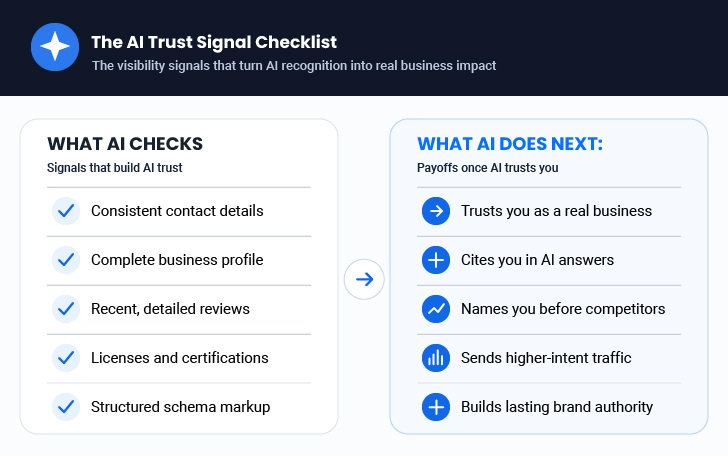
Seven core strategies can position your business inside AI-generated answers and recommendations. Each approach builds traditional Home Services Seo while addressing how AI systems review, understand, and cite local contractors.
I. Create Content Around Real Customer Questions
Customers need answers to common questions before hiring contractors. They may ask things like “Why is my furnace blowing cold air?” or “Should I choose metal roofing in a cold climate?” These queries reflect natural search patterns that AI systems prioritize.
Home service websites should aim to answer all such questions using conversational language rather than forcing exact-match keywords. FAQ-rich pages that talk about common user problems, troubleshooting steps, and service selection decisions help AI tools identify genuine expertise, which, in turn, improves rankings.
II. Build Strong Local SEO Foundations
Google Business Profile (GBP) optimization forms the backbone of AI visibility. Companies with complete and active profiles are far more likely to appear in AI-generated local recommendations. For this reason, business owners should fill every field within their profile, including categories, services, hours, and contact details.
Their service area pages should specify locations served, common local problems, reviews, work photos, FAQs, and emergency availability where relevant. In addition, the name, address, and phone number listed on their website must match what appears across all directories. Businesses should also consider professional seo services to strengthen their local search foundations and support their broader AI visibility efforts.
III. Demonstrate First-Hand Expertise and Trust
AI systems review content quality using Experience, Expertise, Authoritativeness, and Trustworthiness (EEAT) principles. Businesses that display these signals through their certifications, licenses, and professional memberships get cited more often.
Project examples with before-and-after photos, detailed case studies, and expert explanations demonstrate genuine knowledge. Similarly, author bylines, credentials, and team bios build authority signals that AI tools recognize when compiling recommendations.
IV. Strengthen Your Reviews and Reputation
“You can spend a month attempting to spam the web… or be the business customers are raving about, thereby allowing them to do all the LLM SEO work for you.”
Steve Wiideman, CEO, Wiideman Consulting Group
Reviews influence rankings and shape AI citations. The average consumer reads up to 104 reviews before trusting a business. Recency also matters. Recent reviews mentioning specific services often perform better than older generic ones.
Businesses should request reviews right after completing jobs when customer satisfaction is high. They should also respond to all reviews in a timely manner. Detailed reviews mentioning services and their outcomes provide context that AI systems use when evaluating local providers.
V. Make Your Website Easy for AI Systems to Understand
Structured data helps AI systems parse website content accurately. LocalBusiness, Service, FAQPage, Review, and BreadcrumbList schema types provide machine-readable context about a business. Structured data enables search results that are more engaging and encourage increased interaction.
Home service companies should use clear page structures with descriptive headings and logical hierarchy. Additionally, they should implement mobile-responsive design, fast load speeds, and crawlable site architecture to ensure AI systems access complete information. It is also important to avoid hiding content behind JavaScript interactions that prevent AI crawlers from reading critical details.
VI. Publish Original Local and Service-Specific Content
Original content earns citations. Content that describes local weather patterns, regional regulations, seasonal timing, and actual job examples gives AI tools the geographic specificity they need. Service area pages should reflect genuine local knowledge, not duplicated templates with a city name swapped in. Publishing fresh, structured content regularly also boosts AI citation frequency.
VII. Build Authority Beyond Your Own Website
External mentions from local publications, trade associations, suppliers, community organizations, and industry websites contribute to the entity definition that AI tools use when evaluating a business.
Accurate directory listings on trusted platforms reinforce consistency. Getting involved in the community, whether by sponsoring a local event or joining a neighborhood initiative, generates website mentions, branded searches, and social signals. These all show that a business has an established local presence. Guest posts on relevant industry websites build referral traffic, but only when the content offers value. Working with a Digital marketing agency with experience in home services also provides an additional approach for building these external visibility signals.
Here’s How Local SEO for Home Services Helps You Dominate Your Market
What AI SEO Mistakes Should Home Service Companies Avoid?
Several missteps can undermine your home services AI SEO efforts even with good intentions. Companies that recognize these patterns can save resources and avoid ranking penalties.
1. Creating Large Volumes of Generic AI-Written Content
Generic blog posts about topics like “Why HVAC Maintenance Matters” fail to produce rankings or AI citations. AI-generated content without local specificity offers no value, as search engines can detect artificial optimization patterns in headings and paragraphs. Actual job examples and service area mentions are essential. Without these, the content provides nothing useful to readers or algorithms.
2. Stuffing AI-Related Keywords Into Pages
Keyword stuffing can show up as excessive repetition in headings, alt text, internal links, and FAQs without adding value. AI-powered search experiences favor content that answers questions clearly using natural language. Forced keyword placement hurts user experience and signals low-quality content.
3. Ignoring Local SEO While Focusing on Broad Informational Content
Broad informational content misses how customers search for local services using terms with geographic modifiers. Search engines cannot associate services with specific coverage areas when location-based keywords are absent. Local SEO creates connections between a business and its nearby customers.
4. Leaving Business Information Inconsistent Across Platforms
Inconsistent name, address, and phone number details confuse search engines. Small formatting differences like “123 Williamson St” versus “123 Williamson Street” can trigger algorithmic red flags. Search engines lose confidence in listings that show conflicting information. They favor competitors with consistent details instead.
How Should You Measure AI Search Optimization Results?
Tracking performance requires both traditional metrics and AI-specific visibility signals. Success in AI SEO for home services shows up across several layers.
I. Organic Traffic and Rankings
Monitor organic traffic volume, keyword rankings for target terms, and click-through rates from search results. Track these metrics monthly. Segment conversion rates by keyword and landing page. Google Search Console helps you track rankings, click-through rates, technical issues, and Core Web Vitals.
II. Branded Searches and Direct Traffic
Branded search volume rises as AI citations increase customer awareness. Track branded search impressions in Google Search Console and compare them against your posting schedule. Branded searches convert at nearly a hundred percent click-through rate. This metric is essential for measuring AI impact.
III. Citations in Relevant AI Search Results
AI citation tracking measures how often platforms like ChatGPT, Perplexity, and Google AI Overviews reference your brand or content. Citation frequency shows how often your content appears in AI responses for tracked questions. Users referred by AI convert at much higher rates than organic search visitors. A citation in an AI-generated answer reaches someone already deep in the decision process.
IV. Leads and Calls From Organic Channels
Set up conversion tracking in Google Analytics 4 to measure form submissions and calls from organic channels. Track conversion rates, lead value, and return on investment from organic search. These numbers connect your optimization work to revenue.
V. Monitor Question-Based Search Rankings
Apply regex filters in Google Search Console to surface question-format queries that trigger AI responses. Track rankings specifically for how, what, why, and when questions. These question-format rankings show whether your content matches the structure AI systems prefer to pull from.
VI. Growth in Reviews, Local Visibility, and Third-Party Mentions
Monitor new reviews per month, average rating, and response rate. Track Google Business Profile views, website clicks, phone calls, and direction requests. Measure citation growth and ensure name, address, and phone number consistency across all directories.
Conclusion
AI search optimization for home service companies builds on traditional SEO rather than replacing it. To achieve success, businesses must focus on answering real customer questions, maintaining consistent business information everywhere, and building trust through reviews and expertise. These fundamentals drive AI citations and qualified leads.
Want to get found in AI search results? Book a consultation with Damco’s digital experts and start winning more local calls.
References
- 1. https://www.orbitmedia.com/blog/traditional-search-vs-ai-search/
- 2. https://www.brightlocal.com/resources/local-seo-statistics/
- 3. https://www.scorpion.co/roofing/insights/blog/verticals/roofing/roofing-seo-marketing-what-ai-search-means-for-y/
- 4. https://capitaloneshopping.com/research/online-reviews-statistics/