
 ChatGPT
 Claude
 Perplexity
 Gemini
Is your content ready for the age of instant answers? Large language models and AI search engines are rapidly transforming into answering machines. They are usurping traditional searches by providing direct responses instead of just links. All this has changed how people find information online, so older optimization methods are no longer enough.
This has created a new challenge for several businesses. They find it hard to maintain visibility on the very channels that let people discover their brand. An Artificial Intelligence Optimization or AIO strategy offers the solution. It takes standard practices to the next level to help businesses stand out within AI-created answers.

What Is AIO and How Does It Differ From Conventional SEO?
What happens when the rules for online visibility change all of a sudden? The evolution from traditional search to AI-driven answers brings a fundamental change in how people find content. This shift has spawned a new discipline, Artificial Intelligence Optimization (AIO).
Artificial Intelligence Optimization focuses on improving digital content’s structure, clarity, and retrievability for large language models and other AI systems. AIO aligns content to fit how AI interprets meaning and context. The technique directly impacts business results as more users rely on AI for getting knowledge and making decisions.
Traditional SEO and AIO serve different but complementary purposes in a content strategy. SEO helps rank higher in search engine results pages. AIO ensures content appears in AI chat responses or AI Overview summaries.
With SEO, visibility means securing a position on a list of links. AI search also ranks content, but focuses on which specific content pieces are used to create the final answer.
User behavior creates another key difference. SEO focused mainly on typed keywords. AIO handles the more natural and conversational questions people ask AI assistants. It emphasizes context, intent, and depth more than keyword density.
Both approaches work perfectly together. SEO builds the foundation with strong keywords and backlinks. An AIO strategy prepares content for voice search and generative responses.
| Aspect | Conventional SEO | AIO (Artificial Intelligence Optimization) |
|---|---|---|
| Main Purpose | Ranks content high on search engine results pages. | Gets content used in AI chat answers and summaries. |
| Visibility | Being on a list of links. | Being the source for a direct AI-produced answer. |
| How Content is Used | Pages are ranked as whole documents. | Content is broken into pieces for AI to understand and reuse. |
| Key Signals | Keywords and backlinks (links from other sites). | Content clarity, context, and authoritativeness. |
| User Query | Focuses on typed keywords. | Focuses on natural, conversational questions. |
How AI Search Engines Interpret Content?
AI search engines use complex technology working behind their simple interfaces. These systems understand content differently from old search engines. Users creating content can gain an advantage by understanding how they work.
1. Natural Language Processing and Semantic Search
Natural language processing serves as the brain of AI search engines. This branch of artificial intelligence helps these engines understand and create human language. It splits text into smaller units called tokens and then uses an attention mechanism to study relationships between words, sentences, and concepts.
Semantic search goes beyond traditional keyword matching. It tries to understand the intent behind a search. Results are based on the query’s purpose, and not the exact keywords used. To give an example, semantic search can tell if “capital” refers to money, a city, or an uppercase letter by understanding the context.
2. The Role of Structured Data and Schema Markup
Structured data gives AI search engines clear clues about a page’s content. This is where schema markup comes into the frame. It uses standard formats to label various elements like product prices, recipe ingredients, or events.
This structured information helps AI in many ways:
- Converts human writing into machine-readable signals
- Links content to huge knowledge networks like Google’s Knowledge Graph
- Makes information clearer by identifying whether numbers are phone numbers, prices, or addresses
Google has not confirmed that schema markup directly affects rankings. But it certainly helps search engines understand your content better, which eventually results in better rankings.
3. How AI Systems Evaluate Authority and Clarity
AI search engines study many aspects of content quality besides regular SEO metrics. Google’s E-E-A-T framework (Experience, Expertise, Authoritativeness, Trustworthiness) shows how they assess content.
AI ranking systems check for topical relevance, original insights, and fresh information. They judge expertise by looking at the author’s background and the citations used. Content structure elements, such as headings, enable AI to understand meaning and context.
AI systems prefer content with:
- Clear headings with a logical order
- Short paragraphs that focus on one idea
- Organized formats like tables, lists, and FAQs
- The main topic stated early in the content
- Simple signals like “to sum up” that guide the reader
Research tells us that AI Overview answers, in most cases, come from top organic results and respected domains, like educational sites. It shows that quality and clarity matter more than complex technical optimization.
What Are the Important Elements of AI-Optimized Content?
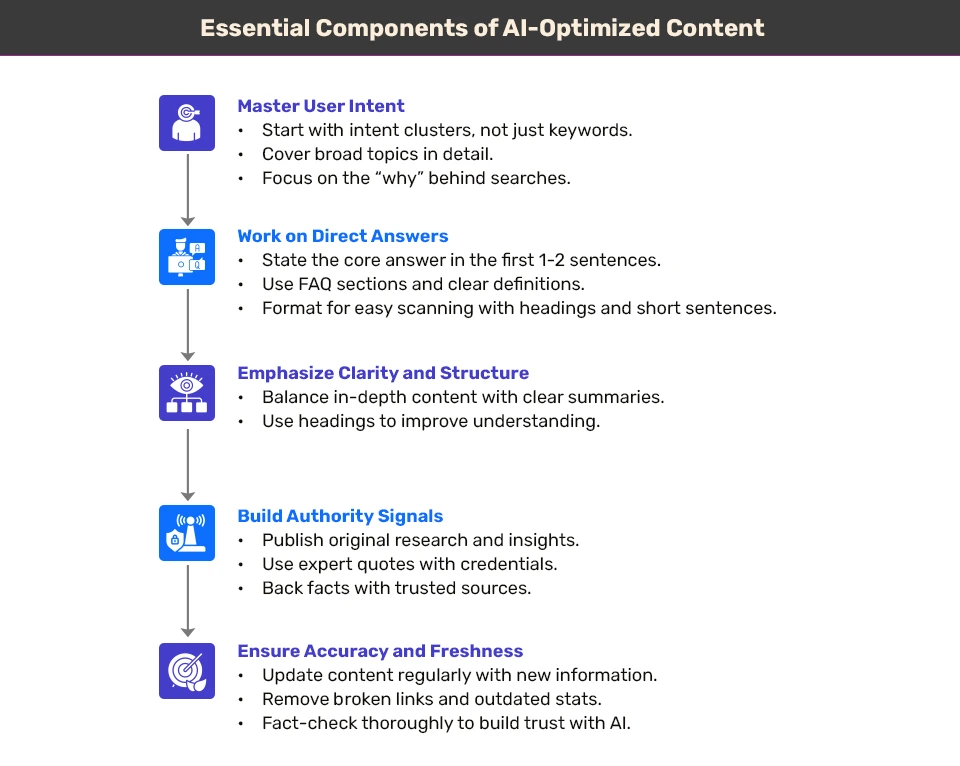
AI search systems demand a completely new way of creating content. Content creators must understand what AI looks for and how it processes information.
I. Intent-Driven Topic Selection
The key to AI search lies in understanding user intent patterns. Modern search cares more about meaning than exact words. Organizations creating content must address actual questions that users ask. This means moving away from simple keyword addition to content that covers a topic fully.
To map user intent properly:
- Start with intent clusters rather than keyword lists
- Cover broad subjects in detail
- Focus on the “why” behind search queries
- Use questions that sound like natural speech
II. Content Built for Direct Answers
AI search prefers content that answers questions right away in the first two sentences. AI models tend to mention pages that start with clear facts before telling stories. This “answer-first” style helps readers and crawlers grasp the main point quickly.
Definition boxes, FAQ sections, and clear explanations work well. Using the FAQ schema has become a top strategy for AI-powered search optimization. Pages that appear in Google AI Overviews are 3.2 times more likely to have FAQ schema implemented than those that don’t.
Clean, easy-to-scan formatting helps AI models extract information better. Clear headings, short sentences, and smart internal linking also help. All these elements boost the model’s understanding and improve your chances of content appearing in AI summaries.
III. Depth with Clarity
People enjoy content with stories and emotions. But AI prefers clarity. Models like explicit and verifiable information. Each sentence should make a clear point without requiring extra context.
Finding the right balance between depth and clarity is hard. A good rule is to create summaries that are short and dense with facts but still easy to understand. The sweet spot lies between too little detail and too much complexity.
Headings and structure help AI understand context and meaning. Each section needs a clear purpose with semantic cues that make the content cogent and easier to follow. These include:
- Navigational Cues: “let’s read about”
- Comparison Cues: “unlike older methods”
- Definition Cues: “it means”
IV. Authority Signals for AI Models
AI models trust content backed by solid evidence. They easily pull and cite information from original sources, like industry reports or official product documents. Recent research tells us that pages with original insights get 30-40% higher AI visibility.
Elements that improve AI visibility:
- Original data and research
- Expert quotes with clear credentials
- Well-organized and scannable articles
- Facts backed by statistics or trusted sources
V. Content Accuracy and Verification
AI engines do not like contradictions and outdated information. Fresh, accurate content tells AI systems that your page is current and reliable. Broken links and old statistics hurt credibility and reduce your chances of appearing in AI summaries.
Recent studies have found that the majority of the content cited by ChatGPT has been updated in the last few months. This shows how much AI skews toward new information. Regular updates and fact-checking signal to AI that the content is relevant and trustworthy.
AI in Digital Marketing: Why It’s Essential for Businesses Today
Which AIO Tactics Support Generative Engine Optimization (GEO)?
“Once in a while, the technology comes along that is so powerful and so broadly applicable that it accelerates the normal march of economic progress. And like a lot of economists, I believe that generative AI belongs in that category.”
Andrew McAfee, author
AI search engines require proper content structure, in addition to good writing. Smart tactics make your content more useful and easier for AI to interpret.
1. Creating Modular Content
AI engines do not read pages from start to finish, as many of us do. They parse content into smaller, usable pieces. These modular components help AI study information and build responses. Each module works independently while contributing to the whole picture, similar to building blocks.
Here’s how to create modular content:
- Map connections between content fragments through a logical information architecture
- Write sections that make sense even when someone reads them alone
- Ensure semantic coherence by using consistent terms for related ideas
- Create content that serves multiple goals, from basic information to advanced knowledge
2. Using Reasoning-Friendly Formatting
How you format your content matters a lot for AI. These formats work best:
- Step-by-Step Guides: AI systems rank these guides very high. Numbered steps are clearer than long paragraphs. This helps AI reproduce instructions accurately.
- Comparisons and Lists: “Best of” lists or comparisons work well because their clear “this vs. that” format is easy for AI to summarize. Tables are especially effective.
- Checklists and Tables: Language models read checklists and tables accurately. These formats offer small, unambiguous chunks of information that AI can reliably use.
3. Writing Authoritative, Non-Promotional Content
AI systems favor text that reflects clarity and precision. Content should address information needs directly without fluff or promotional material.
To create content that AI models trust:
- Use verifiable information and show where your facts come from. AI penalizes old or contradictory statements.
- Use clear formatting hierarchy. Use H2s for main sections and H3s for subpoints, while adding a new heading every 150-200 words. This structure helps AI rate your content higher.
- Show expertise through proper citations, data, and expert quotes. AI models prefer proprietary research and survey results because they provide unique insights.
Multi-Line Insurance Brokerage Achieved a Staggering 45% Rise in Traffic with Strategic Website Redesign
How to Optimize Content for Answer Engines?
Answer engines are changing how people find information online. These systems give direct answers in simple language instead of just showing a number of links. This makes Answer Engine Optimization (AEO) essential for being seen online today.
I. Anticipate the Questions People Ask
AI search engines like content that answers users’ questions clearly. These systems use natural language processing to understand their search intent. For instance, a search for “how to fix a leak” requires the AI to figure out if the user means a faucet or a roof leak based on context.
Organizations developing content should organize their information around common questions. They need to understand how users phrase their questions and then provide clear answers. AI engines prefer well-organized content with FAQs that match what users are asking.
One can anticipate questions by:
- Checking the “People Also Ask” section for related queries
- Using search data to find trending question formats
- Structuring content to answer who, what, when, where, why, and how
II. Use Schema Markup for Clarity
Schema markup helps AI systems understand webpage content better. The code gives clear labels for key items on a page, e.g., products, people, or events. This lets AI models interpret your content accurately.
The FAQ schema works especially well because AI systems can easily extract and cite its question-answer pairs. Users interact with answer engines through natural language queries, making this format ideal.
Key schema types include:
- HowTo schema that labels each step in a set of instructions
- Product schema with details like name, description, pricing, and ratings
- Organization schema that establishes entity recognition through name, URL, and social profiles
- Article schema with headline, publish date, and author information
III. Improve Entity Recognition
Named Entity Recognition (NER) spots and categorizes entities like people, organizations, and locations in text. AI systems use this to understand content on a deeper level, which improves their ability to find the right information.
Good entity recognition needs consistent entity references across websites. To give an example, if you mention a product on several pages, use the same name and details every time. This helps AI systems build stronger entity connections and makes content easier to find in the right searches.
| Principle | Key Actions |
|---|---|
| Anticipate User Questions |
|
| Use Schema Markup |
|
| Improve Entity Recognition |
|
How Can One Track and Measure AIO Performance?
Older SEO metrics do not fully capture how well AI-powered search optimization is working. With AI-driven answers becoming more common, organizations need new ways to measure their AIO strategy success.
1. Inclusion In AI Search Summaries
It’s important to track when your brand and content are mentioned in AI-generated answers. Modern metrics now focus on these mentions and citations. They show whether AI models treat your content as a trusted source for specific queries.
Tools like LLM Refs provide visibility scores. Ahrefs has launched AI Citations tracking to show how often your domains appear as cited sources on major AI platforms.
2. Entity Recognition Performance
Entity recognition metrics show how well AI systems identify and sort key content elements (entities). The main metrics include:
- Precision: The ratio of correctly identified entities to all identified entities shows labeling accuracy.
- Recall: The percentage of entities correctly identified shows detection coverage.
- F1 Score: A balanced measure combines precision and recall through their harmonic mean.
3. Traditional KPIs Adapted for AI SEO
Traffic from AI engines is usually high-quality. Google’s research suggests that visitors who click through AI Overviews stay on a site longer. To track AI-sourced visitors, one can use custom channel groupings in GA4. Teams should watch:
- Conversion rates from AI-referred traffic
- Time spent on the site from AI sources
- Click-through rates from AI Overviews
Conclusion
An AIO strategy fundamentally changes how businesses build visibility in an AI-driven world. AI systems have become the main content evaluators, and this has left traditional SEO tactics inadequate. To build trust, content now needs to show clear logic and cite verifiable sources.
Search engines and large language models have morphed into answering machines. This change requires businesses to embrace a more meticulous approach that covers intent-driven topics, direct answers, and authority signals. They also need to track new metrics beyond traditional SEO measurements to verify the effectiveness of their AI search optimization strategy. Websites can stay visible and relevant by carefully implementing these methods.