
 ChatGPT
 Claude
 Perplexity
 Gemini
Running an ecommerce store can overwhelm any business owner. The online marketplace is huge and unbelievably competitive. Billions of dollars are at stake each year. This has created a race, where a large number of businesses clamor for the same set of customers.
It’s true that many owners manage their marketing in-house in the beginning. But this strategy meets its limits when growth demands more specialized knowledge. Ecommerce marketing agencies are able to effortlessly close this gap by using advanced technologies and strategic insights to improve the business’s competitive position.
Despite the gains it offers, working with an agency is a serious financial investment. One must carefully study the cost against the potential for growth. Making this decision at the correct time is vital for sustained growth and success.

This blog talks about the signs that tell you it’s time to team up with professionals. It explains the benefits to expect and how to find an agency that meets your business needs.
What Does an Ecommerce Marketing Agency Do?
Ecommerce marketing agencies work as growth partners for businesses that want to get ahead in the incredibly crowded digital world. These firms help online stores increase their traffic and sales through various digital channels and tactics.
I. Key Services Offered by Ecommerce Marketing Companies
Ecommerce marketing agencies provide a complete set of services that work together to help your online store succeed. SEO forms the foundation of these services. It helps your products appear higher in organic searches. Because of this, customers can find them more easily.
Paid advertising drives quick results for many stores. Agencies run campaigns on platforms like Google Ads and Meta. These ads increase brand awareness and bring in sales right away.
Social media marketing plays a vital role, too. Facebook and Instagram bring strong returns to ecommerce businesses. People spend several hours each day on social media, which creates great opportunities to reach them easily.
These agencies also provide:
- Content marketing
- Email marketing and automation
- Conversion rate optimization
- Website design and development
- Product listing management
- Custom analytics and reporting
II. How Agencies Support Digital Marketing for Ecommerce
Marketing agencies work closely with your organization and bring expertise you may not have in-house. They evaluate how well your business is performing and find out areas where you need to improve. These agencies also create strategies that match your business’s goals, target audience, and market position.
One big benefit is that agencies can handle many marketing tasks at once. Instead of trying to learn everything yourself, you get experts for each area. SEO specialists focus on rankings. Email experts create engaging messages. Ad managers make sure money is wisely spent.
Agencies also have cutting-edge tools that most businesses cannot afford. This technical advantage allows them to use data-backed methods instead of guessing what might work.
The Complete Guide to Digital Marketing for Real Estate: Building Your Online Presence That Converts
III. When Do Founders Consider External Help
Many business owners reach a stage where they cannot handle marketing internally. Sales flatline despite a lot of hard work. And that is when they need fresh perspectives and expert knowledge.
Time becomes another catalyst. Marketing demands constant attention across many channels. When founders try to handle everything at once, other business areas start to suffer.
Skill gaps are a common trigger. Many business owners are great at one or two marketing areas but struggle with others. Recognizing these constraints early helps them make smart decisions about getting marketing support.
Top Signs It’s Time to Hire an Ecommerce Marketing Agency
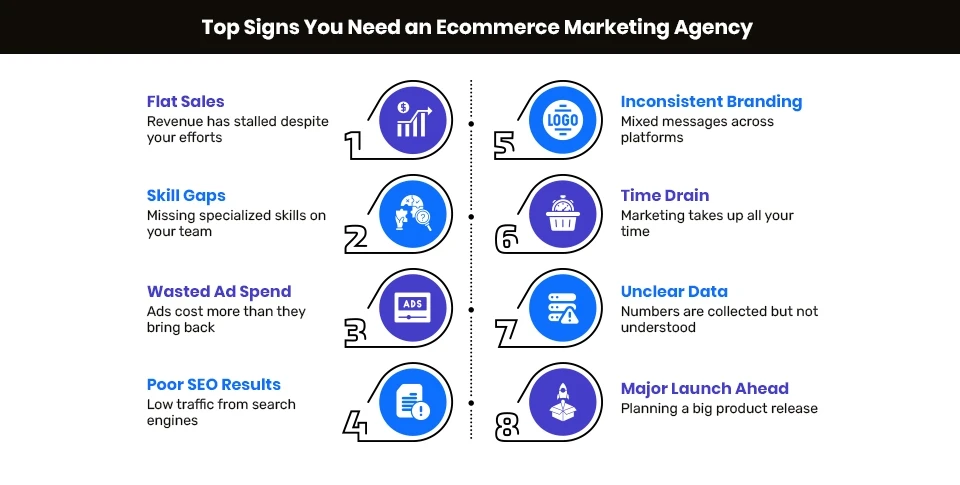
Knowing when to seek outside marketing help is hard. Here are a few signs that show you might need professional expertise to help your business prosper.
1. Your Sales Have Plateaued
Many ecommerce stores see rapid growth at first, then it slows down. If your sales stay flat for months even after trying different approaches, your retail business is in dire need of fresh, unexplored ideas. What worked when you started might not be adequate as your market becomes more competitive and crowded.
2. Your Team Lacks Key Marketing Skills
Digital marketing covers many complex areas. Your team might be great at some areas but weak in others. You may need external help if your team struggles in certain areas, like:
- Technical work like conversion tracking
- Building multi-channel strategies
- Keeping up with platform updates
- Setting up advanced ad features
3. You’re Not Making the Most of Ads
Paid advertising needs specific skills to be profitable. Professional help can improve your results if you regularly spend more than you earn from ads. Also, agencies usually have access to new features and direct support from ad platforms that smaller businesses do not receive.
4. SEO and Content Are Not Performing Well
Successful ecommerce businesses get a significant amount of traffic from organic search results. Poor performance in this area often points to technical SEO problems or content that doesn’t answer customers’ questions. Marketing agencies can spot valuable keyword opportunities using competitive analysis tools that most businesses are unable to access.
5. Your Brand Message Isn’t Consistent
Customers interact with brands on different platforms before buying something. Mixed messages, different visual styles, or changing tone between these platforms can confuse them and break trust. Agencies know how to create a consistent brand experience. They keep their message uniform while conforming to each platform’s rules.
6. Marketing Tasks Take Up a Lot of Your Time
Core business operations often suffer when founders spend endless hours each week on marketing. This time could be better spent elsewhere. Creating content and managing campaigns can consume a lot of resources without giving enough return.
7. Your Data is Confusing
Smart marketing decisions depend on solid data interpretation. If you collect data but cannot turn it into useful actions, you have a critical skills gap. Marketing agencies bring the analysis expertise you lack. Their teams have proper tracking systems to measure how each channel performs and how customers move through their buying experience.
8. You’re Planning a Major Launch
Launching new products is, without a doubt, full of risks. A big portion of launches fail because of poor marketing planning. Expert help becomes valuable during these moments when specialized knowledge determines your success.
The decision to work with an agency depends on your team’s skills and business goals. These signs show when outside expertise might provide the skills you need to overcome challenges and make your mark in a competitive marketplace.
What Do You Gain by Hiring the Right Agency?
Working with an ecommerce marketing agency offers much more than extra hands. Business owners gain access to expert knowledge that improves their entire online business.
I. Access to Specialized Skills and Tools
Agencies give you a team of experts without the expense of full-time hires. There’s absolutely no need to pay separate salaries for SEO experts, content creators, and paid advertising specialists. The average annual salary for just one marketing manager crosses $161,000. With this budget, you could easily fund a complete partnership with an experienced agency and work with a whole bunch of marketing specialists.
These agencies also use premium tools that small businesses can seldom afford. You get access to powerful software for SEO, data analysis, and email marketing. All this lets you compete with bigger players without spending a lot on software subscriptions.
II. Quicker Implementation of Marketing Campaigns
Marketing agencies know how to execute plans quickly and efficiently. Their teams follow tested processes that deliver quality work on time and within budget. Years of experience and qualified teams make this possible.
Your marketing campaigns can scale up or down as needed. This helps when deadlines come up or new opportunities appear. Their experience with everything from email campaigns to paid ads ensures a smooth implementation.
III. Improved Return on Ad Spend and Customer Acquisition
Professional campaign management improves financial results, too. Smart handling of paid ads helps you spend money wisely. This leads to higher returns on the amount spent.
Data fuels this performance. Agencies use analytics to track campaign performance in real time. They study what works and optimize ROI quickly. This reduces customer acquisition costs and bolsters conversion rates. Even a small 1% increase in conversion rate can add thousands to your revenue.
IV. Alignment Between Marketing and Business Goals
Marketing agencies link marketing activities with the bigger business picture. They don’t work in a bubble. They learn your main business goals and create marketing strategies that boost profit and growth.
Agencies turn your business targets into clear marketing goals and develop strategies to reach them. Regular reviews keep efforts centered on outcomes that matter. All this connects your digital marketing efforts with your broader business strategy.
Insuring Your Success: A Guide to Crafting a Winning Insurance Agency Marketing Strategy
How to Evaluate and Choose the Right Agency?
The selection of a suitable ecommerce marketing agency involves several vital factors. A reliable partnership can substantially boost your business growth, while a bad choice can waste your resources and time.
1. Review Their Portfolio and Past Results
An agency’s portfolio shows their capabilities and track record. Look if their projects span different industries and business types. Such diversity shows how well they adapt to new challenges. Their portfolio must showcase real outcomes with tangible numbers for higher traffic, better conversions, and more sales.
Trusted agencies share specific client success stories. They provide clear before-and-after data. This shows the real impact of their work.
2. Ask About Their Experience in Your Industry
Your campaign’s success depends, to a great degree, on industry-specific knowledge. An agency that understands your market clearly has a head start. They already know your customers and the hurdles you’re likely to face at different stages.
You should request case studies from your industry or business model to test their knowledge. Take a closer look at how they have helped other online stores generate leads and boost sales through different channels.
3. Learn About Their Communication and Reporting Process
Good communication forms the foundation of successful partnerships. You should ask about the agency’s reporting schedule and the metrics they track. Doing this is important, as many clients feel left in the dark by their agencies.
Their reports should include clear explanations of what the numbers mean and their recommended actions. Also, know who your main contact person will be. Set up regular meetings to assess performance. Transparent communication avoids misunderstandings. It also keeps things going largely as planned.
4. Clarify Pricing Models and Contract Terms
A proper understanding of an agency’s pricing structures helps prevent unexpected expenses. Agencies generally charge a fixed monthly retainer, a percentage of ad spend, or performance-based fees tied to revenue. You should pick the option that suits your finances best.
The contract should mention deliverables, payment schedules, intellectual property rights, confidentiality terms, and termination conditions. Clear terms protect everyone and set the right expectations from the outset.
| Key Area to Evaluate in an Agency | What to Look For |
|---|---|
| Portfolio and Results |
|
| Industry Experience |
|
| Communication and Reporting |
|
| Pricing and Contract Terms |
|
What to Expect After Hiring a Marketing Agency?
A successful agency relationship starts right after hiring. Knowing what happens after signing the contract helps founders build a productive partnership.
I. Onboarding and Discovery Process
Your journey with a marketing agency begins with a systematic onboarding process. Agencies set up kickoff meetings to connect you with their team. The team will ask you to complete detailed questionnaires about your business. Through this exercise, they try to learn about your goals, your ideal customers, and your current place in the market before they create strategies. At this stage, you’ll also need to provide access to your content management systems, ad accounts, and data tools.
II. Setting Goals and Defining Success Metrics
Next, you will work together to set clear goals. A reliable agency helps turn your business aims into specific and measurable objectives. Their team tracks key performance indicators using custom dashboards that show important metrics.
Metrics that you must track, in addition to ROI, include:
- Cost per Acquisition: How much you spend to get a new customer
- Cost per Lead: Amount spent on getting a new lead
- Lead-to-Customer Conversion Rate: Percentage of leads that turn into customers
- Customer Lifetime Value: Profits you expect to make from a single customer throughout their relationship
- Click-Through Rate: How many times a link is clicked on compared to the number of impressions
- Cost per Click: The amount paid every time a user clicks on your advertisement
III. Collaboration and Performance Reviews
Regular communication is a vital ingredient for successful agency relationships. Agencies schedule weekly check-ins and monthly or quarterly performance reviews. These meetings help assess progress against goals. You can then adjust strategies based on what the data shows. Clear reporting is crucial. It highlights both wins and challenges, which promotes accountability.
Summing Up
Knowing when to partner with a marketing agency can shape your business’s future. The right partner can, without a doubt, fix stagnant sales, fill knowledge gaps, and bring consistency to your marketing efforts.
Many businesses do fine on their own at first. But the path to lasting growth opens only when we are willing to get professional help. Your decision to work with an agency should be a strategic one and made only after understanding your current limits and future opportunities. Smart agencies can substantially speed up your business growth and provide the expert knowledge you need to succeed in today’s competitive ecommerce world.