

 ChatGPT
 Claude
 Perplexity
 Gemini
Key Takeaways:
Answer engine optimization (AEO) is all about making sure your content can be used by search engines and AI tools. If your customers are using these tools to research their purchase or service, then start by answering their questions, explaining the source of your information, and ensuring your pages are easy to find.
- AEO helps search engines and AI tools find, understand, and use your website content to answer user questions.
- Focus on answering the questions your customers ask when researching products, services, or businesses.
- Support your answers with credible sources, accurate information, and clear explanations.
- Make your pages easy to crawl, access, and understand for search engines and AI tools.
- Improve your content so it provides useful information to potential customers during their research and decision-making process.
When was the last time you looked up advice online? You may have used the Google AI summary tool or asked a follow up question to ChatGPT. Depending on what you’re looking for, this may have provided all the answers you need.
As a business with content on your website, you will need to consider how your content is being viewed. While website traffic is still important, it is equally important to know whether your content is being displayed in the answers people are looking at before they contact a business.
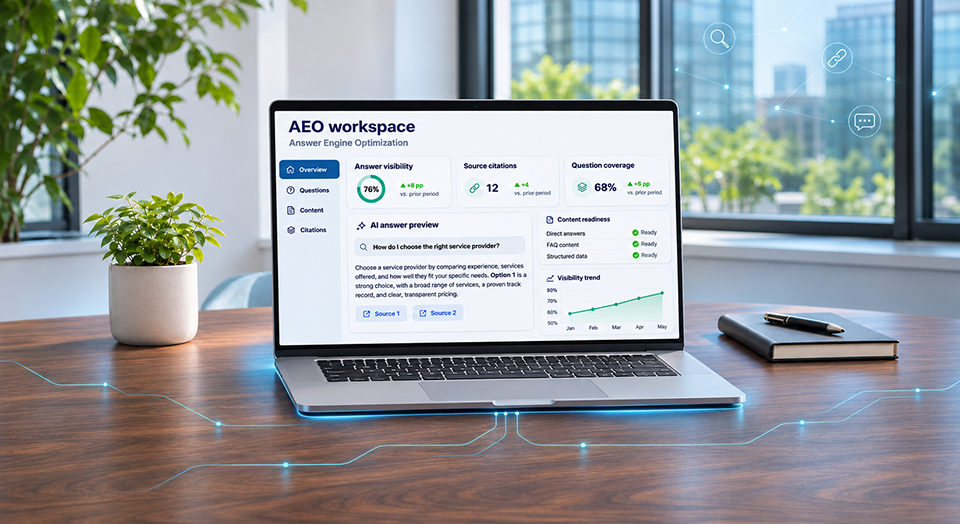
This is where Answer Engine Optimization comes in. This answer engine optimization guide explains what AEO is, how it connects with SEO and which changes to make on your website. We will also look at how to measure your results and get the best out of your efforts, especially if you work with a digital marketing agency to improve your online visibility.
What Is Answer Engine Optimization (AEO)
Answer engine optimization is the process of ensuring your content can be found, understood and used by search engines and AI assistants. This means you are providing clear answers to questions people would actually ask as a buyer, providing evidence to back up your claims and ensuring your page is easily accessible.
An easy way to test if your content works well within an AI answer is to take one paragraph from your page and see if it still makes sense and is helpful. Most pages will not work well as helpful content will be lost in the background information or the answer is conditional on something that was mentioned three paragraphs earlier.
Your information may appear in:
- Featured Snippets – A short summary provided by Google.
- People Also Ask – Expandable questions with answers and sources.
- AI Overviews/AI Mode – Answers generated by Google with links to the page.
- ChatGPT Search/Perplexity – Chat answers with sources.
- Voice Assistants – Answers given in a voice search, may or may not have a source.
AEO vs GEO vs LLMO: How the Terms Overlap
AEO relates to direct answers such as Google’s featured snippets and answers from AI tools. GEO (generative engine optimization) relates to answers provided by generative AI.
LLMO (large language model optimization) is a general term used for optimizing language models to better understand and describe your business/subject. It doesn’t mean you can directly control what the model will say about your business.
There is some overlap.
Different agencies may use these names for much of the same service. When reviewing a proposal ask what platforms they will be optimizing, what changes they will make, and how they plan to measure whether those changes helped.
Why Does AEO Matter in 2026?
AEO is valuable because people aren’t clicking through as much, but for those who do, they’re usually further down the funnel. People are now starting to consider only those businesses that are mentioned in the answer.
This is supported by the data, though it’s less dramatic than many AEO pitches suggest:
- Users clicked traditional results less often when an AI summary appeared. A study done by Pew Research Center in March 2025 shows that only 8% of visits to Google had a click to a traditional result when an AI summary was present. Whereas 15% of visits had a click to a traditional result when there was no AI summary. Only 1% of visits had a click to a link in the summary. [1]
- AI assistants are still a small source of traffic. Ahrefs’ benchmark of 118,671 websites shows that only 0.46% of traffic comes from AI assistants. Whereas 27.55% comes from search engines. Most of the traffic came from ChatGPT. [2]
- The traffic can be well converted. In June 2025, Ahrefs stated that 0.5% of visits came from AI searches, however 12.1% of signups came from AI searches. This is only from one company, so it’s always best to test against your own data. [3]
Overall, we can see that AI assistants are not a large source of traffic, they’re a filter. A buyer searching for 3 roofing contractors in ChatGPT and then visiting one of them is almost at the end of the funnel. This can be very valuable for businesses selling considered purchases as they want to be mentioned in the answer.
This is why you should include AEO in your reporting. Start by looking at how many times you’re mentioned and cited. Then see if you’re getting quality enquiries.
Improve Your Brand’s Visibility in AI-Generated Answers
How Do Answer Engines Choose Their Sources?
When using an AI to search the internet, the question will be split into multiple parts. The tool will then perform multiple searches based on the question, pull out relevant sections from each page, and create an answer. Some answers will include references to pages, while others will be based on the knowledge of the model.
Google refers to this as ‘query fan-out’. Some AI Overviews and AI Mode searches will include multiple related searches before providing an answer.[4] For example, if a homeowner was asking about the best roofer to repair hail damage to their roof, the system may also search for insurance claims, materials, guarantees and local reviews. This means the referenced page will often be the one that provided an answer to a sub-question that no one else would have thought of asking.
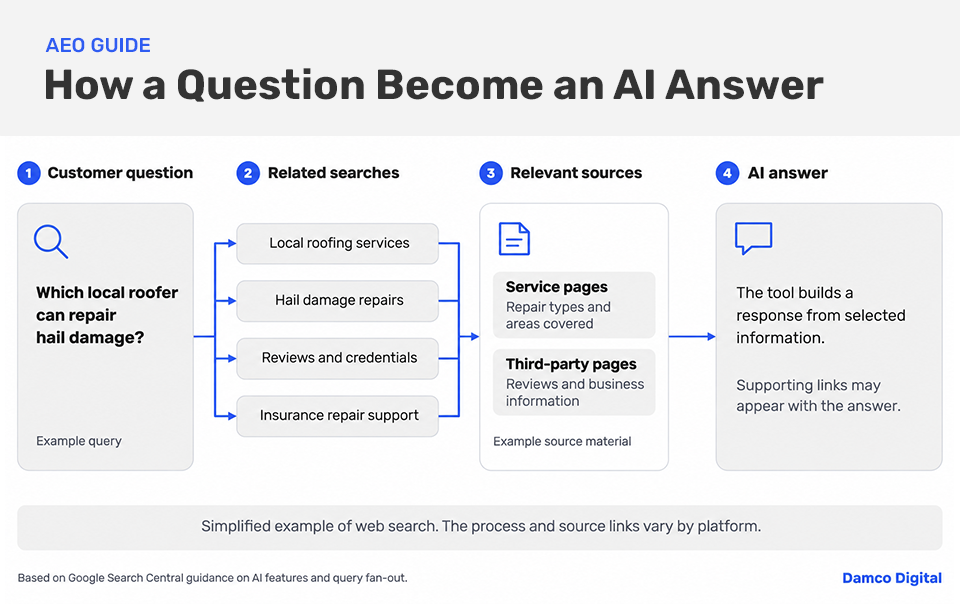
There is no formula for what will be referenced on any of the platforms; however, there are some consistent factors that will help. Having a clear answer, an author that is clearly named and has knowledge of the subject, evidence for any claims and well-structured data that shows the page accurately. Also having mentions of your business on other reputable sites.
Each platform handles sources a little differently:
| Platform | How sources appear | What to check |
|---|---|---|
| Google AI Overviews and AI Mode | Generated answer with links to supporting pages | The page is indexed and eligible for snippets; Search Console’s generative AI report |
| ChatGPT search | Answer with inline links to sources | OpenAI’s search crawler can reach the page; public facts about you are accurate |
| Perplexity | Numbered citations beside the answer | The page states specific, checkable facts |
| Gemini app | Sometimes sources or related links | A related link doesn’t always mean that page supplied the claim |
Being cited in one of these tells you little about the others. Check each platform your buyers actually use.
What Are the Key Differences Between AEO and SEO?
While SEO will ensure that your pages appear in the search results, AEO aims to help include the information you offer in the answer. Due to the similarities between the two disciplines, AEO is best used as an additional layer to your SEO strategy.
| Area | SEO focus | AEO focus |
|---|---|---|
| Goal | Search visibility and relevant traffic | Accurate inclusion or citation in direct answers |
| Metrics | Rankings, impressions, clicks, conversions | Mentions, citations, AI referrals, conversions |
| Unit of content | The whole page | The passage: one section that stands on its own |
| Query type | Short keywords and longer searches | Full questions, comparisons and follow-ups |
| Signals | Relevance, quality, links, technical health | The same, with more weight on evidence and complete answers |
According to Google’s guidelines, there are no specific requirements to have content included in AI Overviews or AI Mode, other than standard SEO fundamentals. Therefore, it’s not recommended to reduce budget from your SEO services, rather focus on ensuring the fundamentals are strong and improve the most likely to be quoted sections.
Your Answer Engine Optimization Guide: 8 Steps to Get Cited by AI
Start with pages that naturally generate leads, using your core offer pages, pricing page and top performing guides. Improving these pages can be a better starting point than creating 20 new posts.
1. Research the Questions Buyers Actually Ask
The best questions will rarely be identified using a keyword tool. Look at your sales notes, support tickets, live chats, search console queries, people also ask, and forums buyers use. Group the questions into categories based around the decision they are trying to make.
A team looking for a CRM, for example, will want to know:
- Does it integrate with our tools?
- How do we transfer our data?
- What are the additional charges?
Map these to the pages you already have. Often this will be a simple case of improving a paragraph on an existing integrations page. As a rule of thumb, if your sales team hears the question once a week then it should go on your website.
2. Lead Each Section With a 40 to 60 Word Answer
Give the answer first and then the details. Keep your answers to between 40-60 words, but there are some questions that will require more space.
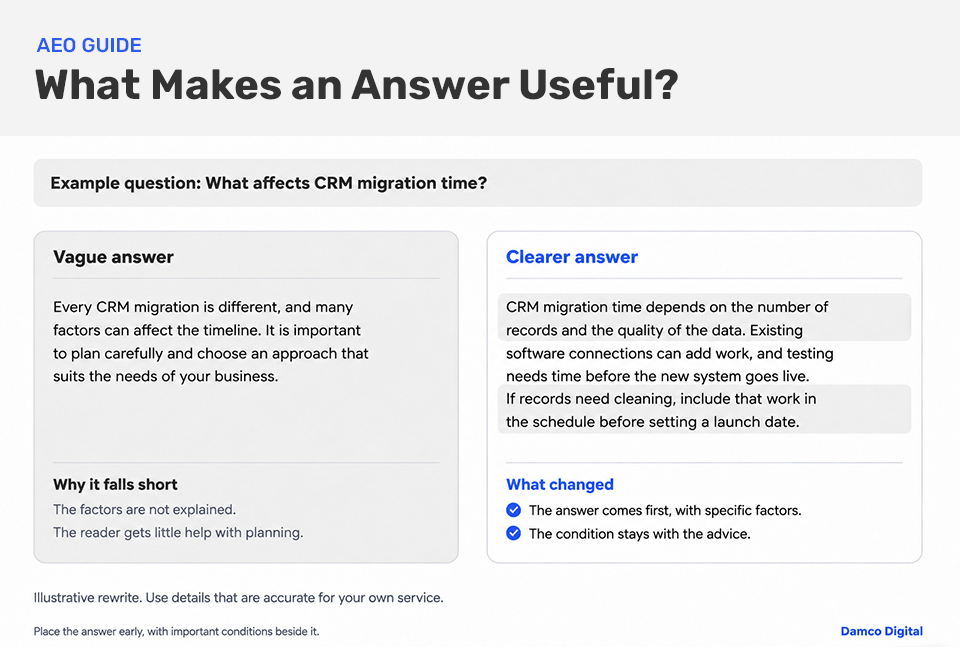
Compare two openings to “How long does a CRM migration take?” A weak response would say; every migration is different, and many factors play a role. A strong answer showcases a typical range for a team of a stated size, then names what moves it: record volume, data quality, the number of integrations and how much testing is needed.
If there are any conditions to your answer, include them. For example, if the starting price only includes the basic plan, make sure to include that in the same sentence. This way if someone reads this passage or an AI quotes it, they will have the correct understanding.
3. Use Question Based Headings
Use the language that customers would search for/ ask during sales. This will help the reader know what to expect from the content. For example, ‘How much does a new roof cost?’ is far more descriptive than ‘Understanding your roofing investment’.
Answer the heading’s question at the start of the section. Not all headings may need to be a question, but if it fits, then great.
4. Use Lists, Tables and Short Paragraphs
Use numbered lists for any step-by-step instructions. Tables can be used to compare different options using the same criteria. Keep paragraphs short and to the point.
Include any conditions with the answer. If you’re including pricing then make sure to state what is included.
5. Use Schema Markup
Schema helps to label information on your page for machines. Article schema will label your post and who wrote it. Organization will label your business. FAQPage will label any questions and answers that have been published. HowTo will label instructions on how to complete something.
Choose markup that fits the content already on the page:
| Schema type | What it describes |
|---|---|
| FAQPage | Questions with answers provided by the website publisher. |
| HowTo | Instructions for completing a task through a series of steps. |
| Article | An article or blog post, including details such as its author and publication date. |
| Organization | The business behind the website, with details such as its name and official website address. |
Check what schema your CMS is adding automatically and ensure that it matches the page. Google has retired FAQ and HowTo rich-result displays. [5] [6]. Adding them does not restore those displays or guarantee an AI citation. Use them where they accurately describe the content, rather than adding every type to every page.
6. Build E-E-A-T
The term E-E-A-T stands for Experience, Expertise, Authoritativeness, and Trustworthiness. It is something both the reader and an AI will be after; you cannot put a generic spin on it. Have an author who has put in the work put his or her name to it, with a brief bio at the end of the piece. Do not simply say your process is error free, rather detail the checks the team makes and what is done if one does not hold up. A word from someone with first-hand knowledge of the subject goes a long way.
There is no substitute for original data. Put some of your most frequent support questions under the microscope, put your product through its paces or share client results you have the approval to make public. Include the method, sample size,and limits, so readers can judge the numbers for themselves.
7. Strengthen Entity and Brand Signals
AI systems need to know which business a page describes. The company’s name, services, location and contact information must be the same on your site as they are on your Google Business Profile and in directory listings. That is what entity SEO is all about.
Encourage reviews that reflect an actual experience and offer your expertise to publications your buyers frequently read. A detailed mention on a respected industry site helps buyers understand you, even if no AI tool ever cites it. Don’t pay for mentions just to raise a count.
8. Fix the Technical Foundation
None of the above mentioned steps matter if a crawler is unable to get to the page. See that the right pages are indexed, and internal links are in order, that mobile performance is good, and key info is in HTML text and not locked in an image. Verify your firewall or CDN is not turning away legitimate crawlers.
Understand the controls clearly. OpenAI uses OAI-SearchBot to determine what shows up in ChatGPT search and GPTBot for gathering content to train the model, and they are separate entities [7]. If you block GPTBot the content is off limits for training; block OAI-SearchBot and you are out of the ChatGPT answers.
Google now has a Search Console setting that removes a site from AI Overviews and AI Mode. Google states that sites that opt out “will not receive traffic or impressions from our generative AI features.”[8] Leave it on its default unless you have a clear reason to opt out.
“Find Out Where Your Brand Shows Up in AI Answers.”
How Does AEO Change for Different Content Types?
Every page type will have a different aim, so the information it provides should match what the reader needs. A blog will explain, product pages confirm, while local pages show that you are local to that area, and service pages set expectations.
The fastest way to improve your page is to change any vague statements into statements the buyer can act on:
| Page type | Vague | Specific |
|---|---|---|
| Blog | CRM migration requires planning. | Before migrating CRM data, remove duplicates, map the required fields and run a test import. |
| Product | Designed for growing teams. | The Business plan adds shared approvals and role-based access. Check its user limit before you buy. |
| Local | Local roofing experts. | We inspect leaking roofs and give repair estimates to homeowners in the towns listed below. |
| Service | Effective marketing that drives results. | Includes campaign setup, conversion tracking, and a monthly review against your agreed lead targets. |
Only write what you actually offer, and include the limits: exclusions, compatibility, and service areas. An AI tool that quotes your page will repeat any overpromise along with it.
How Does AEO Work for Voice and Local Search?
Voice and Local Search add an element of practicality. Are you open now? Do you fix tankless water heaters? Do you cover my zip code? The business that answers these plainly, and consistently everywhere, is the one that gets cited.
Start with your Google Business Profile. Keep hours, services, categories and service areas current, and make sure they match your website word for word. Add LocalBusiness schema that reflects the same details.
Location pages need something that’s genuinely true of each place: response times, local project examples, permit or rebate notes, or the neighborhoods you cover. Swapping one city name for another adds nothing, and Google treats near-identical pages with suspicion. Our complete guide to local SEO for home services covers this in depth and local SEO for HVAC companies shows it applied to one trade.
Voice assistants run on different systems from chatbots, so a ChatGPT citation doesn’t mean Siri or Alexa will name you. Test the assistants your customers actually use or are popular within the community.
How Do You Measure AEO?
Do it by tracking mentions, citations and traffic on their own and then relating them back to enquiries. They have a way of moving independently; an AI may put your business name in an answer with no link to you or cite the page without so much as mentioning the brand.
| Measure | What to track | What it tells you |
|---|---|---|
| Answer inclusion | Featured snippets and AI Overview appearances for chosen queries | Whether your content shows up in those results |
| Brand mentions | AI answers that name your business | Whether you’re part of the conversation |
| Citations | Answers that link to your domain, and which pages | Which content AI tools are using |
| AI referrals | GA4 sessions from sources such as chatgpt.com and perplexity.ai, with landing pages and key events | What identifiable visitors do once they arrive |
| Business impact | Qualified enquiries, sales and CRM records | Whether any of it turns into revenue |
Run a Simple 20-Prompt Test
There is no need for a tool to establish a baseline, just some consistency.
- Write down 20 of the most common questions your buyers ask you, from discovery through to purchase.
- Go to the AI tools they use and run each one in a new conversation. Put down the date and whether web search was active, and location where relevant.
- Make a note of what businesses get named and the pages that are cited.
- Improve three to five relevant pages, and log exactly what you changed.
- Repeat the same prompts weekly for six to eight weeks.
Say six of your 20 prompts cite your business; your citation rate for that set is 30%. The number only means something against your own baseline and your own prompts, and repeated checks matter more than one good result. Answers vary from run to run, so look for a trend rather than a single jump.
Use Search Console’s Generative AI Report
Google introduced a separate report for its AI search features in June 2026 and made it available to all sites on August 31. [9] The report gives a breakdown of impressions from AI Overviews and AI Mode by date, device, country and page. Clicks and queries are not part of the picture yet, they remain in the standard Performance report.[10]
Combine this with GA4 and your CRM. But also be mindful of the fact that a certain amount of referral data is lost with some AI traffic, and buyers may well return at a later date through a branded search, so put a “How did you hear about us?” line on your enquiry forms. If you need help connecting these sources, our Google Analytics consulting team sets this up regularly.
What Are the Best AEO Tools in 2026?
The best tool is one that helps you make important decisions such as what page to improve next or analyze which competitors are being mentioned/cited. Most teams will only need one tool from each row below.
| Job | Examples | What it’s for |
|---|---|---|
| AI visibility tracking | Semrush AI Visibility Toolkit, Ahrefs Brand Radar | Track any mentions of your brand and website references across supported AI platforms. |
| Question research | Search Console, Semrush, Ahrefs, sales and support notes | Identify the questions customers are asking and any gaps in your website content. |
| Schema checks | Schema Markup Validator, Google Rich Results Test | Ensures your schema is error free and eligible for use in supported Google search features. |
| Content review | An experienced editor, plus content analysis tools | Checks whether answers are clear and supported by useful evidence |
| Performance Tracking | Search Console, GA4 and your CRM | Track traffic, enquiries, and sales from AI sources. |
There are a number of tools available to track AI visibility. Different tools track different prompts, platforms, and locations. For example, Semrush’s Prompt Tracking and Ahrefs’ Brand Radar will not have the same numbers as they use different prompts. [11] [12] Neither tool will track private conversations. It is important to know what each tool tracks to ensure you can make comparisons or provide results to leadership.
What Are the Most Common AEO Mistakes?
For the most part, AEO mistakes are a case of writing for a machine over a buyer. Here is what we see the most:
- Burying the answer. When three paragraphs of background must be waded through before the point is made, it is too much work for the reader and leaves AI with nothing to put in a clean quote.
- Answers without any substance. You can quote a one-line definition, but it is rarely of any use. Put in enough detail that someone could act on it.
- Question headings on every page. If there are 30 near-identical questions on a page it will read as if put together for a crawler. The reader will spot it and move on.
- Using schema as a shortcut. Markup that doesn’t match with the page or where authorship is not clear does more to erode trust than to establish it.
- Overlooking technical SEO. Good writing can’t do much if a blocked crawler or an unindexed page means it cannot be cited.
- No baseline. There is no way to know if a new citation is due to your efforts or normal variation unless you have a record of what was changed and where you were to begin with.
AEO Checklist
Use this checklist to make sure you’ve covered everything when improving your pages.
- The page answers a question that customers ask and ties into a business objective.
- You’ve checked to see if there is an existing page that can answer the question.
- Each section answers the question clearly at the start of the section, including the criteria that need to be met.
- Headings clearly show what the page will cover.
- Information is presented as a list of steps, comparison tables, or paragraphs.
- All claims made are supported with evidence, examples, or your own data.
- A named author with genuine experience is included. A reviewer is included where appropriate.
- Schema matches the content shown. No duplicate or conflicting information.
- Page is indexed, mobile friendly and accessible by the correct crawlers.
- Business information is consistent across your site, Google Business Profile, and listings.
- You’ve taken note of your baseline mentions, citations, AI referrals, and enquiries.
- Someone owns the page and has a date to review it.
Is your page ready for AI search?
Identify opportunities to improve your content visibility across AI search platforms.
Should You Do AEO In-House or Hire an Agency?
The ideal option is to have AEO done in-house. This means you have your own team that can dedicate time to working with subject matter experts, editing pages, technical issues, and monthly tracking. Start small, just a few pages and ensure there is an owner for each task.
If you operate in multiple markets, have multiple products or platforms or nobody in your team has the time to dedicate to this on a regular basis, an agency would be the best option. However, before you begin, make sure you ask the following questions:
How do you decide which questions and pages to work on?
How do you track mentions and citations?
What is considered a result and how will you prove this?
A good agency partner will be honest with you and answer all these questions plainly. They will also ensure they are connecting the work to enquiries and not just citations. If you want a second opinion on where to start, Damco Digital provides AI Seo Services, where everything from content, technical solutions and measuring performance can be done in one place.
Conclusion
AEO isn’t about starting from scratch. It’s about making your best pages more quotable, credible, and findable. Go to your top 5 lead generating pages and using this answer engine optimization guide you can ask yourself:
- Are answers clear, specific, and backed up with evidence?
- Can search engines and AI crawlers easily access and understand the page?
- Are you tracking citations?
Make a note of any changes made and allow 6-8 weeks to see how they perform. If you would like some guidance on where to start, book a free AI search audit with Damco Digital to review your website’s current AI search visibility and identify areas for improvement.
References:
- [1]: Pew Research Center: Google users are less likely to click on links when an AI summary appears
- [2]: Ahrefs: AI vs Search Traffic benchmark (updated November 3, 2026)
- [3]: Ahrefs: Does AI search traffic convert better than traditional search?
- [4]: Google Search Central: AI features and your website
- [5]: Google Search Central: documentation updates
- [6]: Google Search Central: Changes to HowTo and FAQ rich results
- [7]: OpenAI: Overview of OpenAI crawlers
- [8]: Google: New opportunities, control and insights for website owners
- [9]: Google Search Console AI reports rolled out worldwide
- [10]: Google: Search Console Generative AI performance report
- [11]: Semrush: Prompt Tracking
- [12]: Ahrefs: What is Brand Radar