
 ChatGPT
 Claude
 Perplexity
 Gemini
Key Takeaways:
- A complete Google Business Profile helps homeowners find you faster.
- Local SEO brings your business in front of people ready to book.
- Paid ads with strong landing pages bring real customer leads.
- Homeowners read reviews before hiring, so reputation management matters.
- Helpful content like blogs and videos builds trust between service calls.
- Email and referral programs keep past customers coming back for more.

What makes one contractor fully booked while another constantly chases the next job?
The difference often comes down to marketing. Homeowners today research online before they call. They look for signs of reliability. They will hire someone else if they cannot find you online easily. So, the goal is simple: be the contractor homeowners can find fast and trust immediately. That is how you win more jobs in 2026.
This piece explores practical marketing for home services that generates more leads and delivers measurable growth.
Build a Strong Local Presence with Home Services SEO
“The reality of SEO is the reality of any successful endeavor: It will take strategic, consistent, and sufficient efforts to rank well”
Viola Eva, Founder of Flow SEO
Local search drives most home services bookings. People who look up phrases like “emergency plumber near me” or “HVAC repair in Austin” often need help right away and are ready to book. Home services SEO helps your business get noticed by these high-intent customers when it matters most.
Set Up Your Google Business Profile
Your Google Business Profile works like an online storefront for your company. If your profile is incomplete, it will not rank well no matter how much you focus on other marketing strategies.
Keep your NAP consistent: Your business name, address, and phone number must match everywhere they appear online. Search engines check this information to verify your credibility. Inconsistencies erode trust and hurt your rankings.
Pick the right category: Your primary category tells Google what you do. It determines when your listing appears. An HVAC company that selects “Heating contractor” instead of “HVAC contractor” reduces its chances of being found without even knowing it.
Fill out every section: List accurate business hours, a local phone number, a professional description, and quality photos. Businesses with complete profiles show up more frequently in local searches.
Use Local Search Terms That Show Buying Intent
Keywords that combine services with locations help attract customers ready to book. Terms like “plumbing services in Atlanta” or “emergency AC repair in Dallas” signal that people need a service immediately.
Use long-tail keywords: Phrases like “affordable HVAC repair in Dallas” or “emergency electrician in Phoenix” pull in homeowners with clear intent. These searches convert better than broad terms because they address specific problems.
Focus on “near me” searches: These searches show that users need local help urgently. Optimizing for them allows you to connect with mobile users who are looking for a solution at that very moment.
Create Location-Specific Service Pages
Service area pages target cities where you operate without requiring physical storefronts. Companies that dominate local search usually have 15 to 20 properly optimized location pages.
Make each page unique: Avoid duplicate content by making 40-60% of each page unique to that location. Include local project showcases. Add FAQ sections that talk about regional concerns.
Structure each page carefully: Use URLs that include city names. Write unique title tags and headers that emphasize location and services. Link services to deeper page details for better crawlability. Avoid dumping city lists into body text. Google treats this as keyword stuffing.
Building a Robust Online Presence with Digital Marketing for Real Estate
Boost Your Local SEO with Schema Markup and Citations
Schema markup removes guesswork for search engines. LocalBusiness schema communicates your category, service area, and contact details. Service schema tells engines what you offer and where. All this helps match user intent with specific services.
Build consistent citations: Citations are online mentions of your business name, address, and phone number. The more consistent citations you have, the better your local SEO works. Google and Bing use citations as ranking factors.
List business on trusted directories: Submit your information to industry-specific directories, like Angi, Houzz, CitySearch, Yelp, and Yellow Pages. Keep your NAP information the same on all these platforms.
Capture High-Intent Leads with Paid Advertising
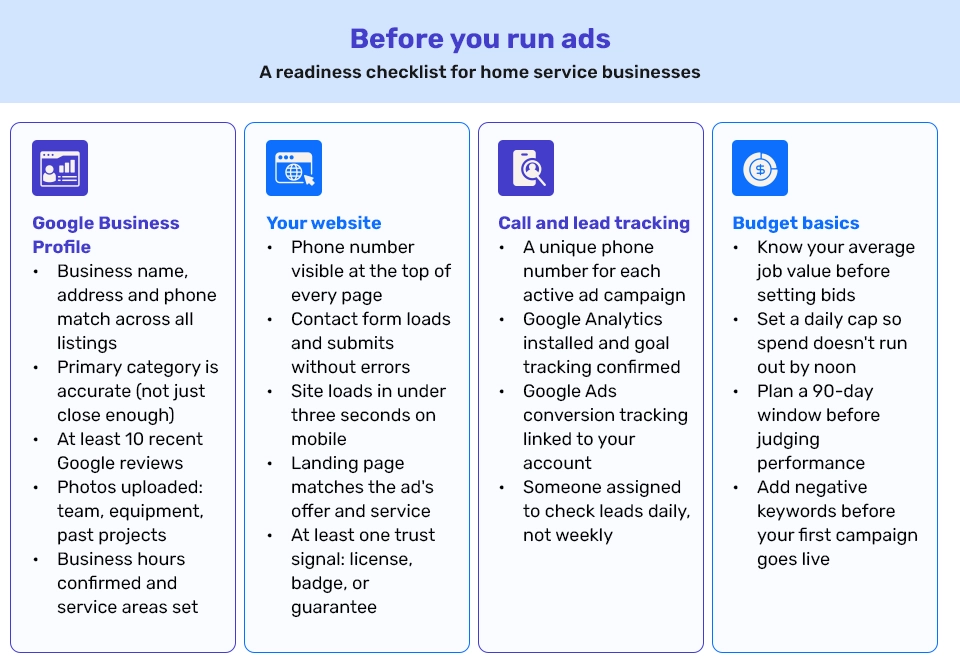
Paid ads help your home services business show up at the top of search results when homeowners need quick assistance. They create a reliable flow of quality leads that helps grow your business faster.
Boost Lead Generation with Google Search Ads
Google Search Ads reach homeowners looking for specific services. These ads show up at the very top and bottom of search results. They occupy prime positions when someone searches for services similar to yours. Search ads give instant visibility compared to SEO services, which take time to yield results.
Pick the right keywords: The success of your ads depends on choosing the right keywords. Terms like “plumber near me” or “emergency AC repair” attract customers ready to book. More detailed keywords such as “affordable HVAC repair near me” or “local electricians for home rewiring” pull in more specific traffic.
Manage your budget well: You only pay when someone clicks your ad. This makes it easier to track how well your money is working for you. Set daily or monthly limits that match your marketing goals.
Try Local Services Ads: These ads appear above regular search ads with a Google Guaranteed badge. Businesses with strong reviews and complete profiles get an edge here. The badge builds instant trust with potential customers.
Enable call extensions: One-click dialing converts mobile searches into immediate phone calls. Call tracking numbers in your ads and landing pages attribute phone calls to specific campaigns. That way, they show which keywords drive the most phone leads.
Bring Back Past Leads with Retargeting Campaigns
Retargeting re-engages potential customers who visited your website but did not convert. These campaigns place tracking pixels on users’ browsers. Then they show targeted ads as those users browse other websites and social platforms.
Target specific behaviors: If a user viewed your plumbing services page but did not request a quote, show them ads highlighting your expertise or special offers. This encourages them to return and complete their booking.
Segment your audience: Create different retargeting lists for different behaviors. Visitors who abandoned service request forms need different messaging than those who viewed several service pages. Tailor your offers to address specific needs at each stage.
Optimize Landing Pages for More Conversions
Landing pages convert two to five times better than homepages for ad traffic. Why? Because they focus on a single action. The landing page determines whether users take the desired action, so design matters greatly.
Match your copy: Your landing page copy should match your ad copy and fulfill the keyword’s search intent. This increases your quality score and improves conversion rates.
Place forms at the top: Put contact forms above the fold. Use clear call-to-action buttons with contrasting colors and action-oriented text like “Get a Free Quote”.
Test and refine: Try different headlines, images, and button text. Small changes can significantly impact conversion rates. Use what works and improve what does not.
Build Trust Through Reviews and Reputation Management
Research tells us that around 97% of consumers read online reviews before choosing a local business. Reputation management builds the credibility that makes your home services marketing strategies work.
Build a Consistent Flow of Customer Reviews
Timing matters a lot in reviews. Ask for feedback right after you finish the job. Satisfaction is fresh, and customers are most willing to share their experience. Send follow-up emails or text messages within 24 hours with links to your Google Business Profile.
Automate the process: Set up post-service email sequences through platforms that trigger review requests after job completion. Add QR codes to invoices and business cards that link to your review page. Most consumers are open to writing a review, but convenience decides whether they do it.
Use phone calls: A quick call to check on satisfaction shows genuine care. When customers are happy, they often agree to leave a review right then. This approach feels personal, not transactional, and gives better results than automated requests alone.
Respond to Every Review with Professionalism
Response rates matter. Around 89% of consumers are more likely to buy from a business that responds to all reviews, positive and negative.
Address reviewers by name and acknowledge the points they mentioned. Generic responses show disinterest and reduce trust. For positive reviews, express genuine gratitude and reference details from their experience. For negative reviews, acknowledge their concerns, apologize, even when issues were beyond your control, and offer clear solutions.
Showcase Testimonials on Your Website and Social Media
Displaying testimonials on your website and social channels can increase your conversions significantly.
Place testimonials strategically: Place them on your homepage, on service pages, and near call-to-action buttons where customers make booking decisions. Genuine testimonials include customer names, photos when possible, and details about the services received.
Mix up the formats: Some visitors prefer reading text. Others like to watch video testimonials. Before-and-after photos combined with customer feedback provide solid proof of your results. Share testimonials across social platforms to reinforce your positive reputation. Every testimonial strengthens the trust signals that make your contractor marketing strategies work.
Struggling with an Empty Job Calendar?
Keep Your Business Top of Mind with Content Marketing
Content marketing keeps contractors visible between service calls. Homeowners research before booking, and businesses that provide helpful information position themselves as experts. Customers call the companies they know and trust when urgent needs arise.
Answer Common Homeowner Questions Through Blogs
Blog posts address the questions homeowners search for before hiring contractors. Topics like “how to lower your electric bill” or “how to maintain your air conditioner” attract visitors seeking solutions. These posts establish your expertise and bring organic search traffic.
Educational content builds credibility: People prefer learning about a company through articles rather than advertisements. Seasonal maintenance guides work especially well. Post them months ahead to give Google time to index and rank your content. For example, a furnace maintenance guide published in early fall pulls in homeowners preparing for winter.
Share your posts on social media: This expands your reach and drives website traffic. Businesses that publish educational content regularly see better lead quality. Many report improved prospects from their content marketing efforts.
Showcase Real Projects with Before-and-After Stories
Before-and-after transformations show your capabilities better than descriptions alone. Real project showcases reveal your problem-solving skills and quality standards. Photos showing awkward layouts transformed into functional spaces provide solid proof of results.
Tell the story behind projects: Explain the problem, your solution, and the result. Homeowners connect with relatable challenges. A poorly placed staircase. An inefficient floor plan. An outdated electrical system. When they see how you solved similar issues, they imagine you solving theirs.
Mention specific details: Tell users about the timeline, the materials used, and any unique challenges you overcame. This level of detail builds trust and shows your expertise.
Use Short-Form Videos to Build Trust
Short-form video delivers the highest ROI among content formats in 2026. Videos answer buyer questions quickly and build personal connections with potential customers. 93% of companies gain new customers from marketing their video content.
Start simple: Film quick answers to common questions. Show behind-the-scenes work. Create seasonal maintenance tips. Even smartphone footage works well when your expertise addresses genuine homeowner concerns.
Be consistent: Regular videos establish familiarity. When a service need emerges, your brand comes to mind first. Contractors who show up consistently in videos become the obvious choice.
Improve Customer Retention with Email and Referral Marketing
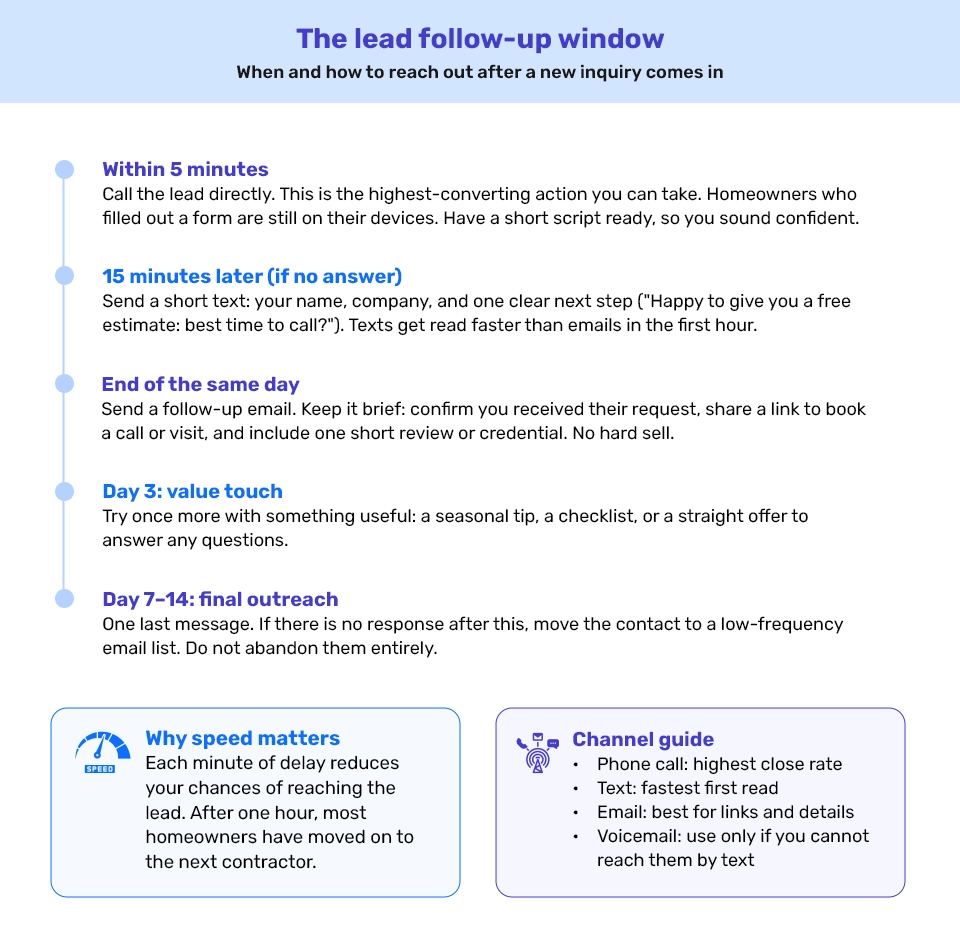
New customers cost five times more to acquire than keeping existing ones. Email and referral marketing turn one-time jobs into recurring revenue. These home services marketing strategies keep your business top of mind without the expense of paid ads.
Send Maintenance Reminders & Seasonal Offers
Email marketing delivers strong returns. You can expect $36 to $42 in revenue for every dollar you spend.
Personalize your messages: Emails that speak to individual customers achieve much better conversions than generic messages. Use the customer’s name. Talk about the specific services you provided. Mention their equipment type and home details when possible.
Time your communication: Send reminders based on when customers last used your services. A customer who had their furnace serviced in November should hear from you in October of the following year. This timing catches them before they search elsewhere.
Turn Customers Into Brand Advocates with Referral Programs
Referral programs use trust that paid advertising cannot buy. In fact, many home service businesses report referrals as their top source of new work.
Offer meaningful incentives: Service discounts, gift cards, or free maintenance visits motivate customers to spread the word about your business. A $50 credit toward future service often costs less than acquiring a new customer through advertising, and the lead quality is usually higher.
Promote your program everywhere: Feature it in email campaigns. Add a form to your website. Leave physical cards at job sites. Mention the program when you ask for reviews. The more visible your referral program, the more customers will take part.
Still Running Your Campaigns on Guesswork
Treat Your Home Services Marketing Strategies Like an Investment
Marketing budgets separate growing home services companies from those struggling to fill schedules. Successful businesses track key metrics, improve their digital assets, and refine campaigns based on performance data.
Track the Metrics That Matter
Data takes the guesswork out of your growth. Focus on these key performance indicators:
- Cost per Lead: This tells you how much you pay to find a new prospect. Calculate it by dividing your total marketing spend by the number of leads you generated.
- Marketing ROI: This measures your profit. It shows how much money you earn back for every dollar spent on advertising.
- Customer Lifetime Value: This estimates the total revenue you can expect from one customer throughout their entire time with your business.
- Website Conversion Rate: This tracks the percentage of site visitors who take action, such as submitting a contact form.
- Phone Call Tracking: Use unique tracking numbers for different campaigns. This lets you see which ads make the phone ring.
Continuously Test and Improve Your Campaigns
Instead of deciding what works based on opinion, you can test variations using A/B testing and let your data decide.
Test small changes: Test two or more email subject lines to see which gets more opens. Test ad copies to see which drives more clicks. Test landing page elements to see which converts better. Test call-to-action buttons to see which gets more taps.
Start with one variable at a time: Change your headline first, and not your headline, your image, and your button color all at once. That way, you know what caused the improvement. Run the test long enough to get statistically significant results.
Build a culture of experimentation: Continuous testing brings steady growth for every digital marketing agency and home services business.
Conclusion
To win more jobs, you need more than quality work. Homeowners book contractors they can find quickly and trust right away. Home services marketing strategies that combine local SEO, paid advertising, and reputation management do better than businesses waiting for referrals.
Success comes from treating these strategies as interconnected systems instead of separate tools. Track cost per lead, conversion rates, and return on ad spend to identify what works. And then refine campaigns based on this data.
Contractors dominating their markets view marketing as an investment that brings long-term growth. This approach keeps their lead pipelines full while their competitors struggle to find their next job.
References
- SEO quotes to guide your SEO campaign
- Local SEO home service marketing — the complete resource guide
- What is a landing page — how to build one that converts in 2026
- Local consumer review survey
- Respond to all your online reviews
- 93% of businesses now use video marketing to generate leads
- Email marketing for home service businesses