
 ChatGPT
 Claude
 Perplexity
 Gemini
The Internet has become the go-to source for home buyers searching for a new property today. The real estate arena has changed completely. Print ads and yard signs don’t produce enough traction. Digital channels now rule the market and bring traffic. Agents must meet buyers online where they spend most of their time.
Successful real estate businesses work with digital marketing agencies to help them navigate this new terrain. An agency comprehends the unique demands of property marketing and creates tailored strategies to reach buyers. Their efforts help produce quality leads and improve sales for agents dedicated to closing more deals.

What Makes Digital Marketing Critical for Real Estate Enterprises?
The real estate industry has undergone a fundamental change. Property search now happens mostly online, making digital marketing an essential part of business success. The National Association of Realtors reports that all homebuyers use the Internet during their search. Businesses need to adjust their strategies to reach these buyers online.
I. Changing Real Estate Buyer Behavior
Today’s homebuyers do a lot of research online before contacting an agent. This has changed how people find and evaluate properties. Digital interactions now serve as the first point of contact between potential buyers and properties.
Virtual tours have become a standard expectation today. Research tells us that 73% of buyers reported wanting to see a property virtually before visiting in person. Properties with these tours sell much faster than those without.
AI-based search tools have changed how buyers find homes. Zillow and similar platforms now allow natural language searches. Users can skip complex filter systems and type everyday phrases like “2-bedroom homes near Central Park” to get results. What’s more, these tools grow smarter each day. They learn from past searches to provide more personalized results over time.
II. Growing Need for Visibility, Trust, and Engagement
A big majority of homebuyers start their search online, so a strong digital presence across different channels has now become essential. A good digital marketing strategy covers:
- Search engines for getting quality leads.
- Social media as a standard lead-generation tool.
- Email marketing for maintaining relationships with buyers.
Yet visibility alone is not enough. Trust is now a big deciding factor. As AI-based imagery and virtual staging become more common, transparent marketing helps realtors stand out. Marketing materials that create unrealistic expectations can damage an agent’s reputation.
Smart marketing strategies focus on improving engagement. They use quality photos and videos to get user attention and build emotional connections. They also back these with accurate information in the form of interactive floor plans and virtual tours. All this helps buyers picture themselves living in that space and understand if it matches their needs.
Real estate professionals must adjust their strategies as the industry becomes digital. They can stay competitive in today’s marketplace by establishing a strong online presence and building trust through authentic content.
Digital Marketing for Real Estate: Strategies for Growth
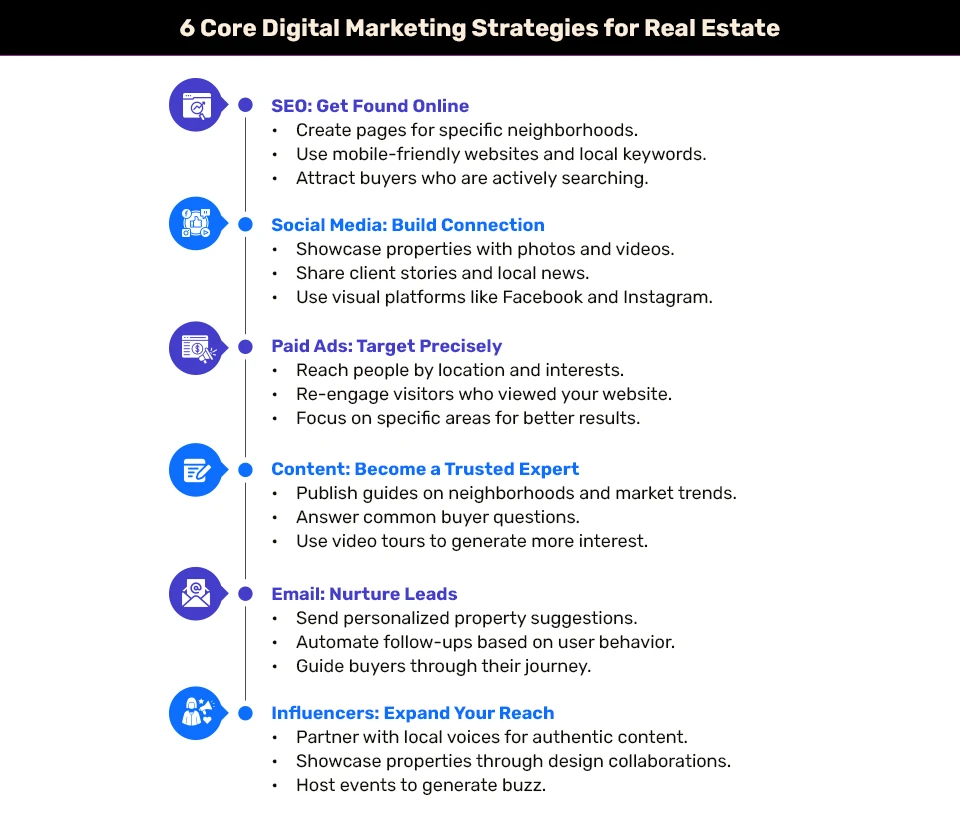
Real estate companies understand that successful digital marketing needs a coordinated approach. They need to use various strategies in combination to attract interest and generate leads.
1. SEO to Attract Qualified Leads
SEO is the foundation of real estate digital marketing. Real estate businesses that use good SEO strategies attract serious buyers and drive traffic with higher chances of conversion.
These strategies work well in real estate:
- Creating location-based landing pages for different neighborhoods
- Optimizing websites for mobile devices
- Using targeted keywords that match buyer intent
- Getting quality backlinks from real estate directories and local business associations
When used properly, these methods help agents reach people who are already looking to buy homes. This leads to faster sales.
2. Social Media to Improve Engagement
Social platforms allow agents to showcase properties and build stronger community connections. Facebook is widely used by realtors. Instagram’s visual nature makes it useful for selling properties. Pinterest reaches buyers researching homes, especially women who make up 70% of its user base.
Visual content shows better results on these platforms. Most people would much rather see a property than just read about it. Agents also use these platforms to share client stories, market news, and local updates, which helps build reputation and show their expertise.
3. Paid Advertising for Better Returns
Paid advertising helps realtors reach qualified prospects easily. Ads on Google and Facebook let them target users based on location, demographics, interests, and life events like job changes.
Remarketing delivers good results for many real estate businesses. It shows ads to people who visited a website previously but did not inquire about properties. Remarketing can bring them back. Facebook’s dynamic ads take this further by showing users properties based on their browsing behavior.
Real estate paid campaigns perform well when they focus on specific neighborhoods or property types rather than general branding. This approach leads to more serious inquiries and strong returns.
AI in Digital Marketing: Why It’s Essential for Businesses Today
4. Content Marketing to Strengthen Brand Authority
“The easiest way to turn off your community members is to broadcast the same message across multiple channels. Instead, determine the kind of content that interests the members of your community in a way that is useful to them.”
Joe Pulizzi,founder, Content Marketing Institute
Content marketing helps real estate professionals become knowledgeable advisors. Blogs, guides, and videos let them build credibility and attract potential clients who need assistance in the buying process.
Quality content provides answers to questions buyers might have during their property search. It covers:
- Neighborhood guides that display local amenities
- Market analyses that explain current trends
- Tips on home buying, financing, and investment
- Property comparisons that help buyers evaluate options
Agents who provide satisfactory answers become the go-to experts for users seeking guidance.
Video is a particularly useful format in this context. Property listings with videos get 403% more inquiries than those without. Property tours, neighborhood spotlights, and client testimonials in video format create a better connection with buyers and support more sales.
5. Email and Marketing Automation for Driving Conversions
Emails are a smart way to nurture leads through their buying journey. Properly designed email campaigns deliver content based on buyers’ interests, preferred locations, and buying stages. This information assists them in making decisions.
Marketing automation makes this process more efficient. It sends timely messages based on prospect behavior. To give an example, when someone views certain properties multiple times, the system can send personalized follow-ups with information on similar listings. This approach maintains regular communication and does not require a lot of manual work.
6. Partnerships with Influencers to Improve Reach
Collaborations with local influencers help real estate businesses find previously untapped groups of buyers. Micro-influencers with modest followings deliver better results than celebrity endorsements for property marketing.
These partnerships create content around a property’s features, nearby amenities, or lifestyle benefits. Real estate agents also work with home design influencers on staging projects that show properties in their best light.
For luxury properties, organizing events with influencers can create visibility. These events generate attention. They also produce content that can be shared across many platforms, reaching beyond a company’s current audience.
How Does a Real Estate Digital Marketing Agency Deliver Value?
Digital marketing in any domain requires specialized expertise. Real estate businesses choose to work with dedicated marketing agencies to gain an edge in competitive property markets. These agencies bring skills and industry knowledge that are difficult to build internally.
Marketing agencies first conduct a thorough analysis of the local property landscape. They spot target audiences, study competitor activity, and discover areas for growth. This research helps them build custom plans, whether the goal is to secure more listings, increase sales, or boost brand reputation.
These agencies deliver value in many ways:
- Technical Execution: Building websites suited for property searches, adding virtual tours, and setting up customer management systems
- Multi-Channel Campaigns: Coordinating efforts across search engines, social media, email, and content platforms
- Data-Backed Decision Making: Setting up metrics, tracking results, and adjusting strategies based on performance
- Industry-Specific Creativity: Developing content that addresses the specific concerns of home buyers and sellers
- Budget Optimization: Directing funds toward channels that deliver the best results for real estate
Their execution capabilities play an equally vital role. While some real estate professionals understand marketing fundamentals, agencies provide specialists in each discipline. These experts keep track of changes in marketing technologies and methods that real estate professionals might overlook.
An external perspective is another benefit. Internal teams can sometimes miss gaps in their own strategy. A digital marketing agency for real estate brings fresh insight drawn from experience with multiple clients.
Project management also adds value. Digital marketing involves many elements. Agencies create smooth workflows to handle these elements. Agents remain free to work on clients and closings.
Furthermore, agencies provide budget-friendly solutions. Hiring a real estate digital marketing agency might look expensive initially. But after adding up the costs of hiring a full team of specialists, the agency model often makes more financial sense.
Successful agency relationships work more like partnerships than vendor arrangements. Real estate businesses share their deep market knowledge and business goals. The agency brings its marketing expertise and skillful execution. This collaboration creates campaigns that reflect the unique value of the real estate business.
Australian Company Realized a 23% Increase in Qualified Leads From Website After Strategic Redesign
How Can Real Estate Firms Build a Data-Driven Marketing Ecosystem?
Leading real estate firms base their marketing decisions on data rather than guesswork. Their teams build practical systems that gather data, turn data into insights, and use integrated platforms to share information in real time.
I. Use of Analytics Dashboards and Marketing Automation Platforms
An analytics dashboard works as a control center for marketing operations. It shows important metrics such as website traffic immediately. It also allows teams to create custom reports based on specific marketing goals. They can spot which properties get the most attention and which marketing channels bring the best results.
Marketing automation platforms handle routine jobs. They can publish new listings to multiple channels automatically. These systems can also schedule social media posts and segment email campaigns based on how buyers behave. For example, if someone looks at several luxury homes online, the system can automatically send them information on other similar properties.
II. Predictive Analytics for Market Demand Forecasting and Lead Nurturing
Predictive analytics helps real estate teams forecast market changes and find serious buyers. These tools study past information to reveal patterns in seasonal demand, neighborhood development, and broader economic factors. This provides a clearer view of future market conditions.
These systems also help nurture leads. By examining how buyers have behaved before, the technology can identify which potential clients are most serious. It can also suggest the right time to contact them. This helps agents spend less time on unlikely leads and more time on real opportunities.
III. Aligning Marketing and Sales Through CRM Systems
Customer Relationship Management systems link marketing actions to actual sales results. These platforms track every interaction throughout the buyer’s journey, keeping all information in one location.
CRMs also remove barriers between departments. Marketing teams see which leads convert to sales. Agents receive detailed prospect data before their first call. This shared information ensures consistent communication with the buyer.
Leading CRMs also connect with existing business tools. Data flows automatically between property databases, accounting systems, and marketing platforms. This eliminates duplicate data entry and reduces errors across teams.
| Component | Key Functions |
|---|---|
| Analytics & Automation |
|
| Predictive Analytics |
|
| CRM Systems |
|
Conclusion
Today’s home buyers begin their property search online. This makes digital marketing for real estate essential for those who want to reach potential buyers effectively. A strong digital strategy uses a combination of methods to attract interested buyers and guide them toward a decision.
Successful real estate businesses know the value that digital marketing agencies bring through their expertise. These collaborations let realtors concentrate on serving clients while experts manage their digital presence.
Real estate firms that build comprehensive marketing ecosystems with analytics dashboards, predictive tools, and integrated CRM systems are better prepared for the future. These tools help their teams understand the market, identify serious buyers, and connect them with the right properties. All this eventually leads to more sales and happier clients.