
 ChatGPT
 Claude
 Perplexity
 Gemini
What happens when a homeowner’s pipe bursts at 9 pm, and they grab their phone? A quick search. The Map Pack appears. A contractor gets called. If your business is not visible in those searches, the job goes to someone else.
This is the reality of how home service companies get found today. Yet many contractors still rely only on referrals. Word-of-mouth brings in some work but leaves too much demand on the table.
Local SEO for home services determines who shows up when customers need help and who stays invisible. The gap between those outcomes is growing. This blog explores how contractors close that gap and dominate local search in their markets.

What Local SEO Means for Home Service Contractors
Local SEO focuses on search results tied to a location. When someone types “electrician in Thousand Oaks,” they need professionals who can get to their house right away. And Google knows this. So, it filters results by geography, and not national rankings. This local focus separates contractors who lead their markets from those who struggle to find leads.
Let us see how local SEO for contractors works today. Whenever a homeowner searches for a service, Google shows four main things on the first page:
- The Map Pack: The top three local listings that receive the most of the clicks
- Google Maps results: Additional local businesses shown within the Maps interface
- AI-generated answers: Summaries that answer users’ specific queries
- Organic links: Standard search results
Of these, the Map Pack gets the most attention. In fact, a big majority of people never scroll past it. The organic results below build trust but get far fewer clicks.
In the sections that follow, we will talk about strategies that boost local SEO for home services. We will cover how to optimize your Google Business Profile, win the Map Pack, build a website that ranks, and grow your online reputation.
Setting Up Your Google Business Profile for Visibility
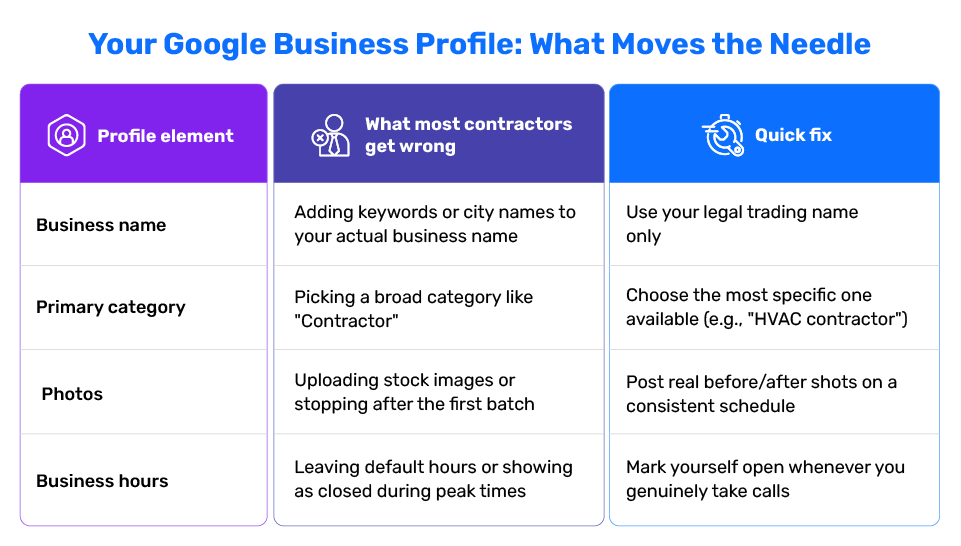
Your Google Business Profile is your primary tool for local SEO for home services, helping you win local leads. If you skip this step, you essentially hand your customers to your competitors.
1. Complete Your Business Information
Your Name, Address, and Phone Number must be identical everywhere online. Even a small difference, like “St.” vs. “Street”, confuses Google and hurts your rankings. If you do not have a storefront, set up your service areas correctly.
Fill out your business hours, holiday hours, website links, and booking links. Use attributes like “licensed” or “insured”; they add trust signals. Also, Google prefers verified, complete businesses. An incomplete profile will limit your rankings, no matter how much other work you do.
Google verifies your profile by postcard, email, phone, or video. Without verification, your profile stays invisible to searchers.
2. Choose the Right Business Categories
Your primary category has the biggest impact on rankings. It tells Google what you do. Secondary categories support it but do not replace it. Pick the most specific category available. So, if you do HVAC, choose “HVAC Contractor”, and not “Contractor” or “Home Improvement.”
Look at the top three listings for your main service. What categories are they using? Follow what works for successful competitors, but do not overload your profile. Add only two to three relevant secondary categories. Mentioning too many categories dilutes your relevance and confuses Google.
3. Add Quality Photos and Videos
Google now uses visual AI to analyze your images. So, what you show matters as much as how many photos you post.
Before-and-after photos work best for home services. Pictures of your branded vehicles parked near a local landmark help build trust. By contrast, stock photos make you look generic and untrustworthy.
Your search impressions will drop if you stop posting photos for 30 days or more. Upload three to five new photos each week to keep momentum.
Here’s How You Can Optimize Your Content for AI Search Results
4. Use Posts and Updates with Strategy
Google Posts show your customers and search engines that you are still in business. Posting at least once per week helps maintain an active profile without overdoing it. You can share updates, offers, announcements, or events. Each post should include a photo and a relevant call-to-action button.
5. Enable Messaging and Booking Features
Your customers can reach you indirectly through your phone number or website link. Text messaging or WhatsApp may be available for eligible accounts.
The “Reserve with Google” feature allows certain businesses to connect their scheduling software to their profiles. That way, customers can book appointments without leaving the profile.
Winning the Google Map Pack for Home Service Businesses
“Successful SEO is not about tricking Google. It’s about partnering with Google to provide the best search results for Google’s users.”
Phil Frost1, Founder, Main Street ROI
The Google Map Pack converts better than any other search feature. Businesses in the top three spots capture 44% of all clicks on the results page. Winning this position brings more phone calls, quote requests, and booked jobs than any other marketing channel for home service local SEO.
I. How Map Pack Rankings Work in 2026
Map Pack rankings update in real time. Google evaluates your listing the moment someone searches. It considers the searcher’s location, what they are looking for, and dozens of other factors.
Behavioral signals also matter. The algorithm notices when people visit your website, view your photos, or request directions. Profiles that get steady engagement will climb rankings faster than profiles that remain dormant.
II. Ranking Factors That Matter Most
Google uses these three key factors in Map Pack rankings:
- Relevance: Does your business match what the user searches for? If you offer plumbing services, your profile and website should clearly say “plumber” and list specific services like “water heater repair” or “drain cleaning.” You will not rank well if Google is not sure what you do.
- Distance: How close is your business to the person searching? Google uses the searcher’s location to decide this. You can set up target service areas, but you cannot control where customers are. Focus instead on the signals you can change.
- Prominence: How strong is your online reputation? Building local prominence through reviews, citations, and location-specific content on your website can help you beat competitors on both Google and AI search engines.
Building a Website That Ranks in Local Search
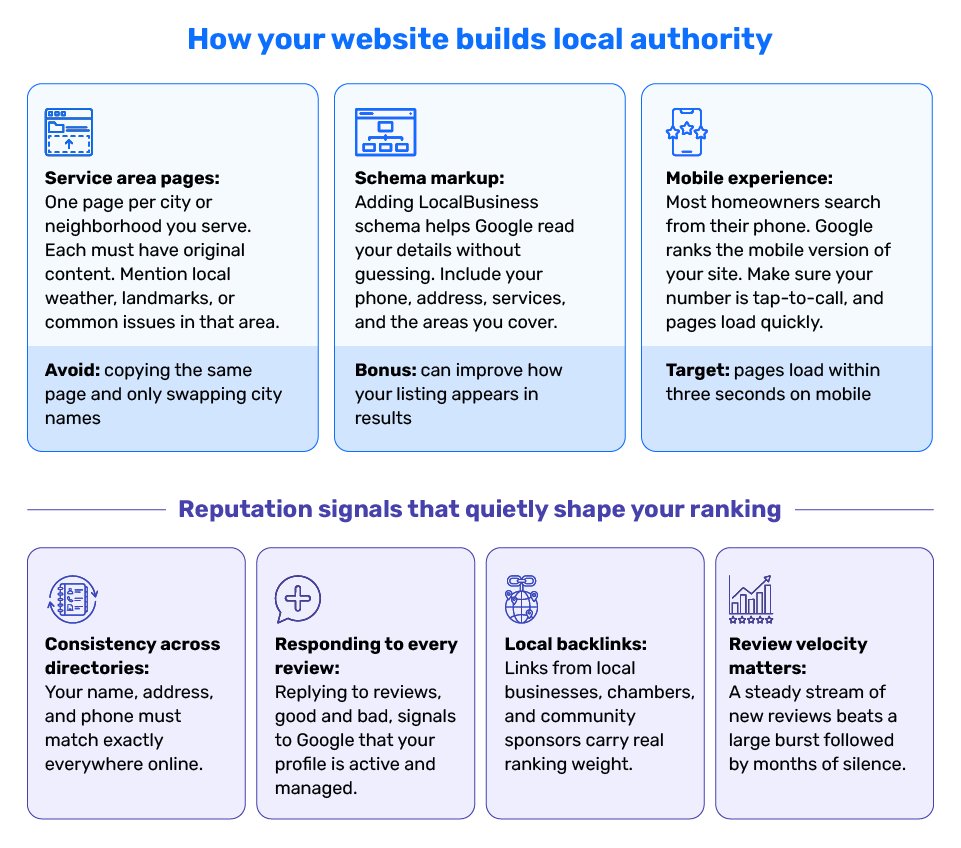
Your website is one thing you fully control, and it plays a central role in local SEO for home services. Unlike third-party directories or review sites, you own every page, and this creates ranking opportunities that should not be overlooked.
1. Creating Dedicated Service Area Pages
Service area pages target the towns and neighborhoods you serve, not just your home base. For example, if you are based in Austin but also provide services in Round Rock and Cedar Park, create a unique page for each of these cities. These pages help you rank for local searches in those areas, even without a physical office there.
Each page must have original content. Do not copy one template and just swap the city name. Google flags that as a “doorway page” and may penalize it. Instead, include real local details. Mention common weather issues and nearby landmarks.
2. On-Page SEO for Local Keywords
About 20 to 403 quality keywords capture around 80% of the search traffic for most home service businesses. For each page, focus on three main keywords, and add three to five supporting long-tail phrases. Professional seo services help identify the right keyword mix based on search intent and competition.
Keyword research must now consider both traditional Google rankings and AI citations. Pick the terms your customers actually use, and not jargon. A homeowner, for example, does not search for “HVAC refrigerant recharge.” They might type “AC stopped cooling”. That difference can greatly shape your rankings.
Amplify Your Online Footprint with Custom SEO Solutions
3. Adding Local Business Schema Markup
Schema markup helps Google understand your business details. Sites with schema can see up to a 40% increase in click-through rates. This explains why most pages on Google’s first page use it.
Add LocalBusiness schema to your site. Include your business name, phone number, address, and services. Use the provider property to specify who offers the service, and areaServed to list the cities or zip codes you cover.
4. Mobile Speed and User Experience
More than half of all web traffic comes from mobile devices. Google uses mobile-first indexing and ranks your site based on the mobile version. Your pages should load in under three seconds. Your visitors will leave immediately if they do not.
Mobile users also expect “click-to-call” buttons, embedded maps, and simple navigation, not long forms or tiny links. Make it easy for them to find your number and tap to call.
Reputation Signals That Quietly Shape Your Ranking
- Consistency across directories: Your name, address, and phone must match exactly everywhere online.
- Responding to every review: Replying to reviews, good and bad, signals to Google that your profile is active and managed.
- Local backlinks: Links from local businesses, chambers, and community sponsors carry real ranking weight.
- Review velocity matters: A steady stream of new reviews beats a large burst followed by months of silence.
Growing Your Online Reputation and Authority
Reviews, citations, and backlinks work in combination to boost local SEO for home service businesses. In their absence, even a properly optimized profile will not outrank competitors.
I. Getting More Customer Reviews Consistently
Encourage your satisfied customers to leave a review right after the job is finished. Follow up with emails and text messages if needed. Automation helps you save time here. Use a system that automatically sends review requests and removes the need for follow-ups.
Aim to get at least half of your customers to leave a review on key platforms like Google or Yelp. If you are a small business, respond to every single review, good or bad. If you are larger, respond to reviews on your key platforms first.
II. Managing NAP Citations in Directories
NAP stands for Name, Address, and Phone Number. Your business is more likely to appear in the local pack when this information is consistent across the web. First, update your information on major data aggregators like Foursquare, Data Axle, and Neustar.
After that, clean up your profiles on core sites like Yelp, Yellow Pages, and Bing Places. Then, list your business in industry-specific directories, such as HomeAdvisor or Angi, for home services.
III. Building Local Backlinks and Mentions
Backlinks are links from other sites to yours. When a local site links to you, Google sees you as a trusted pillar of that community. For example, joining your local Chamber of Commerce can help you gain an authoritative local link.
Sponsor a Little League team or a community event, if possible. The organizers often post links to sponsors on their websites. Link to complementary local businesses and ask them to link back to you. Every mention adds authority and helps you rank higher.
Struggling to Fill Calendar with Word-of-Mouth Leads?
Tracking Results and Avoiding Common Mistakes
Measuring success requires tracking specific performance indicators. Contractors cannot spot what works or where competitors gain ground without proper monitoring.
1. Key Metrics to Monitor Monthly
Check these numbers monthly to gauge your success:
- GBP Performance: Check how many people called your business, requested directions, or visited your website from your Google Business Profile.
- Organic Traffic: Monitor how many people find your website through local searches.
- Keyword Rankings: Track if you are moving up for terms like “best plumber in [City].”
- Conversion Rate: Are your visitors booking jobs? Traffic must turn into revenue.
2. Tools for Measuring Local SEO Performance
Smart contractors use a combination of tools.
- Google Analytics tracks website traffic and conversion events.
- Google Search Console shows search performance and ranking positions.
- SEMrush Local includes Map Rank Tracker and review analytics.
- BrightLocal and Local Falcon provide grid-based rank tracking across service areas.
III. Common Mistakes That Hurt Rankings
Even experienced contractors fall into these traps. Avoid them at all costs:
- Wrong primary category: The number one negative ranking factor
- Duplicate listings: Confuses search engines and splits authority
- Inconsistent NAP data: Damages trust across the citation network
- Copied service area page content: Google flags your site as spam
- Ignoring poor reviews: Erodes both rankings and reputation
- Keyword stuffing: Raises spam signals that reduce visibility
- Poor mobile optimization: Leads to the loss of over half of the potential traffic
Conclusion
Local SEO for home services determines which contractors win customers and which ones stay hidden online. Most businesses see measurable growth within a few months when they follow these strategies.
The path forward is simple. Start with a completed and verified Google Business Profile. Then, build a steady flow of reviews. Create unique service area pages for each location you serve. And then stay consistent with updates.
The businesses that stay invisible in local searches are not always the ones with poor services. They are often the ones who treat visibility as a one-time project.